Phone
Consular Issues
Phone
Uzbekistan news
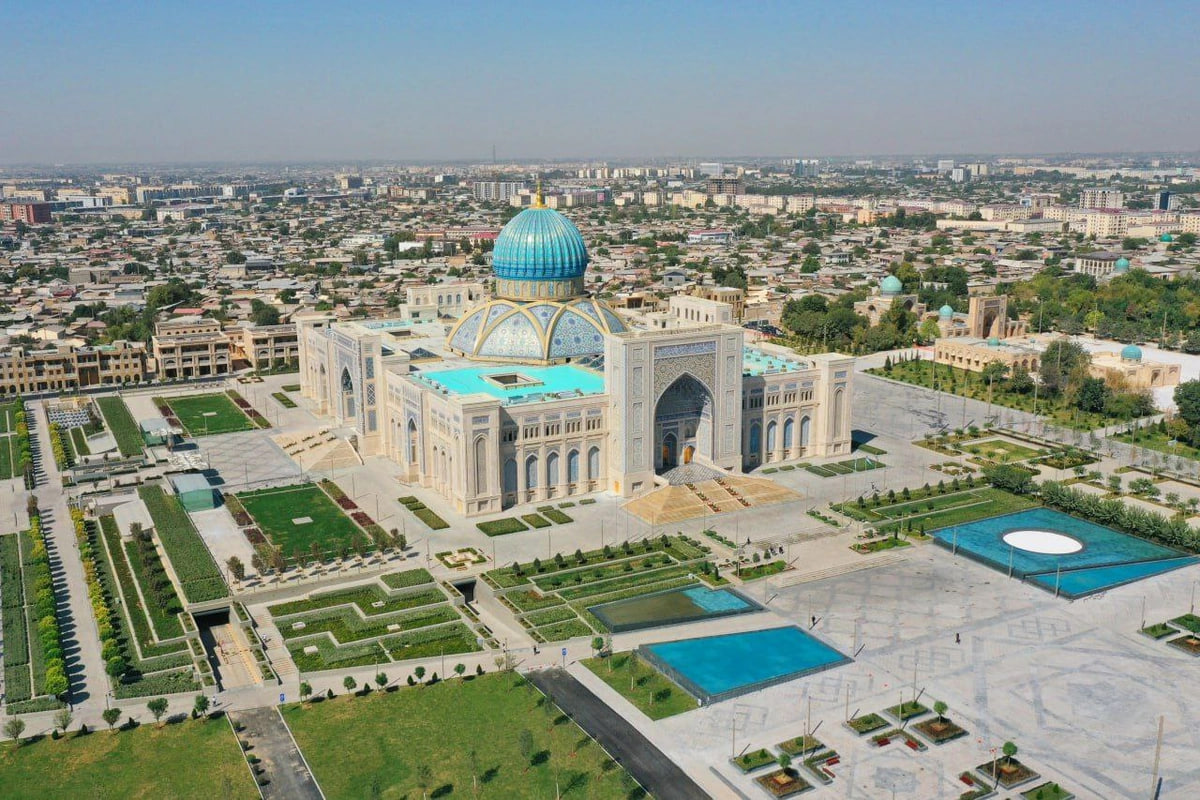
Center for Islamic Civilization: A Megaproject Recognized by the International Community
Exactly one year ago, on January 29, 2025, His Excellency the President of the Republic of Uzbekistan, Shavkat Mirziyoyev, visited the Center of Islamic Civilization in Uzbekistan. During his visit, he provided a series of recommendations and directives regarding the incorporation of scientific and innovative projects developed by more than two thousand domestic and international researchers into the exhibitions of the Center.
It was truly a historic visit. Over the past year, the construction of the Center has been fully completed. Specialists and designers from more than 40 countries were involved in enhancing the Center’s activities and enriching its exhibitions. All of them were united around a megaproject initiated and guided by the vision of the President.
In September 2025, the Head of our State, from the high podium of the United Nations, announced the completion of the construction of the Center of Islamic Civilization in Uzbekistan and its imminent opening. Since then, the internal content of the exhibitions has become even more comprehensive. The Center has evolved into a unique space that captures the attention of the global community. Today, visitors from around the world, as well as leaders of states and international organizations, engage with the Center’s work, its scientific projects dedicated to civilizations, prominent figures and discoveries, openly acknowledging its significance.
The world is experiencing a period of profound civilizational transformation. Technological advancement often outpaces moral reflection, while global crises – ranging from geopolitical conflicts to the erosion of cultural identity – increasingly raise questions about humanity’s capacity for dialogue. In circumstances where religion is sometimes used as a tool for conflict, and culture becomes a dividing line, the need for new platforms that can restore the constructive essence of inter-civilizational dialogue is especially urgent.
It is in precisely this historical moment, in the heart of Eurasia – on land where great civilizations and empires arose, where trade routes, religions, scientific schools, and cultures have intersected for millennia – that the unique Center of Islamic Civilization in Uzbekistan has been established. Its creation is no coincidence and is not motivated by transient considerations; it is a direct reflection of the strategic vision of the President of the Republic of Uzbekistan, Shavkat Mirziyoyev.
As early as 2017, speaking from the podium of the United Nations, the President addressed the global community with a call to restore the true place of Islamic civilization in world history, emphasizing that the foundations of sacred Islam lie in enlightenment, science, and humanistic values and that extremism and ignorance can be countered through knowledge and culture.
United Nations Secretary-General António Guterres, during his visit to the under-construction Center of Islamic Civilization, expressed high international appreciation for this initiative, noting:
“Your President, Shavkat Mirziyoyev, is a great and respected leader who consistently promotes the ideas of dialogue, enlightenment and mutual respect from the high podium of the United Nations”.
These words reflect the understanding that has already taken hold within the international community: under the leadership of Shavkat Mirziyoyev, Uzbekistan has become an active participant in shaping contemporary history.
The address of the President of Uzbekistan from the United Nations podium laid the intellectual and scholarly foundation for the Center, both as a monumental architectural complex and as a fundamentally new humanitarian model of global significance. Within this model, Islam is presented through the history of great civilizations where scientific revolutions occurred, universities and academies were established, libraries and laboratories were created and the foundations of medicine, philosophy, art and scientific thought were formed.
Thanks to the President’s personal political will, strategic vision and consistent leadership, the idea of creating the Center of Islamic Civilization has been realized on an unprecedented scale, in terms of scope, content and international significance. A unique civilizational complex has been established, uniting a next-generation museum, advanced research infrastructure, a modern library, national and international archives on the history of Central Asian civilizations, digital humanities technologies and a broad network of global scientific and cultural cooperation.
The project also received high praise from the President of the Republic of Kazakhstan, Kassym-Jomart Tokayev:
“This is a large-scale and unique facility. It is a scientific, tourist and ethnocultural project. I agree with the President of Uzbekistan: Center of Islamic Civilization can become a shared platform for research in this important field”.
According to global experts, Center of Islamic Civilization in Uzbekistan is not merely an infrastructure project or a symbol of cultural policy. It represents a deliberate civilizational response by the leader of Uzbekistan to contemporary global challenges. For the first time in the history of the Islamic world, such a large-scale permanent platform for genuine inter-civilizational dialogue has been created.
Uzbekistan has assumed a historic and spiritual mission - not by issuing declarations, but by establishing a real, world-class intellectual space to counter distorted interpretations of Islam and Islamic civilization.
President of the Republic of Azerbaijan, Ilham Aliyev, emphasized:
“Visiting the Center of Islamic Civilization, established at the initiative of the President of Uzbekistan, we were once again convinced of the country’s leadership’s deep commitment to preserving and promoting the rich cultural and spiritual values of the Uzbek people. In the context of rising Islamophobia, the opening of the Center carries special significance. It vividly demonstrates that Islam is a religion of creation, humanism, tolerance, friendship and brotherhood”.
Experts and policymakers unanimously note that this project has become a humanitarian shield against radicalism and distorted perceptions of Islam - a shield built on knowledge.
A particularly important aspect of the Center’s activities is the repatriation of cultural heritage. By the directive of the President, special state and diplomatic mechanisms were established to ensure systematic cooperation with the world’s leading auction houses - Sotheby’s, Christie’s, Bonhams - as well as with major museums and private collectors. As a result, around two thousand rare artifacts have been returned to the country, including manuscripts of Ibn Sina, works of Al-Biruni, Timurid-era miniatures and masterpieces of Islamic art.
This achievement represents a tangible restoration of Central Asia’s civilizational memory and the historical justice of the region.
President of Paraguay, Santiago Peña, upon visiting the exhibitions, noted:
“Visiting the Center of Islamic Civilization left a profound impression on me. Many of humanity’s scientific and cultural achievements originated here. Unfortunately, the world does not always recognize that fundamental works in algebra and medicine emerged on this land. This visit inspired me and strengthened my confidence in Uzbekistan’s tremendous potential”.
Experts emphasize that the President of Uzbekistan shapes the future with the same consistency with which he restores the past. For this reason, the Center was conceived from the outset as a dynamically evolving system - an international scientific platform, a media space and a publishing and educational hub.
President of Finland, Alexander Stubb, after his visit, stated:
“I was struck by an impression I have never experienced anywhere else. Three thousand years of history are presented in a modern and compelling way. Here, one truly feels history - it is impossible to remain indifferent”.
Today, Center of Islamic Civilization is becoming an intellectual hub of the modern world, much like Bayt al-Hikma in Baghdad, Academy of Al-Ma’mun in Khwarazm and Ulugh Bek madrasa in Samarkand once shaped the development of science.
Center represents a new type of civilizational institution for the 21st century. Historical knowledge is combined with digital technologies, manuscripts become global digital resources, the museum acquires the characteristics of a scientific laboratory and national heritage becomes a foundation for international dialogue and mutual understanding.
In conclusion, it is appropriate to cite the words of the President of Serbia, Aleksandar Vučić:
“I have never seen a center like this anywhere. It is built in a modern and very expressive architectural style. I have learned a great deal here and will certainly return. I would tell my fellow citizens: dear friends, I made a big mistake by not coming here earlier. Please visit Uzbekistan as soon as possible”.
Firdavs Abdukhalikov
Director of the Center of Islamic Civilization in Uzbekistan
📅 12.03.2026
Uzbekistan news
Samarkand hosted an international scientific and practical conference on “Brother Cities: A New Model for Sustainable Development and Public Diplomacy”
Uzbekistan and Kyrgyzstan: Strategic Partnership, Institutionalization, and Mechanisms of Cooperation
Uzbekistan–Kyrgyzstan: From Border Neighbourhood to Long-Term Economic Cooperation
Uzbekistan and Kyrgyzstan: Transitioning to Joint Value Chains
Towards a Unified Intellectual Space of the Turkic World: A New Era of Scientific Integration in the Renaissance Age
Uzbekistan – Kyrgyzstan: Prospects for Cooperation on Water Resources
Central Asia and Azerbaijan: Prospects for a Common Transport Area
Central Asia and Azerbaijan Are Emerging as a Shared Hub for Startups, Investors, and Talent
Uzbekistan - Azerbaijan: economy of trust, routes and joint projects
Uzbekistan - Kyrgyzstan: from border neighborhood to long-term economic cooperation
Central Asia and Azerbaijan: Strategic Partners Building a Green Energy Hub Together
Through the Caspian to New Markets
Uzbekistan embraces the language of international law and becomes part of the global financial system
On July 24–25, Samarkand Will Bring Together Global Sister Cities at International Forum
Uzbekistan: An Open and Safe Destination Recognized by the International Community
Green Economy, Social Sustainability, and Transparent Governance: Uzbekistan’s New Development Formula
The text of the appeal of the participants of the first international forum of Islamic civilization to the head of State
Declaration adopted by the participants of the First International Islamic Civilization Forum
Uzbekistan–Belarus economic cooperation: promising projects in the Agri-food sector
Uzbekistan and Belarus: Stable Partnership and Strategic Development Prospects
Uzbekistan and Belarus strengthen multifaceted partnership based on mutual trust and pragmatic cooperation
Areas of Cooperation between Belarus and Uzbekistan in Strengthening Sustainable Transport Corridors in Eurasia
Uzbekistan–Belarus economic cooperation: promising projects in the Agri-food sector
Uzbekistan and Georgia: From historical friendship to a strategic partnership
Uzbekistan–Georgia Relations: Contemporary Priorities for Bilateral Development
Ecological cooperation between Uzbekistan and the United States elevated to the level of a strategic partnership
Cooperation Between Uzbekistan and Georgia in Strengthening Connectivity in Central Asia and the South Caucasus
Uzbekistan as an Operational Hub for Technology Companies: Key Figures, Conditions, and Advantages
“O'zbek futboli” – A Documentary Chronicle of a Century-Long Journey Toward the Nation’s Greatest Football Dream
GENDER POLICY IN UZBEKISTAN

-
 Ministry of Foreign Affairs of the Republic of Uzbekistan
 -
 Diplomatic Service of the Ministry of Foreign Affairs
 -
 State Committee for Tourism Development
 -
Ministry of Investments and Foreign Trade of the Republic of Uzbekistan
-
 invest.gov.uz
 -

-

-

-

-

-

-


of Uzbekistan in the Republic
of Latvia
When using the information, a link to www.uzembassy.lv
must be provided.
All rights reserved
Address
Address: Riga c., LV-1010. 11-11 Elizabetes Str., Latvia
Phone: 37167322424
Fax: 37167322306
Email: embassy@uzbekistan.lv
Useful links
HomeIssuance of biometric passport for departure abroad
Certificate to return to Uzbekistan
Withdrawal of citizenship
Loss of citizenship