Phone
Consular Issues
Phone
Uzbekistan news
SCO AND WATER DIPLOMACY: IN PURSUIT OF COMMON INTERESTS
Transforming water from an object of competition into a factor of cooperation is a vital condition for regional stability.
Water is a precious resource and a source of life. It is not merely a natural resource but also a strategic factor that determines a country's food and energy security, economic development, environmental stability, and the well-being of its people.
Against this backdrop, there is a growing need for political dialogue and practical cooperation aimed at the rational, equitable, and mutually beneficial use of transboundary rivers and shared water resources. In other words, water diplomacy is needed to turn water into a tool of cooperation that brings states together rather than a source of conflict.
The founding documents of the Shanghai Cooperation Organization list the rational use of natural resources, including water, environmental protection, and the implementation of joint ecological programs as main areas of cooperation. Therefore, the issue of water is not a topic that was later added to the SCO agenda, but one of the organization's initial priorities.
In recent years, the political and legal foundations of this area have been further strengthened. The SCO's Dushanbe and Samarkand Declarations identified access to safe drinking water and the integrated, rational management of water resources as important conditions for sustainable development.
At the seventh meeting of the heads of ministries and agencies of SCO member states responsible for environmental protection, held in Bishkek on April 3, 2026, issues of climate change adaptation, glacier preservation, and water resource management were discussed. This indicates that the topic of water is taking on an increasingly important role in the organization's practical agenda.
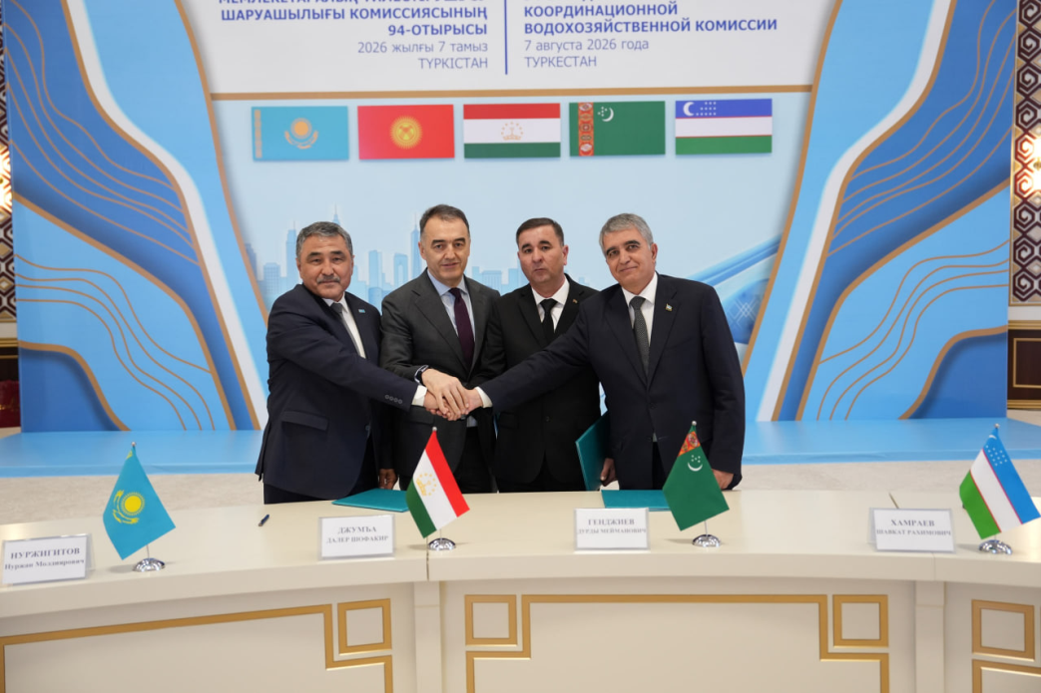
At the same time, representatives of the SCO member states are seeking practical solutions to water-related issues through meetings, consultations, and negotiations in various formats. On August 7, 2026, the 94th meeting of the Interstate Commission for Water Coordination (ICWC) was held in the city of Turkestan, Republic of Kazakhstan.
The water management ministers and officials from Kazakhstan, Tajikistan, Turkmenistan, and Uzbekistan reviewed proposals for water limits and operating regimes for reservoirs in the Syr Darya and Amu Darya basins for the 2026 growing season, as well as a plan to introduce an automated water accounting system in the Syr Darya basin. The development of the document was approved, and special working group is expected to be established by September of this year.
Furthermore, the parties discussed the implementation of the $20 million Regional Cooperation for Improving the Efficiency of Water Resources Use in Central Asian Countries (CAWEC) grant project, in partnership with the World Bank, as well as the execution of tasks stemming from the decisions of the Council of Heads of the Founding States of the International Fund for Saving the Aral Sea.
With the support of the German Agency for International Cooperation (GIZ), measures are being taken to implement a pilot project to automate the water resources monitoring and accounting system at transboundary water facilities between Kazakhstan and Uzbekistan.
From August 10-12, 2026, a three-day regional training was held in Tashkent on the topic "Introduction of Water-Saving Irrigation Technologies and Digital Solutions in the Water Management Sector of Central Asia under Climate Change."
The training was organized at the initiative of the Ministry of Water Resources of the Republic of Uzbekistan, within the framework of the National Water Resources Management Project in Uzbekistan and the Blue Peace Central Asia (BPCA) project, with the participation of the "Suvchilar maktabi" (School of Water Professionals).
Water management specialists from Kazakhstan, the Kyrgyz Republic, Tajikistan, Turkmenistan, and Uzbekistan participated in the event.
The primary objective of the event was to enhance the professional capacity of water management specialists from Central Asian countries, expand the mutual exchange of experience, and strengthen practical cooperation in the efficient use of water resources, the introduction of modern irrigation technologies, and the digitalization of the sector, as well as to familiarize them with the advanced solutions being implemented in Uzbekistan.
It is important to emphasize that Uzbekistan views water diplomacy not only as an instrument of foreign policy but also as a logical continuation of the large-scale reforms being implemented domestically. Indeed, to promote the idea of efficient water use in regional dialogue, each state must first reduce water waste within its own territory and establish a modern management system.
In his Address to the Oliy Majlis and the people of Uzbekistan, President Shavkat Mirziyoyev noted that water scarcity is becoming an increasingly urgent global issue; for this reason, the rational use of water was elevated to the level of state policy from the very first days of the reforms.
The results achieved in the sector in recent years are reflected in the figures . In 2025, construction and reconstruction work was carried out at 258 irrigation and melioration facilities, and 723 kilometers of canals were lined with concrete. Additionally, 158 kilometers of irrigation and 303 kilometers of collector-drainage networks were built or reconstructed. As a result, the water supply for 364,000 hectares of land was improved, and the loss of more than 500 million cubic meters of water was prevented.
In 2026, a total of 2 trillion 199 billion soums were allocated from the state budget for construction and reconstruction work under 308 irrigation and melioration projects.
As of August 1 of the current year, construction work worth 1.3 trillion soums has been completed, which constitutes 59% of the established annual plan. Specifically, 637 kilometers of canals were lined with concrete and reconstructed. Furthermore, 52 kilometers of irrigation networks—flumes and pipes—and 27 hydraulic structures were built and reconstructed. To increase the energy efficiency of water management facilities and ensure uninterrupted water supply, pumping stations with a capacity of 13 m3/sec, 31 irrigation wells, 33 kilometers of pressure pipelines for pumping stations, and 268 kilometers of collector-drainage networks were built and reconstructed.
Significant progress is also being made in the introduction of water-saving technologies. By the end of 2025, the coverage of such technologies reached 2.6 million hectares, or 61% of irrigated areas. Of this, drip irrigation technology was introduced on 664,000 hectares. Thanks to these technologies, 3 billion cubic meters of water were saved. By the end of 2026, the goal is to increase the coverage of water-saving technologies to 3.1 million hectares and save 5 billion cubic meters of water. To date, water-saving technologies have been implemented on a total of 638,000 hectares across the republic.
These figures are significant not only for the national economy but also for the regional water balance. Every cubic meter of water saved in one country reduces the pressure on the entire basin. In this sense, lining irrigation canals with concrete and implementing water-saving technologies are not only national-level initiatives but also diplomatic contributions that strengthen regional trust.
To manage water effectively, it must be accurately measured. Where there is no accounting, it is difficult to assess savings, identify losses, and ensure fair distribution.
From this perspective, the digitalization efforts underway in Uzbekistan's water management sector not only increase the efficiency of domestic management but also create a technological foundation for the reliable exchange of transboundary water data in the future.
In 2025, the Center for Digitalization and Monitoring of Water Management was established, and a modern Situational Center was launched to consolidate industry data at a single point. Ten information systems were introduced. The "State Water Cadastre" and "Melioration" information systems were enhanced with the capability to analyze data, generate forecasts, and develop recommendations using artificial intelligence.
Forty-four sensors were installed in reservoirs, enabling remote monitoring of water levels and volumes. A design organization is conducting nationwide studies for the installation of 272 devices to measure water intake across the state border in real time, as well as for the installation of specialized equipment at 1,895 points for the online management and monitoring of inter-district water resources.
The significance of such projects goes beyond technical convenience. Reliable real-time data increases transparency in water distribution, reduces the human factor, and prevents contentious situations.
In the future, it may be possible to coordinate the national information systems of the SCO member states. This does not mean transferring all data to a single center. On the contrary, it envisions the formation of a mechanism for exchanging necessary hydrological indicators in an agreed-upon format, while respecting the sovereignty and national legislation of each state.
The water-energy-food nexus is a prerequisite for sustainable development. Within the framework of the SCO, it is advisable to form a permanent mechanism that integrates cooperation between water, energy, and agriculture agencies. Such a mechanism would enable the joint analysis of seasonal reservoir operation, electricity exchange, irrigation needs, and ecological flows.
The SCO region has accumulated extensive experience in using drip and sprinkler irrigation, canal lining, closed pipeline networks, smart water meters, energy-efficient pumps, and forecasting systems based on artificial intelligence.
By consolidating this experience, it is possible to implement model projects adapted to various climatic conditions. For example, within the SCO, it would be beneficial to establish pilot zones to demonstrate water-saving technologies, train specialists and farmers, and evaluate the results based on a unified methodology.
Sound decisions on water issues must be based on scientific research. Therefore, it is important to implement joint scientific programs among the research institutes, universities, and water management organizations of the SCO countries.
When managing water resources, considering only today's needs is insufficient. The impact of every decision on future generations, natural ecosystems, and the interests of neighboring states must also be thoroughly assessed.
Today, it is not enough to view water diplomacy solely as a means of preventing conflict. It must also stimulate economic development, attract investment, accelerate the exchange of technologies, and strengthen food and energy security.
The SCO is a major regional structure capable of uniting these opportunities. Cooperation within the Organization must transition from negotiations over water distribution to the stage of creating common economic benefits and ensuring sustainable development through water.
Indeed, water does not recognize state borders. Its flow interconnects the destinies, well-being, and futures of peoples.
The rational use of water is economic development, its just management is good neighborliness, and conserving every drop is our shared responsibility for the future.
Zokir Ishpulatov,
First Deputy Minister of Water Management of the Republic of Uzbekistan
📅 12.08.2026
Uzbekistan news
SCO AND WATER DIPLOMACY: IN PURSUIT OF COMMON INTERESTS
Uzbekistan’s Dialogue with Business: Five Years of Change
ON THE STATUS OF THE HOST COUNTRY AND A NEW PHASE OF INTERNATIONAL CULTURAL COOPERATION
Transport and Logistics Cooperation Between Uzbekistan and the US: A New Stage of Strategic Partnership
Reforms and Active Dialogue in Entrepreneurship: The President's 6th Open Dialogue as a Catalyst for New Economic Growth
How China–Kyrgyzstan–Uzbekistan railway is redrawing the economic map of the continent
G20 and Uzbekistan: Investment, Industry and Trade in a New Economic Reality
CULTURE — THE TREE OF A NATION'S TRUST UZBEKISTAN — THE UNITED STATES
Uzbekistan and Kyrgyzstan: A New Stage and Future Prospects for Environmental Cooperation
Uzbekistan–Azerbaijan: Environmental cooperation emerges as a key pillar of the strategic partnership
Samarkand hosted an international scientific and practical conference on “Brother Cities: A New Model for Sustainable Development and Public Diplomacy”
Uzbekistan and Kyrgyzstan: Strategic Partnership, Institutionalization, and Mechanisms of Cooperation
Uzbekistan–Kyrgyzstan: From Border Neighbourhood to Long-Term Economic Cooperation
Uzbekistan and Kyrgyzstan: Transitioning to Joint Value Chains
Towards a Unified Intellectual Space of the Turkic World: A New Era of Scientific Integration in the Renaissance Age
Uzbekistan – Kyrgyzstan: Prospects for Cooperation on Water Resources
Central Asia and Azerbaijan: Prospects for a Common Transport Area
Central Asia and Azerbaijan Are Emerging as a Shared Hub for Startups, Investors, and Talent
Uzbekistan - Azerbaijan: economy of trust, routes and joint projects
Uzbekistan - Kyrgyzstan: from border neighborhood to long-term economic cooperation
Central Asia and Azerbaijan: Strategic Partners Building a Green Energy Hub Together
Through the Caspian to New Markets
Uzbekistan embraces the language of international law and becomes part of the global financial system
On July 24–25, Samarkand Will Bring Together Global Sister Cities at International Forum
Uzbekistan: An Open and Safe Destination Recognized by the International Community
Green Economy, Social Sustainability, and Transparent Governance: Uzbekistan’s New Development Formula
The text of the appeal of the participants of the first international forum of Islamic civilization to the head of State
Declaration adopted by the participants of the First International Islamic Civilization Forum
Uzbekistan–Belarus economic cooperation: promising projects in the Agri-food sector
Uzbekistan and Belarus: Stable Partnership and Strategic Development Prospects

-
 Ministry of Foreign Affairs of the Republic of Uzbekistan
 -
 Diplomatic Service of the Ministry of Foreign Affairs
 -
 State Committee for Tourism Development
 -
Ministry of Investments and Foreign Trade of the Republic of Uzbekistan
-
 invest.gov.uz
 -
-

-

-
-

-

-

of Uzbekistan in the Republic
of Latvia
When using the information, a link to www.uzembassy.lv
must be provided.
All rights reserved
Address
Address: Riga c., LV-1010. 11-11 Elizabetes Str., Latvia
Phone: 37167322424
Fax: 37167322306
Email: embassy@uzbekistan.lv
Useful links
HomeIssuance of biometric passport for departure abroad
Certificate to return to Uzbekistan
Withdrawal of citizenship
Loss of citizenship