Phone
Consular Issues
Phone
Uzbekistan news
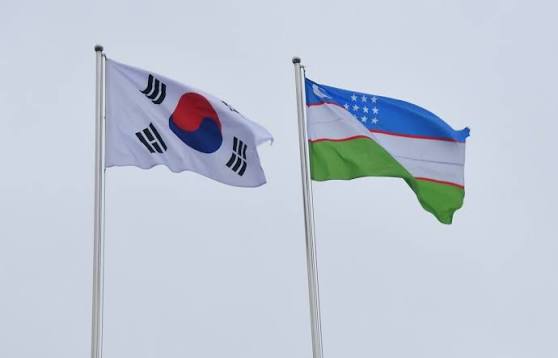
The Infrastructure Already Linking Uzbekistan and Korea What Korea Has Already Built Inside Uzbekistan's Digital Economy From Fiber Optics to AI: The Scope of Uzbek-Korean Digital Cooperation The Digital Bridge Already Built Between Uzbekistan and South Korea
Digital cooperation between Uzbekistan and South Korea already runs through telecommunications manufacturing, e-government data centers, healthcare digitization, artificial intelligence, and education — infrastructure the Central Asia–Korea Summit puts a spotlight on, not one it creates
For Uzbekistan, digital transformation is not a single initiative but a declared national priority, and South Korea has become one of its most consistent partners in pursuing it. As Uzbekistan diversifies its economy and builds out its technology sector, cooperation with Korea reaches into nearly every layer of that effort — telecommunications infrastructure, government data systems, hospital diagnostics, and university classrooms among them.
That relationship is especially dense in information technology, a sector both governments have identified as central to the partnership. Korean companies build infrastructure and open offices inside Uzbekistan; Korean universities train Uzbek engineers; Uzbek IT firms increasingly sell services into the Korean market. High-level meetings between the two countries, including the Central Asia–Korea Summit, mark and reinforce this cooperation rather than create it the projects behind it were already underway.
Korean partners have already manufactured the fiber-optic cable running through part of Uzbekistan's telecommunications backbone, supplied the servers and storage behind its national e-government data center, and begun designing a joint digital government cooperation center for Tashkent. IT Park Uzbekistan opened a representative office in Seoul on October 30, 2024, under a newly formed Uzbek-Korean IT Business Alliance developed with the Korea Institute for International Industrial Cooperation — one visible marker of a relationship that is already several projects deep.
Institutional foundations
Uzbekistan's digital transformation has been driven by a series of structural reforms over the past several years: a dedicated ministry overseeing digital technologies, IT Park Uzbekistan as the country's flagship technology hub with resident-company incentives, and a national strategy for artificial intelligence from 14.10.2024 № RP-358. A national "Digital Government" program, adopted under Presidential Resolution PR-257 from 08.07.2026, set the framework for much of the e-government modernization described below. Two annual state awards — the President Tech Award and the President AI Award — recognize achievement in the sector.
Digital infrastructure and e-government
Uzbekistan's Unified Interactive State Services portal is the backbone of its e-government system and is currently being modernized with artificial intelligence tools, natural-language-processing chatbots, geospatial data integration, and proactive services that deliver documents and notifications to citizens automatically. The infrastructure behind this system was built with direct Korean participation: a project to expand the storage and processing infrastructure for the e-government system was financed with support from Korea's Economic Development Cooperation Fund (EDCF), combining concessional financing with tax and customs incentives from the Uzbek side. Following a tender, a major Korean IT company was selected as general contractor and delivered the data-center network infrastructure, servers, and storage systems, along with software for virtualization, cloud services, monitoring, and information-security incident management. A separate data-center project is planned for the Republic of Karakalpakstan.
IT industry and services export
IT Park Uzbekistan is the country's central vehicle for attracting foreign technology companies, offering resident status with tax and customs benefits. By the first half of 2026, 23 companies with Korean capital were registered as residents — up 53 percent from 15 in the first half of 2024, employing 126 specialists in software engineering, technical support, IT consulting, data processing, and business process outsourcing. Among them are LG CNS Uzbekistan, the ITOMAX Central Asia Development Center, and NOMADIAN. Over the same two-year period, the number of resident companies exporting IT services to South Korea doubled, from 12 to 25, and employment among those exporters rose from 145 to 285 specialists, a 97 percent increase. Sector-wide digital services exports reached $2,606,287 in 2025 and $716,970 in the first half of 2026 alone.
Manufacturing capacity has followed the software growth. Global Optical Communication Uzbekistan, a joint venture with South Korean sector partners, produces fiber-optic cable domestically, having manufactured 232,100 kilometers of cable worth 657.5 billion soums between 2022 and 2025, alongside localization of production and new job creation.
Where the cooperation runs deepest
The breadth of Uzbek-Korean digital cooperation is easiest to see sector by sector.
Government-to-government. Cooperation rests on agreements signed between the two countries' digital technology, internal affairs, security, science, and ICT authorities, alongside joint work within international telecommunication and postal bodies. The clearest expression of this is the planned Digital Government Cooperation Center, to open in Tashkent between 2026 and 2028 with Korea's Ministry of Interior and Safety (MOIS), which already cooperates with Uzbekistan on digital government development. Its mandate covers policy consulting, joint research, civil-servant training, and adapting Korean administrative-technology practice for Uzbek systems — including the modernization of the national services portal described above, an international digital-government forum, and a program to train digital-transformation leads inside individual government bodies. Civil-servant training is already running: Korea's LOGODI institute has been upskilling ten Uzbek officials a year, thirty in total so far.
Healthcare. With technical support from Korea's KOFIH (Korea Foundation for International Healthcare), Uzbekistan is digitizing its national screening system with UZINFOCOM, aiming at earlier disease detection and better monitoring. A separate project, backed by a Korean financial institution, is building a hospital information system integrating medical imaging, AI diagnostics, and electronic medical records, alongside staff training. A state technology integrator has signed a cooperation agreement with a Korean private technology company to bring Uzbek-developed digital solutions into the Korean and Southeast Asian markets — early discussions cover HR-management systems and biometric identification for government buildings.
Artificial intelligence. The two countries frame AI cooperation around complementary strengths: Korea brings a developed regulatory framework, a national data platform, prepared datasets, AI safety mechanisms, high-performance computing, and industrial AI experience; Uzbekistan brings an adopted national AI strategy, an emerging open-data system, and an institutional base for applying AI in public administration and the economy. The stated ambition is for Uzbekistan to pilot AI solutions in healthcare, education, and public services, then extend proven models across Central Asia — positioning Korean partners at the front of a regional rollout, not a single national market.
Education. The Tashkent branch of Inha University, operating since 2014, runs a 4+0 bachelor's program in computer engineering, a 3+1 program in business logistics, and a 1+1 MBA in digital transformation, with Korean-language instruction and robotics workshops; close to 670 students have studied in South Korea through its exchange programs, and ten top students go to Inha's home campus each year on Summer School grants. Tashkent University of Information Technologies hosted more than 80 Korean professors between 2018 and 2023, sent 63 students on exchange to South Korean universities, and is building a joint Business-IT program with a Korean partner university, alongside joint tracks in big data and AI, AI-driven fintech, and ICT engineering. Cyber University has moved quickly on Korean ties: KAIST faculty visited in October 2025, a December 2025 delegation to Konkuk University's GLOCAL campus produced an agreement on faculty exchange and joint research, and a separate industry partnership with a South Korean AI company covers applied research and student projects. Cheju-Halla University runs a joint program for a selected group of high-performing Uzbek students.
Government funding underpins much of this training pipeline. KOICA (the Korea International Cooperation Agency) is running a $14 million project to build out Uzbekistan's IT-education ecosystem, and in 2025 alone funded professional training for 45 civil servants at a cost of $450,000. Korea IT Academy co-runs the Uzbekistan Summer Camp together with Uzbekistan's Ministry of Digital Technologies, the Center for Digital Education Development, and School 21, alongside a dual-degree program with Uzbek partners. In total, Korean grants and investment for joint projects reached roughly $17 million in 2026 — about $14 million from KOICA and roughly $1 million each from Cheju-Halla University, Korea IT Academy, and MOIS — funding IT education, digital-government cooperation, workforce training, and youth innovation projects. Much of that training tracks Korean labor-market demand directly: software developers, AI engineers, data scientists, cybersecurity specialists, cloud and DevOps engineers, mobile and web developers, and GovTech specialists are among the roles Korean employers are seeking from this pipeline.
Alongside these institutional partnerships, the Ministry of Digital Technologies has expanded initiatives to bring more youth into STEM and IT careers.
Korean partners are not being asked to imagine a market. They are already inside Uzbekistan's infrastructure, hospitals, classrooms, and government data systems, with contracts and counterparts in place.
“Our cooperation with South Korea today reaches into nearly every layer of our digital economy — from the fiber-optic plant producing cable for our own telecommunications networks, to the data center that now stores the records of our national digital-government system, to the hospitals adopting Korean-backed diagnostic tools, and the classrooms where Korean professors and Korean grants train our students. Korean partners committed roughly $17 million to joint projects in the past year alone, spanning IT education, digital government, artificial intelligence, and workforce training. This is one of our most substantive technology partnerships, and we intend to deepen it further — through a joint digital government center, expanded AI cooperation, and a wider door for Korean companies into our market and the region beyond it.”
— Sherzod Shermatov, Minister of Digital Technologies of the Republic of Uzbekistan.
International positioning
Uzbekistan has been positioning itself as a regional hub for digital cooperation in Central Asia, a role reinforced by its hosting the International Olympiad in Informatics (IOI) in 2026. For Korean partners, this matters beyond Uzbekistan's own market: solutions piloted domestically are explicitly intended to extend across neighboring Central Asian countries once proven.
Over the next three to five years, the areas most likely to define Uzbek-Korean digital cooperation are the ones already carrying the heaviest institutional weight: the joint digital government center, continued data-center and healthcare-infrastructure financing, AI pilots in public administration and healthcare, and the education and grant pipelines feeding all of it. None of this depends on the outcome of any single meeting — it depends on scaling relationships that already have contracts, campuses, and funding behind them. For Korean partners, that is the signal worth reading: a market already under construction, not one still being pitched.
At a glance
- Korean-capital IT Park Uzbekistan residents grew from 15 (H1 2024) to 23 (H1 2026), +53 percent; resident companies exporting IT services to South Korea doubled, from 12 to 25, over the same period.
- Korean grants and investment for joint digital projects reached roughly $17 million in 2026, led by a $14 million KOICA project to build out Uzbekistan's IT-education ecosystem.
- A Korean IT company built Uzbekistan's e-government data center under EDCF financing; a joint Uzbek-Korean Digital Government Cooperation Center, developed with Korea's MOIS, is planned for Tashkent for 2026–2028.
- Global Optical Communication Uzbekistan, a joint venture with South Korean partners, produced 232,100 km of fiber-optic cable worth 657.5 billion soums between 2022 and 2025.
- Korean partners are engaged across healthcare digitization (KOFIH, hospital information systems), AI cooperation, and education (Inha University's Tashkent branch, TATU, Cyber University, Cheju-Halla University, Korea IT Academy).
📅 18.08.2026
Uzbekistan news
The Infrastructure Already Linking Uzbekistan and Korea What Korea Has Already Built Inside Uzbekistan's Digital Economy From Fiber Optics to AI: The Scope of Uzbek-Korean Digital Cooperation The Digital Bridge Already Built Between Uzbekistan and South Korea
On September 8–10th, Tashkent to gather International Textile Industry Professionals
New Uzbekistan: A Builder of Peace and Trust
‘Mustaqillik’ Generation: New Navigators of the Silk Road
GLOBAL COMPETITION AND NEW PEACE DIPLOMACY: THE VOICE OF ENLIGHTENMENT OF NEW UZBEKISTAN IN THE GLOBAL ARENA
SCO AND WATER DIPLOMACY: IN PURSUIT OF COMMON INTERESTS
Uzbekistan’s Dialogue with Business: Five Years of Change
ON THE STATUS OF THE HOST COUNTRY AND A NEW PHASE OF INTERNATIONAL CULTURAL COOPERATION
Transport and Logistics Cooperation Between Uzbekistan and the US: A New Stage of Strategic Partnership
Reforms and Active Dialogue in Entrepreneurship: The President's 6th Open Dialogue as a Catalyst for New Economic Growth
How China–Kyrgyzstan–Uzbekistan railway is redrawing the economic map of the continent
G20 and Uzbekistan: Investment, Industry and Trade in a New Economic Reality
CULTURE — THE TREE OF A NATION'S TRUST UZBEKISTAN — THE UNITED STATES
Uzbekistan and Kyrgyzstan: A New Stage and Future Prospects for Environmental Cooperation
Uzbekistan–Azerbaijan: Environmental cooperation emerges as a key pillar of the strategic partnership
Samarkand hosted an international scientific and practical conference on “Brother Cities: A New Model for Sustainable Development and Public Diplomacy”
Uzbekistan and Kyrgyzstan: Strategic Partnership, Institutionalization, and Mechanisms of Cooperation
Uzbekistan–Kyrgyzstan: From Border Neighbourhood to Long-Term Economic Cooperation
Uzbekistan and Kyrgyzstan: Transitioning to Joint Value Chains
Towards a Unified Intellectual Space of the Turkic World: A New Era of Scientific Integration in the Renaissance Age
Uzbekistan – Kyrgyzstan: Prospects for Cooperation on Water Resources
Central Asia and Azerbaijan: Prospects for a Common Transport Area
Central Asia and Azerbaijan Are Emerging as a Shared Hub for Startups, Investors, and Talent
Uzbekistan - Azerbaijan: economy of trust, routes and joint projects
Uzbekistan - Kyrgyzstan: from border neighborhood to long-term economic cooperation
Central Asia and Azerbaijan: Strategic Partners Building a Green Energy Hub Together
Through the Caspian to New Markets
Uzbekistan embraces the language of international law and becomes part of the global financial system
On July 24–25, Samarkand Will Bring Together Global Sister Cities at International Forum
Uzbekistan: An Open and Safe Destination Recognized by the International Community

-
 Ministry of Foreign Affairs of the Republic of Uzbekistan
 -
 Diplomatic Service of the Ministry of Foreign Affairs
 -
 State Committee for Tourism Development
 -
Ministry of Investments and Foreign Trade of the Republic of Uzbekistan
-
 invest.gov.uz
 -
-

-

-

-

-

-

of Uzbekistan in the Republic
of Latvia
When using the information, a link to www.uzembassy.lv
must be provided.
All rights reserved
Address
Address: Riga c., LV-1010. 11-11 Elizabetes Str., Latvia
Phone: 37167322424
Fax: 37167322306
Email: embassy@uzbekistan.lv
Useful links
HomeIssuance of biometric passport for departure abroad
Certificate to return to Uzbekistan
Withdrawal of citizenship
Loss of citizenship