Phone
Consular Issues
Phone
Uzbekistan news
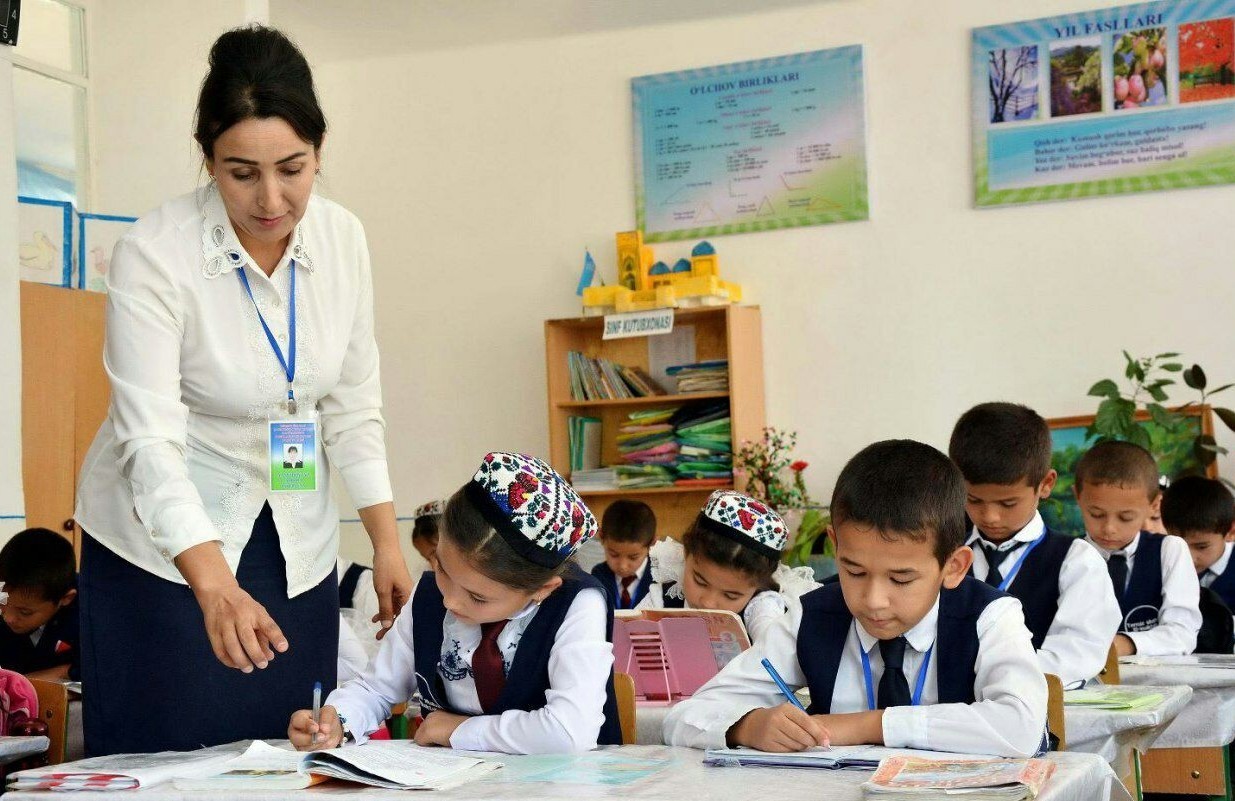
Uzbekistan: Raising the Status of Teachers as an Element of Education Reform
October 1 is celebrated in Uzbekistan as Teachers and Mentors Day.
Previously, Teachers’ Day was not tied to a specific date. It was celebrated on the first Sunday of October and included only teachers at educational institutions. Since 1997, it has been celebrated on a fixed date – October 1 – and has been given the status of an official public holiday and a day off. The scope of the holiday was also broadened to include sports coaches, production instructors and other professionals whose work is in one way or another related to passing on knowledge and experience, education or professional mentoring.
To be fair, however, the change in the status of the holiday was not immediately accompanied by a change in the status of those in whose honor it was established. For many years, its celebration coincided with the beginning of the cotton-picking season, and a large proportion of teachers and mentors celebrated the occasion together with their students in the country’s cotton fields. On their professional holiday, instead of bouquets of fragrant roses and chrysanthemums, teachers were greeted by endless dry bushes covered with dusty cotton bolls.
Today, Uzbekistan has put an end to the practice of involving teachers in cotton harvesting, as well as in public improvement work, landscaping and neighborhood inspections. The elimination of compulsory labor duties has become one of the defining features of modern Uzbekistan. Employees in the public sector are no longer engaged in tasks unrelated to their professional responsibilities, and this has been enshrined in legislation.
Decisions and decrees by President Shavkat Mirziyoyev, along with Uzbekistan’s accession to international instruments establishing national governments’ obligations in this area, have played a key role in eradicating forced labor. As for teachers, over the past decade, efforts to support them and create favorable conditions for them to perform their professional duties effectively have moved from the realm of declarations into practical implementation.
Consider the following: teachers have been relieved not only of duties unrelated to their profession, but also of excessive paperwork that had burdened both schools and higher education institutions. Reporting requirements have now been reduced to a minimum and concern only criteria and indicators directly related to the educational process.
A significant factor in encouraging teachers’ work has been the increase in their salaries and the introduction of various forms and methods of financial incentives.
According to the latest data, for example, with the basic rate for one standard teaching workload set at 3.73 million sums (around $316), the overwhelming majority of school teachers – around 90 percent – earn up to 6 million sums (more than $500) per month, while another group earns between 6 million and 10 million sums ($500-845). At top-performing schools, or with a higher workload and additional allowances, salaries can reach 20 million sums ($1,690) or more.
These amounts are “piling up” through additional payments for professional categories, strong work results, proficiency in foreign languages, and national or international certificates. Additional allowances have also been introduced for teachers who move to schools with low educational performance – classified as “red” under the national rating system – as well as for those relocating to remote and hard-to-reach areas to fulfill their professional mission. In such areas, teachers can also receive one-time financial assistance and housing rental compensation. This is far from a complete list of social support measures available to education professionals in Uzbekistan.
Teachers receive a 50 percent discount on a number of government services, including cadastral registration, connection to utility networks, taking examinations and obtaining certain certificates. Their children are also entitled to a 30 percent discount on tuition fees when enrolling in public higher education institutions. In addition, starting in 2026, the state will cover 25 percent of the down payment on mortgage loans for teachers with the highest professional category and at least 15 years of experience.
Another new initiative, introduced this year on the eve of the professional holiday, has become one of the major developments in the education sector. Uzbekistan has announced the results of a new nationwide “Teacher of the Year” competition, organized for the first time at the initiative of President Shavkat Mirziyoyev to identify teachers’ creative potential, improve the quality of education, foster an environment of healthy professional competition and encourage their work.
More than 46,000 innovative teachers from across the country took part in the competition. A total of 208 participants – one outstanding teacher from each district and city of the country – were declared winners. They received cash prizes equivalent to 1,400 basic calculation units, or about $50,000. A substantial award, isn’t it?
It is also worth noting that under the Law “On the Status of Teachers,” adopted in 2024 and establishing legal, social and economic guarantees for education workers, their professional reputation and activities are protected by the state.
The state is demonstrating this in practice. According to the Ministry of Justice of Uzbekistan, 2,051 cases of violations of teachers’ rights were prevented in the first half of 2026. It is therefore probably too early to say that all problems in this area have been fully resolved. However, they are being addressed, and as part of the broader education reform, Uzbekistan is paying increased attention to raising the prestige of the teaching profession, strengthening social protection, providing incentives for teachers and creating favorable conditions for their work.
We clearly understand that only by ensuring a high status and authority for teachers can we raise the quality of education in the country to a global level. This, in turn, will allow us to effectively address other tasks of consistent socio-economic development of Uzbekistan.
It remains to add that the Uzbek people have always held educated people and mentors in particularly high regard, as reflected in the proverb, “Ustoz otangdek ulug‘” (“A teacher is as great as your father”). We also remember that the great Sahibkiran Amir Temur bequeathed that he be buried at the feet of his spiritual mentor. Thus, the fundamental change in attitudes toward teachers and mentors in Uzbekistan in recent years shows that the country is returning to its ancient roots in this regard.
Rahimjon Jo’raev
Dunyo IA📅 25.09.2026
Uzbekistan news
Aquatherm Tashkent 2026 to Showcase Latest Technologies for Construction and Utility Infrastructure
Uzbekistan is securing its place in the Global Hub for Technological Outsourcing
Digital Cooperation among the Turkic States Towards a Unified Technological Ecosystem
Uzbekistan and Azerbaijan are creating a Hub for Startups, Investors and Talent
UZBEKISTAN AND THE UN: FROM NATIONAL INITIATIVES TO THE GLOBAL AGENDA
The 5th Samarkand Forum on Human Rights to take place on September 28–29th
Uzbekistan's key trading partners participate in CICA
Speech by President Shavkat Mirziyoyev at the solemn ceremony dedicated to the thirty-fifth anniversary of the independence of the Republic of Uzbekistan
Uzbekistan Firmly Establishes Itself as a Stable and Predictable Partner for Long-Term International Business
Changing economic priorities of Uzbekistan reshape its engagement with the CIS
Inaugural Central Asia – Republic of Korea Summit at the highest level opens in Seoul
Uzbekistan and Korea: Advancing Green Energy and New Technologies
Uzbekistan and the Republic of Korea in the Emerging Framework for Cooperation with Central Asia
Tashkent brings together leaders and key deals in Polymer Market of Central Asia
The 1st Republic of Korea–Central Asia Summit: Why This Moment Matters
Uzbekistan – Serbia: A New Geography of Industrial Cooperation
The President of Uzbekistan’s Visit to Serbia: A New Stage in Economic Partnership Between Central Asia and the Balkans
Uzbekistan and the Republic of Korea: From Investment Partnership to Technological Cooperation
Regional Approaches to SDG Delivery: What Can Central Asia Offer?
Uzbekistan Opens a Balkan Gateway to Europe
The SCO Bishkek Summit: The Economic Agenda of a New Stage of Cooperation
Tourism: A new dimension of Uzbekistan-Kyrgyzstan partnership
Uzbekistan’s Role in the SCO: Economy, Security and Regional Cooperation
Economic Cooperation of Uzbekistan within the SCO at a New Stage of Development
Uzbekistan and Serbia: From Labour Mobility to a Strategic Partnership in Human Capital
Prospects for Uzbekistan–Serbia Cooperation in the ICT Sector
Prospects for Cooperation between the Republic of Uzbekistan and the Republic of Korea within the Framework of the Central Asia–Republic of Korea Cooperation Forum
THE SCO’S NEW FINANCIAL ARCHITECTURE: FROM COORDINATION TO PRACTICAL DEVELOPMENT MECHANISMS
INFORMATION NOTE ON COOPERATION WITH SERBIA
On September 8–10th, Tashkent to gather International Textile Industry Professionals

-
 Ministry of Foreign Affairs of the Republic of Uzbekistan
 -
 Diplomatic Service of the Ministry of Foreign Affairs
 -
 State Committee for Tourism Development
 -
Ministry of Investments and Foreign Trade of the Republic of Uzbekistan
-
 invest.gov.uz
 -
-

-

-

-

-

-


of Uzbekistan in the Republic
of Latvia
When using the information, a link to www.uzembassy.lv
must be provided.
All rights reserved
Address
Address: Riga c., LV-1010. 11-11 Elizabetes Str., Latvia
Phone: 37167322424
Fax: 37167322306
Email: embassy@uzbekistan.lv
Useful links
HomeIssuance of biometric passport for departure abroad
Certificate to return to Uzbekistan
Withdrawal of citizenship
Loss of citizenship