Phone
Consular Issues
Phone
Uzbekistan news
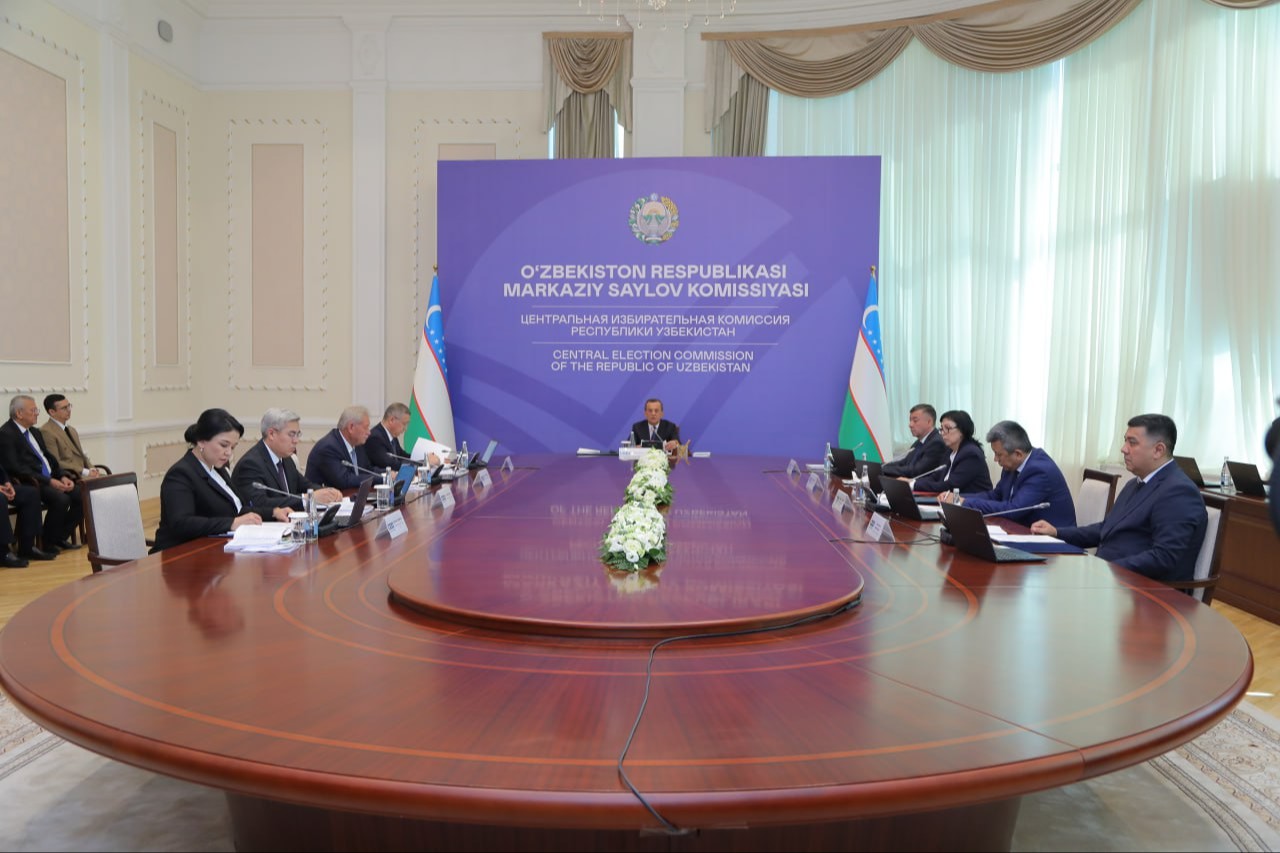
A New and Technological Approach to Elections Begins
The Central Election Commission held a meeting and a series of events today, July 26th. The primary agenda item was the preparation and high-level accomplishment of the upcoming elections for the Legislative Chamber of the Oliy Majlis and the Councils of People's Deputies in full compliance with the Constitution and laws.
According to Article 128 of the Constitution of the Republic of Uzbekistan, elections for the Legislative Chamber of the Oliy Majlis and the Councils of People's Deputies are scheduled to take place on the first Sunday of the third ten-day period of October in the year their term expires. Considering that the term of the deputies of the Legislative Chamber of the Oliy Majlis and the Councils of People's Deputies ends in 2024, the elections will be held on October 27th of this year, and the election campaign will begin on July 26th, as decided by the Central Election Commission.
These elections mark a significant departure from the past, taking place in a new socio-political environment as stipulated by our Constitution. The meeting underscored the unique features of these elections, which include:
- For the first time in Uzbekistan's history, the Legislative Chamber of the Oliy Majlis elections will be conducted using a mixed electoral system, combining majoritarian and proportional systems. This significant change will see seventy-five deputies elected directly through the majoritarian system, where voters vote for specific candidates. The remaining seventy-five deputies will be elected based on votes cast for political parties under the proportional system.
- One of the most significant advancements is the full digitization of election commissions' activities at all levels and their interactions with participants in the election process. This development significantly reduces bureaucracy, time, and document handling in election procedures, ushering in a new era of efficiency in our electoral system.
- Our election legislation has been fundamentally improved to align with advanced democratic standards. These improvements include introducing a new system for election bodies led by the Central Election Commission and requiring political parties to ensure that at least 40% of their candidates for deputy positions are women. Additionally, a candidate must receive a relative majority of votes to be elected. If a candidate gets more votes than other candidates in their respective electoral district, they will be elected without needing a repeat vote.
- The elections are taking place in conditions of significantly strengthened parliamentarianism and the powers of representative bodies at the local level, as established by the Updated Constitution. Specifically, the absolute powers of the Legislative Chamber have increased from 5 to 12, and those of the Senate from 12 to 18. The parliament's oversight functions over the activities of executive, judicial, law enforcement agencies, and special services have been expanded. The institution of hokims leading local Councils of People's Deputies is being abolished. To enhance the role of representative bodies in resolving important state issues, 33 powers previously held by hokims have been transferred to local Councils.
The meeting underscored the significance of these elections as a vivid example of democratic state-building in our country and an essential means for citizens to exercise their constitutional rights to vote and be elected to democratic state bodies. The elections will involve the election of 150 deputies to the Legislative Chamber, 65 members to the Senate, 65 deputies to the Jokargy Kenes of the Republic of Karakalpakstan, deputies to 208 district (city) Councils in the regions and Tashkent city, with around 30,000 candidates and nearly 90,000 trusted representatives actively participating. Over 120,000 election commission members and more than 70,000 citizens and international observers are expected to participate in the election process.
Considering the important role of elections in state life and with the aim of widely engaging citizens in this process, the Central Election Commission announced that the elections will be held on October 27th under the slogan “My Choice—My Prosperous Homeland.”
The 'E-Saylov' information system is a key tool in making the election process more transparent and accessible. It facilitates around 60 interactions between election commissions, political party candidates, observers, and the media entirely electronically. Integrated with other electronic platforms, the system automates many procedures in the election process without human intervention. This system forms an extensive database of nearly 400,000 participants in the election process, including election commission members, candidates, and observers. Around 32,000 participants will professionally use the information system, which includes communication through 40 types of SMS notifications.
For citizens, the "E-Saylov" information system introduces several conveniences in obtaining election-related information. Specifically, it provides statistical data on voters and polling stations, information on candidates for various elections, and interactive maps to learn about candidates and their biographies.
The meeting emphasized that the "E-Saylov" information system represents a new level of technological advancement and transparency in elections.
It was also noted that according to Article 37 of the Election Code, political parties have the right to nominate candidates for deputies to the Legislative Chamber and local Councils.
To participate in the elections, political parties must have been registered by the Ministry of Justice at least four months before the announcement of the election campaign and collect at least 40,000 signatures supporting their participation.
Additionally, the meeting approved a calendar plan to ensure that the activities related to conducting the elections are carried out step-by-step within the timelines specified by election legislation. The Central Election Commission, as an impartial and independent constitutional body, will take all necessary measures to prepare for and conduct the upcoming elections in full compliance with national legislation and international election standards, ensuring the process is open and transparent.
A Press Center has also been established under the Central Election Commission.
Central Election Commission
of the Republic of Uzbekistan
📅 30.07.2024
Uzbekistan news
Strengthening Transport Connectivity in Asia through the Development of the Trans-Caspian International Transport Corridor
Uzbekistan promotes Initiatives in Central Asia unlocking new opportunities for cooperation
Political mutual trust in the Central Asian region is transforming into economic capital
Uzbekistan attracts specialists from 16 countries to the anniversary international exhibition “Mining, Metallurgy and Metalworking – MiningMetals Uzbekistan 2026”
Uzbekistan has moved its economic cooperation with the Turkic states into a practical dimension
Akramjon Nematov: Central Asia is increasingly emerging as an independent centre for shaping its own economic and technological agenda
Central Asia Is Shaping Its Own Model of Regional Cooperation
Initiatives of Uzbekistan aimed at Economic Results for the Countries of Central Asia and Azerbaijan
Regular dialogue is the Foundation for addressing common water-related challenges in Central Asia
Uzbekistan and Turkmenistan: A New Stage in the Development of Their Strategic Partnership
11th Tashkent International Biennale of Contemporary Art to be held in the capital of Uzbekistan on October 12–16th
OTS Member States - A Crucial Link in the Eurasian Space
Uzbekistan plays an active role in Economic Integration within the framework of the Organization of Turkic States
CICA opens new horizons for financial cooperation
Aquatherm Tashkent 2026 to Showcase Latest Technologies for Construction and Utility Infrastructure
Uzbekistan is securing its place in the Global Hub for Technological Outsourcing
Digital Cooperation among the Turkic States Towards a Unified Technological Ecosystem
Uzbekistan and Azerbaijan are creating a Hub for Startups, Investors and Talent
UZBEKISTAN AND THE UN: FROM NATIONAL INITIATIVES TO THE GLOBAL AGENDA
The 5th Samarkand Forum on Human Rights to take place on September 28–29th
Uzbekistan's key trading partners participate in CICA
Speech by President Shavkat Mirziyoyev at the solemn ceremony dedicated to the thirty-fifth anniversary of the independence of the Republic of Uzbekistan
Uzbekistan Firmly Establishes Itself as a Stable and Predictable Partner for Long-Term International Business
Changing economic priorities of Uzbekistan reshape its engagement with the CIS
Inaugural Central Asia – Republic of Korea Summit at the highest level opens in Seoul
Uzbekistan and Korea: Advancing Green Energy and New Technologies
Uzbekistan and the Republic of Korea in the Emerging Framework for Cooperation with Central Asia
Tashkent brings together leaders and key deals in Polymer Market of Central Asia
The 1st Republic of Korea–Central Asia Summit: Why This Moment Matters
Uzbekistan – Serbia: A New Geography of Industrial Cooperation

-
 Ministry of Foreign Affairs of the Republic of Uzbekistan
 -
 Diplomatic Service of the Ministry of Foreign Affairs
 -
 State Committee for Tourism Development
 -
Ministry of Investments and Foreign Trade of the Republic of Uzbekistan
-
 invest.gov.uz
 -
-

-

-
-
-

-

of Uzbekistan in the Republic
of Latvia
When using the information, a link to www.uzembassy.lv
must be provided.
All rights reserved
Address
Address: Riga c., LV-1010. 11-11 Elizabetes Str., Latvia
Phone: 37167322424
Fax: 37167322306
Email: embassy@uzbekistan.lv
Useful links
HomeIssuance of biometric passport for departure abroad
Certificate to return to Uzbekistan
Withdrawal of citizenship
Loss of citizenship