Phone
Consular Issues
Phone
Uzbekistan news
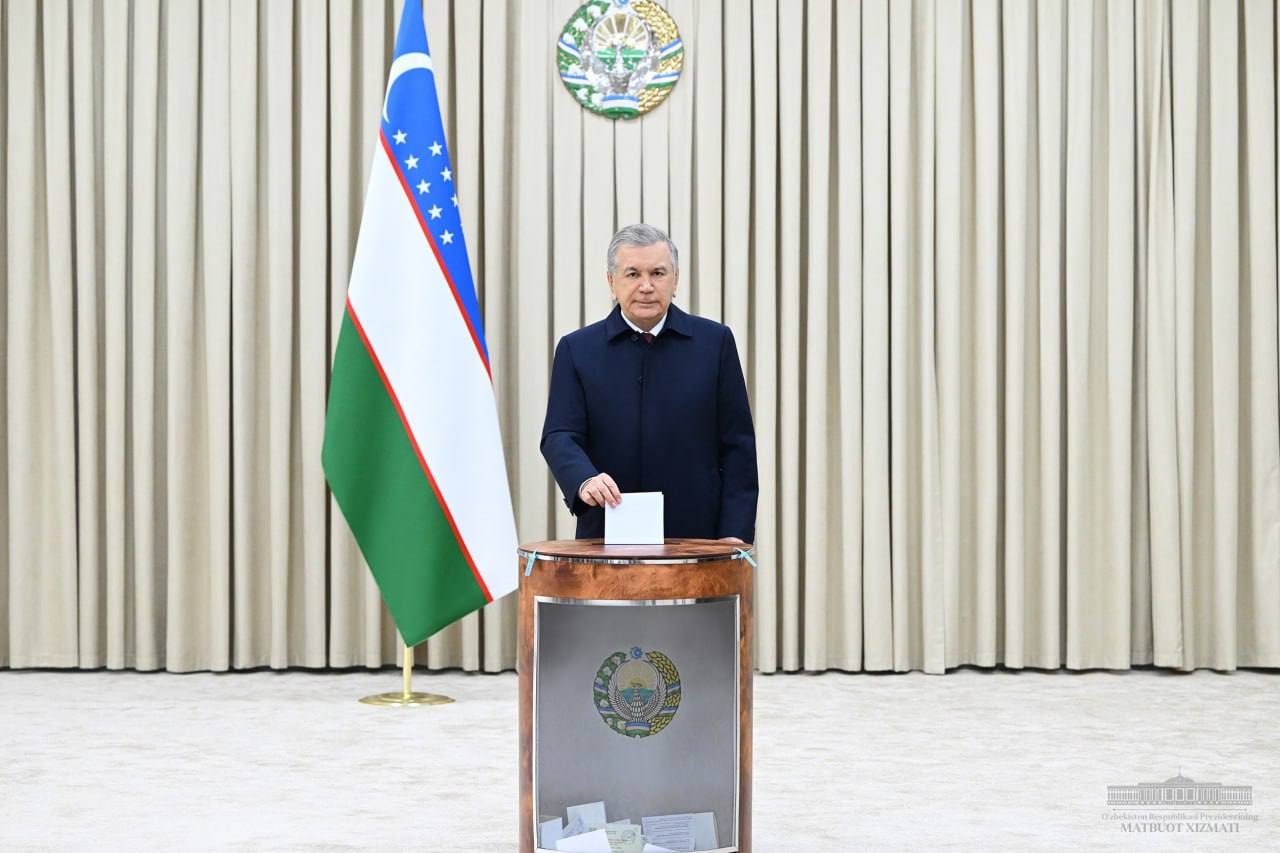
President Shavkat Mirziyoyev votes in elections
Today, elections to the Legislative Chamber of Oliy Majlis and kengashes of people's deputies are being held in our country.
President of the Republic of Uzbekistan Shavkat Mirziyoyev together with his family members visited polling station No. 59 in Mirzo-Ulugbek district of the capital and took part in the voting.
Article 128 of the Constitution of our country states that citizens have the right to elect and be elected to the representative bodies of state power. The right to vote, equality and freedom of expression are guaranteed by law.
Five parties are running in the elections: the Movement of Entrepreneurs and Business People - Liberal Democratic Party of Uzbekistan, the Milliy Tiklanish Democratic Party, the Ecological Party, the People's Democratic Party and the Adolat Social Democratic Party.
This important event is taking place in the context of increased social and political activity in our country, under the slogan “My Choice - Prosperous Motherland”.
For the first time in the history of Uzbekistan, elections to the Legislative Chamber of the Oliy Majlis are held on the basis of a majoritarian-proportional, that is, mixed electoral system. 75 deputies are elected directly under the majoritarian system, i.e. by voting for their preferred candidates, and the remaining 75 - under the proportional system, when votes are cast for political parties.
Over the past period, the electoral legislation has been radically improved in line with advanced democratic standards. In particular, a new system of electoral bodies headed by the Central Electoral Commission had been introduced, and, in order to enhance the role of women in society, it had been established that the proportion of women among political party candidates should be at least 40 per cent.
Another notable aspect of the current elections was that the interaction between the participants in the process had been fully digitalized through the E-Saylov information system.
This information system has raised the openness of the elections to a higher level.
All polling stations have created conditions for voters in accordance with the law. There are 5,770 district and 11,028 precinct election commissions organized in the field, including 57 polling stations in 40 foreign countries.
More than 850 foreign and international observers from the CIS, SCO, Organization of Turkic States, as well as a full-scale mission of the OSCE Office for Democratic Institutions and Human Rights are taking part in monitoring the election process.
The head of state talked to citizens who came to the polling station. He thanked them for their active participation in the elections with a sense of involvement in the fate of their native country and their district.
📅 27.10.2024
Uzbekistan news
Aquatherm Tashkent 2026 to Showcase Latest Technologies for Construction and Utility Infrastructure
Uzbekistan is securing its place in the Global Hub for Technological Outsourcing
Digital Cooperation among the Turkic States Towards a Unified Technological Ecosystem
Uzbekistan and Azerbaijan are creating a Hub for Startups, Investors and Talent
UZBEKISTAN AND THE UN: FROM NATIONAL INITIATIVES TO THE GLOBAL AGENDA
The 5th Samarkand Forum on Human Rights to take place on September 28–29th
Uzbekistan's key trading partners participate in CICA
Speech by President Shavkat Mirziyoyev at the solemn ceremony dedicated to the thirty-fifth anniversary of the independence of the Republic of Uzbekistan
Uzbekistan Firmly Establishes Itself as a Stable and Predictable Partner for Long-Term International Business
Changing economic priorities of Uzbekistan reshape its engagement with the CIS
Inaugural Central Asia – Republic of Korea Summit at the highest level opens in Seoul
Uzbekistan and Korea: Advancing Green Energy and New Technologies
Uzbekistan and the Republic of Korea in the Emerging Framework for Cooperation with Central Asia
Tashkent brings together leaders and key deals in Polymer Market of Central Asia
The 1st Republic of Korea–Central Asia Summit: Why This Moment Matters
Uzbekistan – Serbia: A New Geography of Industrial Cooperation
The President of Uzbekistan’s Visit to Serbia: A New Stage in Economic Partnership Between Central Asia and the Balkans
Uzbekistan and the Republic of Korea: From Investment Partnership to Technological Cooperation
Regional Approaches to SDG Delivery: What Can Central Asia Offer?
Uzbekistan Opens a Balkan Gateway to Europe
The SCO Bishkek Summit: The Economic Agenda of a New Stage of Cooperation
Tourism: A new dimension of Uzbekistan-Kyrgyzstan partnership
Uzbekistan’s Role in the SCO: Economy, Security and Regional Cooperation
Economic Cooperation of Uzbekistan within the SCO at a New Stage of Development
Uzbekistan and Serbia: From Labour Mobility to a Strategic Partnership in Human Capital
Prospects for Uzbekistan–Serbia Cooperation in the ICT Sector
Prospects for Cooperation between the Republic of Uzbekistan and the Republic of Korea within the Framework of the Central Asia–Republic of Korea Cooperation Forum
THE SCO’S NEW FINANCIAL ARCHITECTURE: FROM COORDINATION TO PRACTICAL DEVELOPMENT MECHANISMS
INFORMATION NOTE ON COOPERATION WITH SERBIA
On September 8–10th, Tashkent to gather International Textile Industry Professionals

-
 Ministry of Foreign Affairs of the Republic of Uzbekistan
 -
 Diplomatic Service of the Ministry of Foreign Affairs
 -
 State Committee for Tourism Development
 -
Ministry of Investments and Foreign Trade of the Republic of Uzbekistan
-
 invest.gov.uz
 -
-

-
-
-
-

-

of Uzbekistan in the Republic
of Latvia
When using the information, a link to www.uzembassy.lv
must be provided.
All rights reserved
Address
Address: Riga c., LV-1010. 11-11 Elizabetes Str., Latvia
Phone: 37167322424
Fax: 37167322306
Email: embassy@uzbekistan.lv
Useful links
HomeIssuance of biometric passport for departure abroad
Certificate to return to Uzbekistan
Withdrawal of citizenship
Loss of citizenship