Phone
Consular Issues
Phone
Uzbekistan news
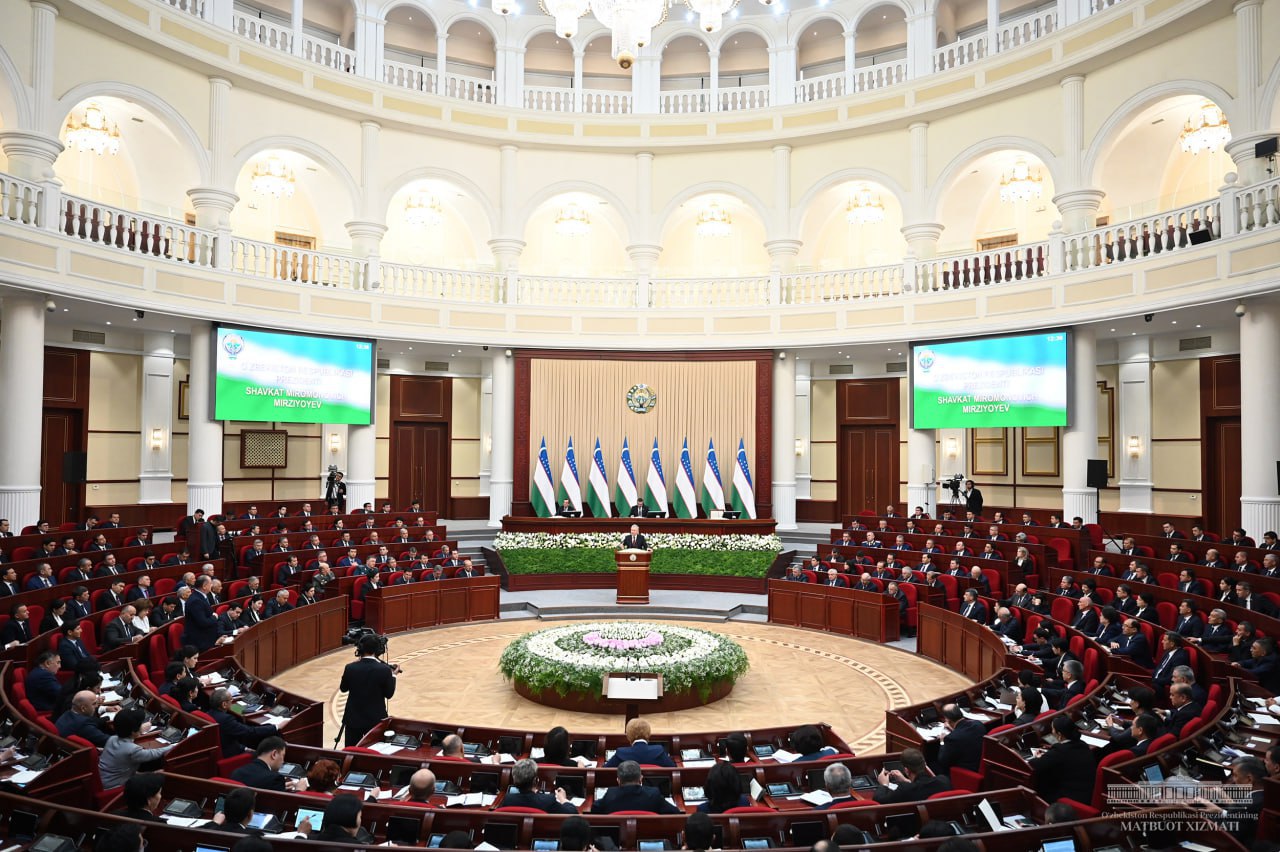
President participates in the session of the Legislative Chamber
On November 18, the first session of the Legislative Chamber of the Oliy Majlis of the Republic of Uzbekistan after the elections was held in Tashkent.
It was attended by President of the Republic of Uzbekistan Shavkat Mirziyoyev.
The session was opened by Chairman of the Central Election Commission Zayniddin Nizamkhodzhaev.
The National Anthem of the Republic of Uzbekistan was played.
Temporary Secretariat of the first session, Counting Commission and temporary group on control over the use of electronic vote counting system were elected. The agenda was approved. The CEC Chairman presented information on the results of the elections to the Legislative Chamber.
On the proposal of the Council of Representatives of Political Parties, deputies elected Nuriddin Ismoilov to the post of Speaker of the Legislative Chamber of Oliy Majlis by secret ballot.
Then the chairmanship of the session passed to the Speaker. Deputy Speakers were elected. The factions of five political parties were registered. Ten committees of the Legislative Chamber were established in accordance with their agreed proposals.
President of Uzbekistan Shavkat Mirziyoyev addressed the session.
At the beginning of his speech, the Head of State congratulated the deputies on their election, emphasizing that this is the embodiment of high trust and respect of our people.
It was emphasized that the current parliamentary elections have entered the history as being the first ones held in accordance with the updated Constitution. This process was conducted for the first time under a mixed electoral system.
As a result of the elections, 150 deputies were elected to the Legislative Chamber. Among them were 57 women and 11 young people under 35 years of age. Overall, the composition of the lower house was renewed by almost 60 percent.
The activities of the Chamber over the past five years were discussed. During this period, the Constitution has been updated and more than 130 new laws have been adopted, which is 1.5 times more than in the previous period.
The President also drew attention to the issues that remained out of parliamentary attention. For example, the share of laws with direct action and clear enforcement mechanisms remains low. Parliamentary and deputy control is still not effective enough. The activity of deputies in constituencies is mostly limited to organizing meetings, answering complaints and questions.
The Head of State outlined his vision of the new tasks ahead of the Legislative Chamber.
In particular, it was proposed to create public councils under each committee with the participation of representatives of civil society to strengthen the dialogue.
It is important to establish not only control and requirements in the work of parliamentary committees, but also close cooperation with ministries. It is also necessary to strengthen party and fractional discipline.
The President emphasized that lawmaking, primarily, should be aimed at solving urgent problems of society, and put forward a number of legislative initiatives. Among them are the construction of modern residential buildings replacing outdated ones, guaranteeing the protection of citizens' funds allocated for housing construction, support for private education and investors in the energy sector, introduction of compulsory health insurance, creation of a legal framework for franchising, capital market and startups, and relations arising in the field of artificial intelligence.
In order to boost the opposition, it was proposed to increase the number of guaranteed rights of the parliamentary opposition from 3 to 6, including giving it the positions of one committee chairman and two deputy committee chairmen, as well as additional rights to submit questions within the framework of the “government hour” and parliamentary inquiries.
Particular attention was paid to the need to transition to a system of broad, high-quality parliamentary control. In particular, in accordance with the updated Constitution, the control over the execution of the State Budget is the exclusive competence of the Legislative Chamber. In this regard, it is necessary to strengthen the work of the Chamber in this direction, including the introduction of the practice of submitting all reports of the Government on the State Budget to the Chamber only together with the audit report provided for by the Budget Code.
- A deputy is a servant of the people, a model for all, a person with a high level of political culture and knowledge, who sincerely loves his homeland. Our people, all of us, above all rely on you to strengthen peace, mutual understanding and harmony in the family, mahalla and society, to educate the youth in the spirit of patriotism, to defend the interests of Uzbekistan in the international arena, - said Shavkat Mirziyoyev.
Heads of political party factions and deputies addressed the session. The President supported their views, urged the deputies to work harder and be closer to the people.
- The voice of a deputy is the voice of the people. If you consider every issue concerning the fate of the country and first of all see our hardworking, generous and noble people in front of you, if you act thinking not only about today, but also about peace and happiness of future generations, then our people will be satisfied with you, - emphasized the Head of State.
The Legislative Chamber of the Oliy Majlis adopted resolutions on the agenda.
📅 19.11.2024
Uzbekistan news
Uzbekistan and Kyrgyzstan: A New Stage and Future Prospects for Environmental Cooperation
Uzbekistan–Azerbaijan: Environmental cooperation emerges as a key pillar of the strategic partnership
Samarkand hosted an international scientific and practical conference on “Brother Cities: A New Model for Sustainable Development and Public Diplomacy”
Uzbekistan and Kyrgyzstan: Strategic Partnership, Institutionalization, and Mechanisms of Cooperation
Uzbekistan–Kyrgyzstan: From Border Neighbourhood to Long-Term Economic Cooperation
Uzbekistan and Kyrgyzstan: Transitioning to Joint Value Chains
Towards a Unified Intellectual Space of the Turkic World: A New Era of Scientific Integration in the Renaissance Age
Uzbekistan – Kyrgyzstan: Prospects for Cooperation on Water Resources
Central Asia and Azerbaijan: Prospects for a Common Transport Area
Central Asia and Azerbaijan Are Emerging as a Shared Hub for Startups, Investors, and Talent
Uzbekistan - Azerbaijan: economy of trust, routes and joint projects
Uzbekistan - Kyrgyzstan: from border neighborhood to long-term economic cooperation
Central Asia and Azerbaijan: Strategic Partners Building a Green Energy Hub Together
Through the Caspian to New Markets
Uzbekistan embraces the language of international law and becomes part of the global financial system
On July 24–25, Samarkand Will Bring Together Global Sister Cities at International Forum
Uzbekistan: An Open and Safe Destination Recognized by the International Community
Green Economy, Social Sustainability, and Transparent Governance: Uzbekistan’s New Development Formula
The text of the appeal of the participants of the first international forum of Islamic civilization to the head of State
Declaration adopted by the participants of the First International Islamic Civilization Forum
Uzbekistan–Belarus economic cooperation: promising projects in the Agri-food sector
Uzbekistan and Belarus: Stable Partnership and Strategic Development Prospects
Uzbekistan and Belarus strengthen multifaceted partnership based on mutual trust and pragmatic cooperation
Areas of Cooperation between Belarus and Uzbekistan in Strengthening Sustainable Transport Corridors in Eurasia
Uzbekistan–Belarus economic cooperation: promising projects in the Agri-food sector
Uzbekistan and Georgia: From historical friendship to a strategic partnership
Uzbekistan–Georgia Relations: Contemporary Priorities for Bilateral Development
Ecological cooperation between Uzbekistan and the United States elevated to the level of a strategic partnership
Cooperation Between Uzbekistan and Georgia in Strengthening Connectivity in Central Asia and the South Caucasus
Uzbekistan as an Operational Hub for Technology Companies: Key Figures, Conditions, and Advantages

-
 Ministry of Foreign Affairs of the Republic of Uzbekistan
 -
 Diplomatic Service of the Ministry of Foreign Affairs
 -
 State Committee for Tourism Development
 -
Ministry of Investments and Foreign Trade of the Republic of Uzbekistan
-
 invest.gov.uz
 -
-

-

-

-

-

-


of Uzbekistan in the Republic
of Latvia
When using the information, a link to www.uzembassy.lv
must be provided.
All rights reserved
Address
Address: Riga c., LV-1010. 11-11 Elizabetes Str., Latvia
Phone: 37167322424
Fax: 37167322306
Email: embassy@uzbekistan.lv
Useful links
HomeIssuance of biometric passport for departure abroad
Certificate to return to Uzbekistan
Withdrawal of citizenship
Loss of citizenship