Phone
Consular Issues
Phone
Uzbekistan news
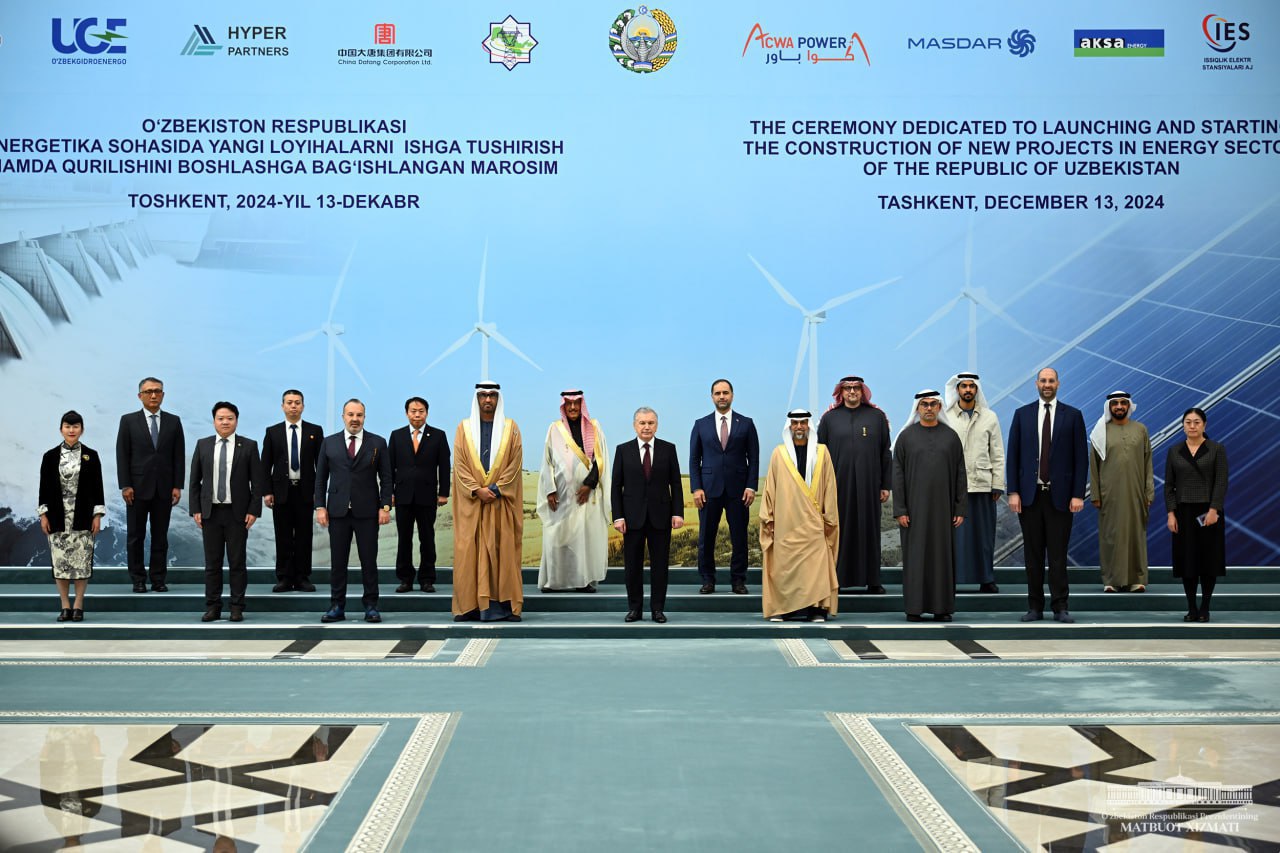
18 new energy facilities commissioned, 6 facilities are launched for construction
President of the Republic of Uzbekistan Shavkat Mirziyoyev on December 13 took part in a solemn ceremony dedicated to the launch of new energy capacities and the beginning of construction of a number of facilities.
These projects are part of a large-scale work aimed at strengthening the potential of the country's energy system. Last December, five solar and one wind power plants were put into operation. Many new projects were launched during the Head of State's visits to the regions.
Today, 24 projects worth more than $7 billion have been launched. In particular, in Bukhara, Navoi, Namangan and Tashkent regions, 5 solar and wind power plants with a total capacity of about 2.3 thousand megawatts, as well as 5 high-voltage substations have been connected to the network.
For the first time in Uzbekistan, an energy storage system with a capacity of 300 megawatts was created in Andijan and Fergana. A 400 megawatt power plant was put into operation in Kashkadarya, and a modern cogeneration plant was put into operation in Tashkent, and in Andijan, Surkhandarya and Tashkent regions - four small hydroelectric power plants.
In addition, construction of 6 energy facilities with a total capacity of 2.5 gigawatts has started in Fergana, Samarkand, Navoi, Tashkent regions and Tashkent city.
These new projects will generate an additional 9.5 billion kilowatt hours of electricity, save 2.5 billion cubic meters of natural gas and prevent the emission of 4.6 million tons of harmful gases in the coming years.
Most importantly, over 4 million households will be provided with uninterrupted and clean energy.
This will also set the stage for $4 billion worth of value creation in other sectors of the economy.
In total, in 2025, our country will produce 84 billion kilowatt-hours of electricity, which is 25 billion kilowatt hours or 1.5 times more compared to 2016.
Speaking at the ceremony, President Shavkat Mirziyoyev emphasized that all these projects are implemented through foreign direct investment. Gratitude was expressed to companies from the United Arab Emirates, Saudi Arabia, Türkiye, China and Germany, as well as international institutions such as the Asian Development Bank, the Asian Infrastructure Investment Bank, the Islamic Development Bank, the European Bank for Reconstruction and Development and the World Bank for their fruitful cooperation.
Thanks to the open access of the private sector, Uzbekistan's energy sector has attracted about $20 billion of foreign direct investment over the past five years.
Twenty-four independent energy producers have started to operate in the sector, where previously only the state was present.
In particular, large solar and wind power plants with a total capacity of 3,500 megawatts, equivalent to 10 billion kilowatt-hours, were launched in the green energy sector. This increased the share of “green energy” in the energy system to 16 percent.
As is known, last year the country's GDP reached the historic figure of $100 billion for the first time. By 2030, Uzbekistan's economy should grow to $200 billion.
This will increase the demand for electricity by 1.5 times over the next five years. In addition, under the Paris Agreement, it is planned to reduce harmful gas emissions by 35 percent by 2030.
The President outlined the priority areas of work in the energy sector.
First, 19 thousand megawatts of additional “green capacity” will be built by 2030, and the share of renewable energy will be increased to 54 percent. Already by 2025, 18 solar and wind power plants with a capacity of 3.4 thousand megawatts and energy storage systems with a capacity of 1.8 thousand megawatts are planned. This will increase green energy production to 12 billion kilowatt-hours next year. Also within two years, a large-scale project will be implemented in cooperation with private partners to create more than 2,000 small and micro-hydroelectric power plants.
Second, liberalization of the electricity market will continue. By the end of next year, it is planned to create a competitive wholesale electricity market. Public-private partnership will be introduced in the sphere of energy distribution, and $4 billion of investments will be attracted for the modernization of networks. The first project of transferring the management of regional power grids to the private sector has been developed in Samarkand region, and an international tender has been announced.
Third, the expansion of international cooperation in the field of “green energy”. Within COP-29, agreements were signed with Kazakhstan, Azerbaijan and Saudi Arabia on joint export of “green energy” to Europe. Jointly with neighboring countries a single platform has been launched to ensure the stability of the regional energy system.
Fourth, development of “green energy” as a new driver for other sectors of the economy and improvement of living standards of the population.
Solar panels with a total capacity of 1,000 megawatts have already been installed, which makes it possible to produce 1.5 billion kilowatt-hours of electricity annually. Support for “green” initiatives will continue with the introduction of dual education for the training of specialists.
- Today's event opens a new page in the history of our country's energy sector. These projects will not only ensure economic growth, but also will create an environmentally friendly and sustainable future for our descendants - said Shavkat Mirziyoyev.
The ceremony was addressed by Minister of Energy and Infrastructure of the United Arab Emirates Suhail Mohamed Al Mazrouei, Minister of Energy and Natural Resources of Türkiye Alparslan Bayraktar and Minister of Energy of the Kingdom of Saudi Arabia Prince Abdulaziz bin Salman Al Saud.
By pressing a symbolic switch, President Shavkat Mirziyoyev launched the operation of 18 energy facilities and construction of 6 new projects.
📅 16.12.2024
Uzbekistan news
Peace and Trust in Asia - essential conditions for sustainable development
CICA amid a Crisis of Trust: Uzbekistan’s Role in Strengthening Cooperation in Asia
Uzbekistan promotes initiatives in Central Asia that unlock new opportunities for cooperation
Strengthening Transport Connectivity in Asia through the Development of the Trans-Caspian International Transport Corridor
Uzbekistan promotes Initiatives in Central Asia unlocking new opportunities for cooperation
Political mutual trust in the Central Asian region is transforming into economic capital
Uzbekistan attracts specialists from 16 countries to the anniversary international exhibition “Mining, Metallurgy and Metalworking – MiningMetals Uzbekistan 2026”
Uzbekistan has moved its economic cooperation with the Turkic states into a practical dimension
Akramjon Nematov: Central Asia is increasingly emerging as an independent centre for shaping its own economic and technological agenda
Central Asia Is Shaping Its Own Model of Regional Cooperation
Initiatives of Uzbekistan aimed at Economic Results for the Countries of Central Asia and Azerbaijan
Regular dialogue is the Foundation for addressing common water-related challenges in Central Asia
Uzbekistan and Turkmenistan: A New Stage in the Development of Their Strategic Partnership
11th Tashkent International Biennale of Contemporary Art to be held in the capital of Uzbekistan on October 12–16th
OTS Member States - A Crucial Link in the Eurasian Space
Uzbekistan plays an active role in Economic Integration within the framework of the Organization of Turkic States
CICA opens new horizons for financial cooperation
Aquatherm Tashkent 2026 to Showcase Latest Technologies for Construction and Utility Infrastructure
Uzbekistan is securing its place in the Global Hub for Technological Outsourcing
Digital Cooperation among the Turkic States Towards a Unified Technological Ecosystem
Uzbekistan and Azerbaijan are creating a Hub for Startups, Investors and Talent
UZBEKISTAN AND THE UN: FROM NATIONAL INITIATIVES TO THE GLOBAL AGENDA
The 5th Samarkand Forum on Human Rights to take place on September 28–29th
Uzbekistan's key trading partners participate in CICA
Speech by President Shavkat Mirziyoyev at the solemn ceremony dedicated to the thirty-fifth anniversary of the independence of the Republic of Uzbekistan
Uzbekistan Firmly Establishes Itself as a Stable and Predictable Partner for Long-Term International Business
Changing economic priorities of Uzbekistan reshape its engagement with the CIS
Inaugural Central Asia – Republic of Korea Summit at the highest level opens in Seoul
Uzbekistan and Korea: Advancing Green Energy and New Technologies
Uzbekistan and the Republic of Korea in the Emerging Framework for Cooperation with Central Asia

-
 Ministry of Foreign Affairs of the Republic of Uzbekistan
 -
 Diplomatic Service of the Ministry of Foreign Affairs
 -
 State Committee for Tourism Development
 -
Ministry of Investments and Foreign Trade of the Republic of Uzbekistan
-
 invest.gov.uz
 -

-

-

-

-

-

-

of Uzbekistan in the Republic
of Latvia
When using the information, a link to www.uzembassy.lv
must be provided.
All rights reserved
Address
Address: Riga c., LV-1010. 11-11 Elizabetes Str., Latvia
Phone: 37167322424
Fax: 37167322306
Email: embassy@uzbekistan.lv
Useful links
HomeIssuance of biometric passport for departure abroad
Certificate to return to Uzbekistan
Withdrawal of citizenship
Loss of citizenship