Phone
Consular Issues
Phone
Uzbekistan news
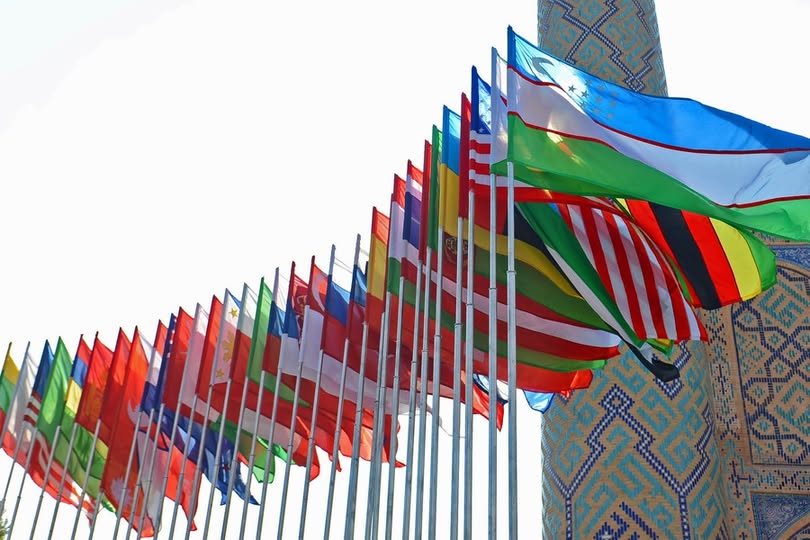
Active Diplomacy of Uzbekistan: 2025 — From Dynamic Dialogue to Tangible Results
The year 2025 marked a stage of qualitative renewal and consolidation of Uzbekistan’s foreign policy positions. Amid a complex and ambiguous international environment characterized by rising geopolitical tensions, the transformation of global institutions, and intensifying competition for resources and markets, Uzbekistan, under the leadership of President Shavkat Mirziyoyev, consistently pursued an open, pragmatic, active, and proactive foreign policy. This approach not only helped preserve the stability of external relations but also infused them with new substantive content aligned with the country’s long-term interests and domestic development priorities.
As emphasized by the President of Uzbekistan, Shavkat Mirziyoyev, in his Address to the Oliy Majlis and the people on December 26, 2025, “in recent times the country has been becoming an international platform for dialogue where global issues are discussed.”
As an integral part of the large-scale socio-economic reforms underway in the country, the diplomatic strategy of New Uzbekistan was aimed at creating favorable external conditions for economic modernization, attracting foreign investment and tourists, expanding export potential, and strengthening humanitarian and cultural ties. The foundations of this foreign policy course remained the principles of openness, equal partnership, mutual respect, non-interference in the internal affairs of states, and strict adherence to international law.
Political dialogue at the highest level with prominent world leaders has reached a new stage and become regular. New agreements have been reached with the leaders of the United States, China, Russia, France, Italy, Turkey, South Korea, Japan, Malaysia and a number of Arab states. In 2025, the number of bilateral meetings at the level of heads of state and government exceeded 55, which indicates a growth in mutual trust with foreign partners.
A similar trend was observed in the development of intensive high-level political dialogue. Throughout the year, high-level Uzbek delegations carried out 172 visits to 93 countries, covering virtually all key regions of the world. Representatives of ministries, agencies, and regional administrations also played a substantial role in shaping the international agenda. With the support of diplomatic missions, they undertook around 300 official visits to more than 50 countries, bringing foreign relations to a more practical and results-oriented level.
Acting as an active host, Uzbekistan has become one of the centers of world diplomacy. This is clearly demonstrated by the fact that the country has hosted forums, assemblies and conferences of the Inter-Parliamentary Union, the United Nations Civil Service, the UNESCO General Conference, the International Climate Conference, the Tashkent Summit of the countries of the region and a number of other major events. Our country has hosted over 120 high-level foreign delegations, as well as about 300 delegations from regional authorities of foreign states. These contacts have contributed to the development of interregional cooperation, the establishment of direct links between business circles and the expansion of the legal framework for cooperation.
Central Asia traditionally occupies a special place in Uzbekistan’s foreign policy strategy. In 2025, this priority received further institutional development. Uzbekistan chaired the Consultative Meeting of the Heads of State of Central Asia, with the chairmanship implemented for the first time on the basis of a comprehensive standalone program. Its agenda covered economic cooperation, transport connectivity, environmental issues, rational use of water resources, and humanitarian exchanges.
The organization of more than twenty major events and the holding in Tashkent of a summit of Central Asian leaders—historic in its outcomes and chaired by President Shavkat Mirziyoyev—became the culmination of regional diplomacy for the year. These developments confirmed the region’s aspiration to deepen mutual trust and pursue joint development.
Today, we can say with confidence that our vast region is becoming a unified, fully-fledged player in world politics for the first time in a long time. This is evidenced by the growing attention of the international community and the changed perception of the region on the global stage. A striking example is the development of the ‘Central Asia Plus’ formats, which in 2025 were filled with new concrete practical content. The summits with the European Union, China, Russia, the United States and Japan clearly demonstrated the region's increased role in global politics and strengthened its position as an area of stability, predictability and mutually beneficial cooperation.
An important direction of Uzbekistan’s foreign policy in 2025 was the further expansion of its geographical reach. Alongside traditional partners in the CIS, Europe, and Asia, contacts with countries in Eastern Europe, the Middle East, Africa, and South America were intensified. The first-ever bilateral high-level engagements with Slovakia, Serbia, Jordan, Paraguay, and several other states testified to the consistent expansion of Uzbekistan’s international presence. As a result, the total number of countries with which Uzbekistan maintains diplomatic relations reached 165.
Against this backdrop, several events of strategic significance had a profound impact on Uzbekistan’s foreign policy positioning in 2025. The signing of the Enhanced Partnership and Cooperation Agreement with the European Union and President Shavkat Mirziyoyev’s visit to Brussels marked a transition in relations with the EU to a qualitatively new level. The agreement established a solid legal framework for deepening political dialogue, expanding trade and economic ties, attracting investment, and developing cooperation in sustainable development, the green economy, and digitalization, while also reflecting the high assessment by European partners of Uzbekistan’s ongoing reforms.
Continuing its course toward expanding and deepening engagement with key global centers of power, Uzbekistan steadily developed relations with the United States. A landmark event in this regard was the successful outcome of the “C5+1” summit held in Washington in November, which brought together the leaders of the United States and the Central Asian states. Uzbekistan’s role in this format has been widely recognized by international experts and policymakers as that of a key initiator of regional cooperation and a responsible partner of the United States in the areas of sustainable development, security, economic interaction, and humanitarian ties.
Equally significant was the participation of the President of Uzbekistan in the session of the United Nations General Assembly. The head of state’s address from the UN’s main international platform reaffirmed the country’s commitment to multilateralism, peaceful dialogue, and the collective search for solutions to pressing global challenges.
In 2025, four resolutions initiated by Uzbekistan were adopted by the UN General Assembly, reflecting the country’s priorities in sustainable development, regional security, and humanitarian cooperation. In addition, Uzbekistan was elected to several authoritative UN bodies, underscoring the growing trust of the international community.
A historic event of the year was the holding of the 43rd session of the UNESCO General Conference in Samarkand. For the first time in forty years, this forum took place outside Paris, representing unprecedented recognition of Uzbekistan’s cultural, historical, and civilization significance. For several days, Samarkand became a global platform for dialogue on education, science, and culture, strengthening the humanitarian dimension of Uzbekistan’s foreign policy and its image as a center of intercivilizational interaction.
Alongside active political diplomacy, economic diplomacy developed dynamically in 2025, firmly establishing itself as one of the key instruments of the country’s foreign policy. Systematic work within the framework of “Ministry of Foreign Affairs — diplomatic missions — sectoral agencies — regions” yielded tangible results in attracting foreign investment and expanding external economic ties. Over the first ten months of the year, USD 34.4 billion in foreign investment was mobilized with the support of diplomatic missions.
The effectiveness of Uzbekistan’s economic policy received high praise from international financial institutions and rating agencies. In 2025, Fitch Ratings and S&P upgraded the country’s sovereign credit rating from “BB-” to “BB,” while Moody’s revised its outlook from “stable” to “positive,” reflecting growing confidence in the economy and the sustainability of ongoing reforms.
The intensification of foreign economic activity also contributed to the growth of trade indicators. Over the first eleven months of 2025, Uzbekistan’s foreign trade turnover reached USD 72.7 billion, with exports amounting to USD 30.8 billion—an increase of USD 6.6 billion compared to the same period of the previous year. A significant reduction in the trade deficit was the result of targeted efforts by diplomatic missions to diversify markets and promote domestic products abroad.
Tourism, as an element of “soft power,” played an important role in shaping Uzbekistan’s positive international image in 2025. Over eleven months, the country was visited by 10.7 million foreign tourists, with more than one million foreign visitors welcomed each month on average. Active participation in international exhibitions, large-scale promotional events abroad, and the hosting in Tashkent of the first “Central Asia–European Union” Tourism Forum helped strengthen Uzbekistan’s position as one of the most promising tourist destinations in the region.
Considerable attention was also devoted to protecting the rights and interests of Uzbek citizens abroad, an important humanitarian dimension of foreign policy. From January to September 2025, more than 385,000 consular actions were carried out, including the return of unlawfully confiscated documents and the recovery of unpaid wages, alongside the implementation of programs facilitating the return of compatriots to their homeland. In parallel, digital consular services were improved, the geography of visa-free and simplified entry for Uzbek citizens was expanded, and cooperation with diaspora communities was strengthened.
In summary, the outcomes of 2025 clearly demonstrate that Uzbekistan’s foreign policy has reached a high level of maturity, consistency, and effectiveness. The country not only strengthened its positions on the international stage but also successfully leveraged diplomatic instruments to support domestic development, enhance investment attractiveness, and improve the quality of life of its citizens. Uzbekistan concludes the year with an expanded network of partnerships, a robust legal and contractual framework, and a clear vision for the future—remaining open to the world and looking ahead with confidence and optimism.
Dunyo IA
📅 28.12.2025
Uzbekistan news
UZBEKISTAN AND THE UN: FROM NATIONAL INITIATIVES TO THE GLOBAL AGENDA
The 5th Samarkand Forum on Human Rights to take place on September 28–29th
Uzbekistan's key trading partners participate in CICA
Speech by President Shavkat Mirziyoyev at the solemn ceremony dedicated to the thirty-fifth anniversary of the independence of the Republic of Uzbekistan
Uzbekistan Firmly Establishes Itself as a Stable and Predictable Partner for Long-Term International Business
Changing economic priorities of Uzbekistan reshape its engagement with the CIS
Inaugural Central Asia – Republic of Korea Summit at the highest level opens in Seoul
Uzbekistan and Korea: Advancing Green Energy and New Technologies
Uzbekistan and the Republic of Korea in the Emerging Framework for Cooperation with Central Asia
Tashkent brings together leaders and key deals in Polymer Market of Central Asia
The 1st Republic of Korea–Central Asia Summit: Why This Moment Matters
Uzbekistan – Serbia: A New Geography of Industrial Cooperation
The President of Uzbekistan’s Visit to Serbia: A New Stage in Economic Partnership Between Central Asia and the Balkans
Uzbekistan and the Republic of Korea: From Investment Partnership to Technological Cooperation
Regional Approaches to SDG Delivery: What Can Central Asia Offer?
Uzbekistan Opens a Balkan Gateway to Europe
The SCO Bishkek Summit: The Economic Agenda of a New Stage of Cooperation
Tourism: A new dimension of Uzbekistan-Kyrgyzstan partnership
Uzbekistan’s Role in the SCO: Economy, Security and Regional Cooperation
Economic Cooperation of Uzbekistan within the SCO at a New Stage of Development
Uzbekistan and Serbia: From Labour Mobility to a Strategic Partnership in Human Capital
Prospects for Uzbekistan–Serbia Cooperation in the ICT Sector
Prospects for Cooperation between the Republic of Uzbekistan and the Republic of Korea within the Framework of the Central Asia–Republic of Korea Cooperation Forum
THE SCO’S NEW FINANCIAL ARCHITECTURE: FROM COORDINATION TO PRACTICAL DEVELOPMENT MECHANISMS
INFORMATION NOTE ON COOPERATION WITH SERBIA
On September 8–10th, Tashkent to gather International Textile Industry Professionals
The Seoul Summit: Uzbekistan in the New Industrial Architecture of C5+1
New Opportunities to Expand Cooperation Between Uzbekistan and Serbia
Uzbekistan and Azerbaijan: Turning Political Alignment into Economic Growth
BRIGHT PROSPECTS FOR MUTUALLY BENEFICIAL PARTNERSHIP

-
 Ministry of Foreign Affairs of the Republic of Uzbekistan
 -
 Diplomatic Service of the Ministry of Foreign Affairs
 -
 State Committee for Tourism Development
 -
Ministry of Investments and Foreign Trade of the Republic of Uzbekistan
-
 invest.gov.uz
 -
-

-

-
-
-

-

of Uzbekistan in the Republic
of Latvia
When using the information, a link to www.uzembassy.lv
must be provided.
All rights reserved
Address
Address: Riga c., LV-1010. 11-11 Elizabetes Str., Latvia
Phone: 37167322424
Fax: 37167322306
Email: embassy@uzbekistan.lv
Useful links
HomeIssuance of biometric passport for departure abroad
Certificate to return to Uzbekistan
Withdrawal of citizenship
Loss of citizenship