Phone
Consular Issues
Phone
Uzbekistan news
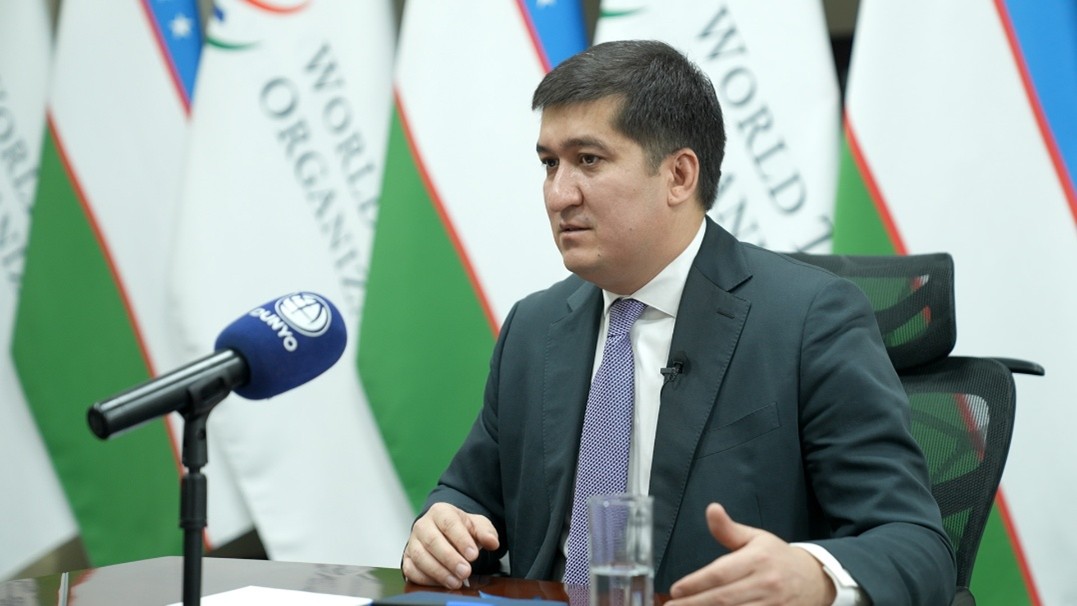
Azizbek Urunov: Uzbekistan reserves the right to protect certain sectors of the economy in accordance with WTO agreements
Today, during a meeting with journalists, Azizbek Urunov, Special Representative of the President of Uzbekistan on WTO issues, answered questions from a correspondent of Dunyo Information Agency:
-How does WTO membership align with the “Uzbekistan - 2030” strategy?
-It fully aligns with it. Uzbekistan’s accession process to the World Trade Organization effectively began in the early days of the large-scale reforms launched under the leadership of President Shavkat Mirziyoyev in 2017. In the initial years, the primary focus was placed on urgent and systemic economic reforms.
These included the liberalization of currency policy, a comprehensive revision of foreign trade policy and a significant reduction and simplification of import tariffs, which helped strengthen competition in the economy and the domestic market.
The active phase of WTO accession negotiations began in 2020. Prior to that, over a period of three to four years, the country deliberately prepared its economy and regulatory framework to meet WTO requirements. A frequently asked question is why the accession process has taken so long, given that Uzbekistan submitted its application back in 1994. Meaningful progress only began after 2020, as before that time the economy and its regulatory mechanisms objectively did not meet WTO standards.
Before 2016, foreign trade was subject to strict regulation. For example, there was a practice of approving a limited list of enterprises authorized to export, particularly in the agricultural sector. The main participants in foreign economic activity were state structures and foreign trade companies affiliated with sectoral ministries.
However, WTO principles are based on equal conditions for all market participants and non-discriminatory access to foreign trade activities. That is why, as part of the reforms, foreign trade policy was comprehensively revised and liberalized. Today, any enterprise has the right to engage in foreign economic activity.
This was not merely an issue of currency convertibility, but rather a set of comprehensive reforms of the entire foreign trade regulatory system, including the elimination of exclusive rights held by state enterprises and the creation of a competitive environment.
I believe it is no secret that the WTO accession process is under the personal oversight of the President of the country. Over the past two to three years, a qualitative breakthrough has been achieved and today Uzbekistan is at the final stage of the negotiation process.
– What long-term national interests does Uzbekistan aim to protect through its accession to the WTO?
As a developing country, Uzbekistan, in accordance with WTO agreements, retains the right to protect certain sectors of the economy in the event of specific difficulties. At the same time, it is important to remember that the fundamental goals of the WTO are to improve the welfare of the population, create jobs and ensure sustainable economic development for member countries.
From a strategic perspective, WTO membership serves two key objectives for Uzbekistan.
The first is exports. Without an active export policy and integration into global value chains, achieving long-term and sustainable economic growth is virtually impossible. Relying solely on the domestic market has inherent limitations. As the domestic market becomes saturated, growth potential diminishes and further development is only possible through expanding presence in foreign markets.
The second objective is investment, primarily quality investment. It is important not only to attract capital but also to ensure its technological, institutional and managerial value. WTO membership sends an international signal that the country’s economy operates under transparent, predictable and investor-friendly rules.
This creates additional conditions for the development of industry and the service sector. Today, about half of Uzbekistan’s GDP is generated by the services sector, indicating its enormous potential for further growth.
Furthermore, Uzbekistan’s geographic location offers significant opportunities. The country is surrounded by dynamically developing markets such as China, the European Union, the Middle East, and India. The active economic development of Saudi Arabia, the UAE, Qatar, Kuwait and other countries generates steady demand for agricultural and industrial products as well as services. This creates favorable conditions for integrating Uzbekistan into global value chains.
– Is it already possible today - at least approximately, in monetary terms - to estimate the total benefit to Uzbek businesses from the removal of tariff regulations within the framework of Uzbekistan’s accession to the World Trade Organization?
– Ten years ago, Uzbekistan’s GDP was around USD 50 billion. By the end of 2025, it had reached approximately USD 147 billion.
Whereas an increase of, say, 5 billion dollars used to represent about 10 percent of GDP, today it accounts for only around 3 percent. Therefore, it is more important to talk not about absolute figures, but about the additional momentum for economic growth.
According to World Bank estimates, WTO membership could provide an additional GDP growth of roughly 17 percent over the next 5–7 years. In the longer term, international studies indicate that developing countries that are WTO members typically achieve an extra 1–1.5 percent GDP growth per year compared with non-member states.
Even a 1 percent additional growth per year, accumulated over 5, 10, or 15 years, can significantly transform a country’s economy.
– What specific instruments and legal mechanisms of WTO rules will work to protect the interests of Uzbekistan and its businesses?
– First and foremost, this concerns the protection of export interests. Today, there are often situations where partners are willing to purchase our raw materials but react negatively to shipments of processed products with high added value. In such cases, discriminatory measures aimed at limiting our exports may be applied.
WTO membership will allow Uzbekistan to challenge such actions in Geneva through the dispute settlement mechanisms and on a bilateral basis, relying on the universal principles of the WTO. This provides protection against unilateral and unjustified trade restrictions.
On the domestic market, the key instruments will be so-called trade remedies - anti-dumping, countervailing and safeguard measures. Currently, draft laws regulating these mechanisms are being developed in Uzbekistan.
The WTO provides developing countries with a longer time frame for applying protective measures: up to eight years and under special conditions - up to ten years. These instruments allow temporary protection for industries under pressure from imports, provided there is evidence of serious economic harm.
Anti-dumping measures are particularly important. Dumping is usually used to push competitors out of the market, followed by the establishment of monopoly prices. WTO legislation allows countries to effectively counteract such practices.
Alongside legislative development, Uzbekistan is preparing national specialists with the support of international experts. Their task is to ensure the competent and professional application of these mechanisms in practice, in the interests of fair competition and the protection of national businesses.
Dunyo IA
Tashkent
📅 28.01.2026
Uzbekistan news
Uzbekistan and the Republic of Korea in the Emerging Framework for Cooperation with Central Asia
Tashkent brings together leaders and key deals in Polymer Market of Central Asia
The 1st Republic of Korea–Central Asia Summit: Why This Moment Matters
Uzbekistan – Serbia: A New Geography of Industrial Cooperation
The President of Uzbekistan’s Visit to Serbia: A New Stage in Economic Partnership Between Central Asia and the Balkans
Uzbekistan and the Republic of Korea: From Investment Partnership to Technological Cooperation
Regional Approaches to SDG Delivery: What Can Central Asia Offer?
Uzbekistan Opens a Balkan Gateway to Europe
The SCO Bishkek Summit: The Economic Agenda of a New Stage of Cooperation
Tourism: A new dimension of Uzbekistan-Kyrgyzstan partnership
Uzbekistan’s Role in the SCO: Economy, Security and Regional Cooperation
Economic Cooperation of Uzbekistan within the SCO at a New Stage of Development
Uzbekistan and Serbia: From Labour Mobility to a Strategic Partnership in Human Capital
Prospects for Uzbekistan–Serbia Cooperation in the ICT Sector
Prospects for Cooperation between the Republic of Uzbekistan and the Republic of Korea within the Framework of the Central Asia–Republic of Korea Cooperation Forum
THE SCO’S NEW FINANCIAL ARCHITECTURE: FROM COORDINATION TO PRACTICAL DEVELOPMENT MECHANISMS
INFORMATION NOTE ON COOPERATION WITH SERBIA
On September 8–10th, Tashkent to gather International Textile Industry Professionals
The Seoul Summit: Uzbekistan in the New Industrial Architecture of C5+1
New Opportunities to Expand Cooperation Between Uzbekistan and Serbia
Uzbekistan and Azerbaijan: Turning Political Alignment into Economic Growth
BRIGHT PROSPECTS FOR MUTUALLY BENEFICIAL PARTNERSHIP
Transport and Logistics Connectivity of the SCO Amid Geopolitical Turbulence: New Opportunities for the Regions
Business in Uzbekistan are moving from digitalization to technological modernization
Uzbekistan and Serbia expand prospects for cooperation in ecology and environmental protection
SCO AND WATER DIPLOMACY: IN PURSUIT OF COMMON INTERESTS
TASHKENT-DELHI: A NEW STAGE OF STRATEGIC PARTNERSHIP
On September 4–6th, Samarkand will host XII Inter-Parliamentary Union Global Conference of Young Parliamentarians
The Infrastructure Already Linking Uzbekistan and Korea What Korea Has Already Built Inside Uzbekistan's Digital Economy From Fiber Optics to AI: The Scope of Uzbek-Korean Digital Cooperation The Digital Bridge Already Built Between Uzbekistan and South Korea
On September 8–10th, Tashkent to gather International Textile Industry Professionals

-
 Ministry of Foreign Affairs of the Republic of Uzbekistan
 -
 Diplomatic Service of the Ministry of Foreign Affairs
 -
 State Committee for Tourism Development
 -
Ministry of Investments and Foreign Trade of the Republic of Uzbekistan
-
 invest.gov.uz
 -
-
-
-
-
-

-

of Uzbekistan in the Republic
of Latvia
When using the information, a link to www.uzembassy.lv
must be provided.
All rights reserved
Address
Address: Riga c., LV-1010. 11-11 Elizabetes Str., Latvia
Phone: 37167322424
Fax: 37167322306
Email: embassy@uzbekistan.lv
Useful links
HomeIssuance of biometric passport for departure abroad
Certificate to return to Uzbekistan
Withdrawal of citizenship
Loss of citizenship