Phone
Consular Issues
Phone
Uzbekistan news
Uzbekistan–Turkiye: From Trade to Expanded Economic Engagement
Economic cooperation between Uzbekistan and Turkiye is carried out within the framework of signed bilateral agreements and established intergovernmental mechanisms, and is supported by regular high-level contacts. In addition, Uzbekistan and Turkiye cooperate within the framework of the Organization of Turkic States.
In 2023, the President of the Republic of Turkiye paid an official visit to Uzbekistan, during which the Uzbekistan–Turkiye Business Forum was held. As a result of the visit, a substantial package of intergovernmental and commercial agreements was signed, covering key sectors of the economy with a total value of around $10 bn.
In June 2024, the President of the Republic of Uzbekistan paid an official visit to Turkiye. During the visit, a meeting of the High-Level Strategic Cooperation Council was held, resulting in the signing of an important package of agreements, protocols, and roadmaps aimed at further expanding trade, economic, and investment cooperation.
Mutual trade between Uzbekistan and Turkiye operates under a most-favoured-nation regime, and a Preferential Trade Agreement has also been signed.
Turkiye is among Uzbekistan’s leading trade and economic partners, ranking 4th in terms of total trade turnover and imports, and 5th in terms of Uzbekistan’s exports.
In 2025, Turkiye’s share in Uzbekistan’s foreign trade turnover amounted to 3.7%, including 3.4% of exports and 4.0% of imports.
Dynamics of Bilateral Trade
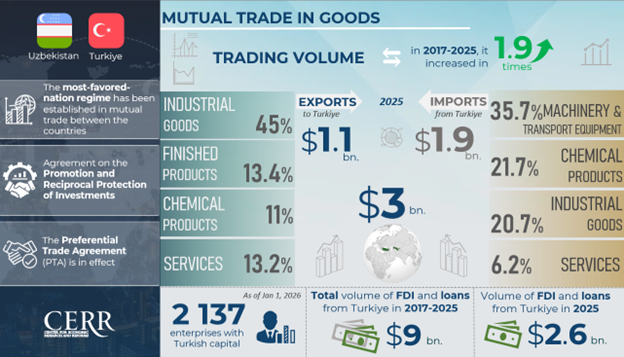
Over the period 2017–2025, bilateral trade between the two countries increased by 1.9 times and reached $3.0 bn by the end of 2025. Exports to Turkiye grew by 1.3 times to $1.1 bn, while imports from Turkiye increased by 2.8 times to $1.9 bn.
At the same time, annual growth rates of imports from Turkiye consistently exceeded export growth rates, resulting in a widening trade deficit to –$751.6 mn.
Uzbekistan’s exports to Turkiye in 2025 comprised the following categories: industrial goods (copper products, yarn, etc.) amounting to $511.4 mn (45%); miscellaneous manufactured articles (mainly precious metal products) at $152.3 mn (13.4%); chemical products (polymers, fertilizers, etc.) at $124.3 mn (11%); machinery and transport equipment at $80.1 mn (7%); food products (dried fruits and nuts) at $63.0 mn (5.5%); petroleum products (gasoline, gas oil) at $36.6 mn (3.2%); non-food raw materials at $18.0 mn (1.6%); as well as services, primarily transport services, at $149.9 mn (13.2%).
Imports from Turkiye in 2025 were dominated by the following categories: machinery and transport equipment at $674.6 mn (35.7%); chemical products at $408.9 mn (21.7%); industrial goods at $390.2 mn (20.7%); miscellaneous manufactured articles at $136.2 mn (7.2%); food products at $94.6 mn (5.0%); petroleum products (lubricating oils) at $30.2 mn (1.6%); non-food raw materials at $30.1 mn (1.6%); and services at $117.4 mn (6.2%).
Investment Cooperation
The two countries have signed an Agreement on the Promotion and Reciprocal Protection of Investments. As of 1 January 2026, 2,137 enterprises with Turkish capital operate in Uzbekistan, accounting for 11.8% of all active enterprises with foreign investment. Of these, 496 are joint ventures and 1,641 are wholly owned by Turkish investors.
Total direct investments and loans from Turkiye to Uzbekistan’s economy over 2017–2025 amounted to $9.0 bn, including $2.6 bn attracted in 2025 alone.
Turkish capital continues to expand its presence in Uzbekistan, primarily in priority sectors such as energy, manufacturing, agriculture, and construction.
In particular, investments in the power sector are linked to the construction by the Turkish company Cengiz Enerji of a 240 MW thermal power plant in Tashkent Region and a similar 220 MW plant in Syrdarya Region.
Prospective Areas of Economic Cooperation
An analysis of Turkiye’s import structure indicates opportunities to increase Uzbekistan’s exports to Turkiye, particularly in product categories that Uzbekistan already supplies to global markets. These include polymers (Turkiye’s imports amounting to $2.8 bn), copper wire ($1.4 bn), fertilizers ($1.1 bn), legumes ($1.0 bn), zinc ($857 mn), copper tubes ($360 mn), textile products, particularly T-shirts and undershirts ($373 mn), knitted fabrics ($158 mn) and other manufactured goods.
Promising areas for cooperative engagement between Uzbekistan and Turkiye include manufacturing industries – especially textiles, electrical engineering, and machinery – chemical industry, agriculture, healthcare, education, as well as projects aimed at preserving and promoting cultural heritage. There are also prospects for joint infrastructure projects, including the construction of water treatment facilities.
In agriculture, particular attention is paid to the selection and cultivation of domestic pistachio varieties and the development of pistachio farming. Agreements have been reached on implementing joint research projects focused on cultivation techniques and adaptation.
A significant emphasis is placed on expanding cooperation in education, including the involvement of Turkish lecturers and specialized professionals in educational initiatives in Uzbekistan, experience exchange, and human capital development.
At the same time, areas of cooperation in healthcare are being discussed, focusing on the development of primary healthcare, the introduction of medical insurance systems, sector digitalization, improvement of service quality, and modernization of the pharmaceutical industry.
Tourism has been identified as a separate and promising area of cooperation. Currently, 12 hotels in Uzbekistan operate with the participation of Turkish partners, along with more than 100 joint restaurants, reflecting sustained interest by Turkish businesses in the country’s tourism sector.
In 2025–2026, with the support of Turkish investors, 11 hotel projects with a total value of $167.9 mn are planned in Bukhara, Samarkand, Jizzakh, Fergana, and Tashkent regions.
Transport connectivity is also expanding significantly. The number of weekly flights between Uzbekistan and Turkiye has increased from 62 in 2023 to 106 at present, creating additional conditions for the growth of mutual tourist flows and the expansion of travel routes.
A key initiative in tourism is the “Million + Million” programme, aimed at attracting at least one million tourists to each country. The programme envisages a further increase in flight frequency and the expansion of tourist routes between Uzbekistan and Turkiye.
Conclusion
In recent years, there has been steady growth in bilateral trade, investment volumes, the number of enterprises with Turkish capital, and the breadth of economic cooperation.
At the same time, Uzbekistan’s exports to Turkiye are still dominated by raw materials and intermediate goods used in Turkiye’s industrial sectors. Against this background, the key task for the coming years is to move from a “raw materials–finished goods” trade model toward the formation of joint production chains with higher value added.
In this context, Turkiye can play a role for Uzbekistan not only as one of its principal trading partners, but also as a contributor to Uzbekistan’s industrial development and to the expansion of its participation in global value chains.
Edvard Romanov
Center for Economic Research and Reforms
📅 29.01.2026
Uzbekistan news
Uzbekistan and the Republic of Korea in the Emerging Framework for Cooperation with Central Asia
Tashkent brings together leaders and key deals in Polymer Market of Central Asia
The 1st Republic of Korea–Central Asia Summit: Why This Moment Matters
Uzbekistan – Serbia: A New Geography of Industrial Cooperation
The President of Uzbekistan’s Visit to Serbia: A New Stage in Economic Partnership Between Central Asia and the Balkans
Uzbekistan and the Republic of Korea: From Investment Partnership to Technological Cooperation
Regional Approaches to SDG Delivery: What Can Central Asia Offer?
Uzbekistan Opens a Balkan Gateway to Europe
The SCO Bishkek Summit: The Economic Agenda of a New Stage of Cooperation
Tourism: A new dimension of Uzbekistan-Kyrgyzstan partnership
Uzbekistan’s Role in the SCO: Economy, Security and Regional Cooperation
Economic Cooperation of Uzbekistan within the SCO at a New Stage of Development
Uzbekistan and Serbia: From Labour Mobility to a Strategic Partnership in Human Capital
Prospects for Uzbekistan–Serbia Cooperation in the ICT Sector
Prospects for Cooperation between the Republic of Uzbekistan and the Republic of Korea within the Framework of the Central Asia–Republic of Korea Cooperation Forum
THE SCO’S NEW FINANCIAL ARCHITECTURE: FROM COORDINATION TO PRACTICAL DEVELOPMENT MECHANISMS
INFORMATION NOTE ON COOPERATION WITH SERBIA
On September 8–10th, Tashkent to gather International Textile Industry Professionals
The Seoul Summit: Uzbekistan in the New Industrial Architecture of C5+1
New Opportunities to Expand Cooperation Between Uzbekistan and Serbia
Uzbekistan and Azerbaijan: Turning Political Alignment into Economic Growth
BRIGHT PROSPECTS FOR MUTUALLY BENEFICIAL PARTNERSHIP
Transport and Logistics Connectivity of the SCO Amid Geopolitical Turbulence: New Opportunities for the Regions
Business in Uzbekistan are moving from digitalization to technological modernization
Uzbekistan and Serbia expand prospects for cooperation in ecology and environmental protection
SCO AND WATER DIPLOMACY: IN PURSUIT OF COMMON INTERESTS
TASHKENT-DELHI: A NEW STAGE OF STRATEGIC PARTNERSHIP
On September 4–6th, Samarkand will host XII Inter-Parliamentary Union Global Conference of Young Parliamentarians
The Infrastructure Already Linking Uzbekistan and Korea What Korea Has Already Built Inside Uzbekistan's Digital Economy From Fiber Optics to AI: The Scope of Uzbek-Korean Digital Cooperation The Digital Bridge Already Built Between Uzbekistan and South Korea
On September 8–10th, Tashkent to gather International Textile Industry Professionals

-
 Ministry of Foreign Affairs of the Republic of Uzbekistan
 -
 Diplomatic Service of the Ministry of Foreign Affairs
 -
 State Committee for Tourism Development
 -
Ministry of Investments and Foreign Trade of the Republic of Uzbekistan
-
 invest.gov.uz
 -
-

-

-

-

-

-

of Uzbekistan in the Republic
of Latvia
When using the information, a link to www.uzembassy.lv
must be provided.
All rights reserved
Address
Address: Riga c., LV-1010. 11-11 Elizabetes Str., Latvia
Phone: 37167322424
Fax: 37167322306
Email: embassy@uzbekistan.lv
Useful links
HomeIssuance of biometric passport for departure abroad
Certificate to return to Uzbekistan
Withdrawal of citizenship
Loss of citizenship