Phone
Consular Issues
Phone
Uzbekistan news
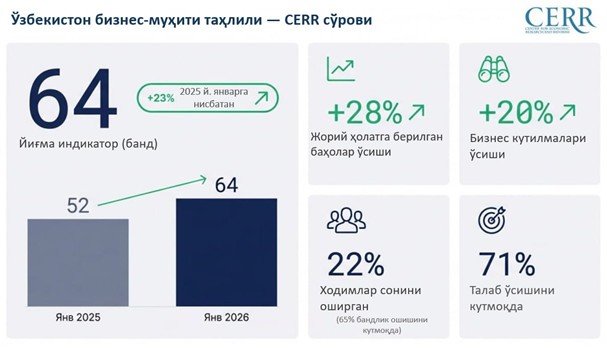
Business Climate Analysis of Uzbekistan – CERR Survey
In January, growth in the business climate was mainly driven by an outpacing increase in the expectations component. The agricultural sector and services became the key drivers of business confidence.
The Center for Economic Research and Reforms (CERR) presented the results of its business climate analysis based on monthly surveys of entrepreneurs across the republic. Based on the collected data, a composite Business Climate Indicator was formed, reflecting both current assessments of business conditions and expectations for the next 3 months.
Dynamics of Uzbekistan’s Composite Business Climate
In January of the current year, Uzbekistan’s composite Business Climate Index stood at 64 points (on a scale from −100 to +100), which is 23% higher than the level of 2025.
The improvement in the business climate was primarily driven by stronger assessments of the current business situation, which increased by 28%.
An additional contribution came from improved optimism regarding short-term business prospects. In particular, business expectations rose by 20%.
According to the survey, 22% of enterprises increased their number of employees. At the same time, 71% of respondents expect demand for their products to grow over the next three months, compared to about 60% in the same period last year.
The share of enterprises forecasting an increase in employment in the coming quarter rose to 65%, up from 58% a year earlier.
Sectoral Dynamics of the Business Climate Index
In sectoral terms, an improvement in the business climate compared to last year was observed in construction, agriculture, and services.
In agriculture, the Business Climate Index increased by 62% year-on-year and reached 77 points, compared to 48 points in January 2025.
Growth was mainly supported by a significant improvement in assessments of current conditions and more favorable expectations. The current situation indicator in the sector increased 2.7 times from 27 to 72 points, while expectations grew by 17% to reach 82 points.
44% of entrepreneurs assessed the condition of their business in the sector as “good,” compared to 39% a year earlier. Growth in demand for products over the past three months was reported by 46% of enterprises versus 39% in January last year. Expectations for further demand growth in the near term remain high at 71%, compared to 68% a year earlier.
In the services sector, the business climate increased by 25% compared to January last year, reaching 65 points versus 52 points a year earlier.
Growth was driven by a gradual improvement in current business conditions. Current assessments in services rose by 18% to 52 points. At the same time, a more pronounced increase was observed in the expectations component, which grew by 32% to 79 points, indicating a substantial strengthening of companies’ confidence in short-term prospects.
70% of entrepreneurs expect demand for their services to grow over the next three months, compared to 58% in January 2025. The share of enterprises expecting to increase employment in the coming quarter amounted to 61%, up from 54% a year earlier.
In the construction sector, the business climate increased by 13% to 61 points, compared to 54 points a year earlier. The current situation indicator improved by 43% to 57 points. Expectations were formed at the level of 66 points, showing a decline of 4%.
38% of respondents reported that business conditions in construction had improved over the past three months, compared to 35% a year earlier. The share of enterprises reporting workforce growth rose to 38% from 22% a year earlier. Expectations of demand growth over the next three months were expressed by 77% of entrepreneurs, compared to 61% in January last year.
In industry, the business climate slightly declined by 5% compared to last year, while remaining at a sufficiently high level of 54 points.
At the same time, optimism among industrial enterprises remains steadily high. In January, expectations increased by 10%, reaching 78 points, indicating a continued positive outlook regarding development prospects.
According to the survey, the share of respondents reporting an improvement in business conditions over the past three months reached 32%, compared to 30% a year earlier. Demand growth over the same period was noted by 38% of industrial enterprises versus 36% in January last year. Meanwhile, employment expansion plans strengthened — 69% of entrepreneurs expect to increase their workforce in the next three months, compared to 62% a year earlier.
Barriers to Entrepreneurial Activity
According to the survey, more than half (57%) of entrepreneurs see no barriers in their activities. Among the problems cited, the most frequent are taxation (11%), utilities (9%), and access to credit (8%).
CERR Sector for the Study of Sectoral Competitiveness and Investment Activity
Tel: (78) 150 02 02 (441)
CERR Public Relations and Media Sector
Tel: (78) 150 02 02 (417)
📅 27.02.2026
Uzbekistan news
CICA Member States Account for More Than 50% of Uzbekistan’s Foreign Trade Turnover
Uzbekistan and the United States: The Economics of Mutual Interest
NEW OPPORTUNITIES IN HIGHER EDUCATION IN THE TURKIC STATES: A COMMON SPACE, SHARED GOALS
Peace and Trust in Asia - essential conditions for sustainable development
CICA amid a Crisis of Trust: Uzbekistan’s Role in Strengthening Cooperation in Asia
Uzbekistan promotes initiatives in Central Asia that unlock new opportunities for cooperation
Strengthening Transport Connectivity in Asia through the Development of the Trans-Caspian International Transport Corridor
Uzbekistan promotes Initiatives in Central Asia unlocking new opportunities for cooperation
Political mutual trust in the Central Asian region is transforming into economic capital
Uzbekistan attracts specialists from 16 countries to the anniversary international exhibition “Mining, Metallurgy and Metalworking – MiningMetals Uzbekistan 2026”
Uzbekistan has moved its economic cooperation with the Turkic states into a practical dimension
Akramjon Nematov: Central Asia is increasingly emerging as an independent centre for shaping its own economic and technological agenda
Central Asia Is Shaping Its Own Model of Regional Cooperation
Initiatives of Uzbekistan aimed at Economic Results for the Countries of Central Asia and Azerbaijan
Regular dialogue is the Foundation for addressing common water-related challenges in Central Asia
Uzbekistan and Turkmenistan: A New Stage in the Development of Their Strategic Partnership
11th Tashkent International Biennale of Contemporary Art to be held in the capital of Uzbekistan on October 12–16th
OTS Member States - A Crucial Link in the Eurasian Space
Uzbekistan plays an active role in Economic Integration within the framework of the Organization of Turkic States
CICA opens new horizons for financial cooperation
Aquatherm Tashkent 2026 to Showcase Latest Technologies for Construction and Utility Infrastructure
Uzbekistan is securing its place in the Global Hub for Technological Outsourcing
Digital Cooperation among the Turkic States Towards a Unified Technological Ecosystem
Uzbekistan and Azerbaijan are creating a Hub for Startups, Investors and Talent
UZBEKISTAN AND THE UN: FROM NATIONAL INITIATIVES TO THE GLOBAL AGENDA
The 5th Samarkand Forum on Human Rights to take place on September 28–29th
Uzbekistan's key trading partners participate in CICA
Speech by President Shavkat Mirziyoyev at the solemn ceremony dedicated to the thirty-fifth anniversary of the independence of the Republic of Uzbekistan
Uzbekistan Firmly Establishes Itself as a Stable and Predictable Partner for Long-Term International Business
Changing economic priorities of Uzbekistan reshape its engagement with the CIS

-
 Ministry of Foreign Affairs of the Republic of Uzbekistan
 -
 Diplomatic Service of the Ministry of Foreign Affairs
 -
 State Committee for Tourism Development
 -
Ministry of Investments and Foreign Trade of the Republic of Uzbekistan
-
 invest.gov.uz
 -

-

-

-
-

-

-

of Uzbekistan in the Republic
of Latvia
When using the information, a link to www.uzembassy.lv
must be provided.
All rights reserved
Address
Address: Riga c., LV-1010. 11-11 Elizabetes Str., Latvia
Phone: 37167322424
Fax: 37167322306
Email: embassy@uzbekistan.lv
Useful links
HomeIssuance of biometric passport for departure abroad
Certificate to return to Uzbekistan
Withdrawal of citizenship
Loss of citizenship