Phone
Consular Issues
Phone
Uzbekistan news
Business Climate Improved Across All Key Sectors of the Economy – CERR Survey
According to the survey results, entrepreneurs are increasingly reporting higher demand, employment growth, and an overall improvement in business conditions.
The Center for Economic Research and Reforms (CERR) presented the results of its business climate analysis based on monthly surveys of entrepreneurs across the country.
Based on the collected data, a composite Business Climate Index has been developed, reflecting both current business conditions and expectations for the next three months.
Business Climate Dynamics in Uzbekistan
As of February 2026, the composite Business Climate Index reached 65 points (on a scale from −100 to +100), which is 11 points higher than in the same period last year.
The improvement in the business climate was primarily driven by rising business expectations, which increased by 13 points to 81. Additional support came from improved assessments of current business conditions, which rose by 10 points to 51.
The survey indicates positive trends across key business activity indicators. The share of entrepreneurs assessing the current business situation as “good” increased to 44%, compared to 38% in February of the previous year.
The proportion of enterprises that increased their workforce rose to 19%, up from 12% a year earlier. Meanwhile, 34% of respondents reported an improvement in business conditions over the past three months, compared to 28% last year.
In addition, 39% of respondents reported increased demand for their products, up from 22% in the same period last year.
Sectoral Dynamics of the Business Climate Index
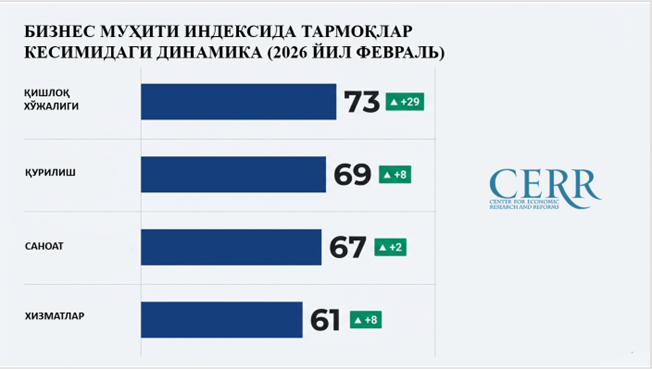
In a sectoral breakdown, improvements in the business climate were observed across all major sectors of the economy compared to the previous year.
The most significant improvement was recorded in agriculture, where the index increased by 29 points to reach 73. This growth was driven by both improved current conditions and a substantial rise in expectations.
The share of entrepreneurs assessing conditions as “good” rose to 56%, compared to 41% a year earlier. Meanwhile, 52% reported increased demand (35% previously), and 49% noted an improvement in the business environment over the past three months (32% previously).
In the services sector, the business climate index increased by 8 points to 61. While assessments of current conditions remained relatively stable, expectations improved.
Entrepreneurs maintain strong expectations regarding demand in the coming three months, with 72% reporting anticipated growth, close to last year’s level (71%). At the same time, employment has been gradually increasing, with the share of firms expanding their workforce rising to 16%, compared to 12% previously.
In the construction sector, the business climate index rose by 8 points to 69. Improvements were observed in both current assessments and expectations. Entrepreneurs are increasingly reporting higher employment and demand, reflecting stable sectoral dynamics.
The share of respondents reporting improved business conditions over the past three months increased to 34%, compared to 26% a year earlier. Meanwhile, 27% reported workforce expansion (15% previously), and 80% expect demand to increase in the next three months, up from 77% last year.
In industry, business climate growth was more moderate, increasing by 2 points to 67. At the same time, business expectations remain high, with continued growth in demand and gradual employment expansion.
Over the past three months, 32% of entrepreneurs reported increased demand, compared to 29% a year earlier. Workforce expansion was noted by 22% (13% previously), while 77% expect further demand growth in the next three months, also exceeding last year’s level.
Barriers to Business Activity
According to the survey, 61% of entrepreneurs reported no constraints in their operations, up from 57% in the previous month, indicating an overall improvement in the business environment.
Compared to the previous month, the share of respondents reporting difficulties related to access to credit, electricity supply, transport, and logistics has declined. At the same time, there has been a moderate increase in concerns related to access to land resources, utility costs, and tax rates.
CERR Sector for Competitiveness and Investment Activity Analysis
Tel: (78) 150 02 02 (441)
CERR Public Relations and Media Sector
Tel: (78) 150 02 02 (417)
📅 19.03.2026
Uzbekistan news
Inaugural Central Asia – Republic of Korea Summit at the highest level opens in Seoul
Uzbekistan and Korea: Advancing Green Energy and New Technologies
Uzbekistan and the Republic of Korea in the Emerging Framework for Cooperation with Central Asia
Tashkent brings together leaders and key deals in Polymer Market of Central Asia
The 1st Republic of Korea–Central Asia Summit: Why This Moment Matters
Uzbekistan – Serbia: A New Geography of Industrial Cooperation
The President of Uzbekistan’s Visit to Serbia: A New Stage in Economic Partnership Between Central Asia and the Balkans
Uzbekistan and the Republic of Korea: From Investment Partnership to Technological Cooperation
Regional Approaches to SDG Delivery: What Can Central Asia Offer?
Uzbekistan Opens a Balkan Gateway to Europe
The SCO Bishkek Summit: The Economic Agenda of a New Stage of Cooperation
Tourism: A new dimension of Uzbekistan-Kyrgyzstan partnership
Uzbekistan’s Role in the SCO: Economy, Security and Regional Cooperation
Economic Cooperation of Uzbekistan within the SCO at a New Stage of Development
Uzbekistan and Serbia: From Labour Mobility to a Strategic Partnership in Human Capital
Prospects for Uzbekistan–Serbia Cooperation in the ICT Sector
Prospects for Cooperation between the Republic of Uzbekistan and the Republic of Korea within the Framework of the Central Asia–Republic of Korea Cooperation Forum
THE SCO’S NEW FINANCIAL ARCHITECTURE: FROM COORDINATION TO PRACTICAL DEVELOPMENT MECHANISMS
INFORMATION NOTE ON COOPERATION WITH SERBIA
On September 8–10th, Tashkent to gather International Textile Industry Professionals
The Seoul Summit: Uzbekistan in the New Industrial Architecture of C5+1
New Opportunities to Expand Cooperation Between Uzbekistan and Serbia
Uzbekistan and Azerbaijan: Turning Political Alignment into Economic Growth
BRIGHT PROSPECTS FOR MUTUALLY BENEFICIAL PARTNERSHIP
Transport and Logistics Connectivity of the SCO Amid Geopolitical Turbulence: New Opportunities for the Regions
Business in Uzbekistan are moving from digitalization to technological modernization
Uzbekistan and Serbia expand prospects for cooperation in ecology and environmental protection
SCO AND WATER DIPLOMACY: IN PURSUIT OF COMMON INTERESTS
TASHKENT-DELHI: A NEW STAGE OF STRATEGIC PARTNERSHIP
On September 4–6th, Samarkand will host XII Inter-Parliamentary Union Global Conference of Young Parliamentarians

-
 Ministry of Foreign Affairs of the Republic of Uzbekistan
 -
 Diplomatic Service of the Ministry of Foreign Affairs
 -
 State Committee for Tourism Development
 -
Ministry of Investments and Foreign Trade of the Republic of Uzbekistan
-
 invest.gov.uz
 -
-
-

-
-

-

-

of Uzbekistan in the Republic
of Latvia
When using the information, a link to www.uzembassy.lv
must be provided.
All rights reserved
Address
Address: Riga c., LV-1010. 11-11 Elizabetes Str., Latvia
Phone: 37167322424
Fax: 37167322306
Email: embassy@uzbekistan.lv
Useful links
HomeIssuance of biometric passport for departure abroad
Certificate to return to Uzbekistan
Withdrawal of citizenship
Loss of citizenship