Phone
Consular Issues
Phone
Uzbekistan news
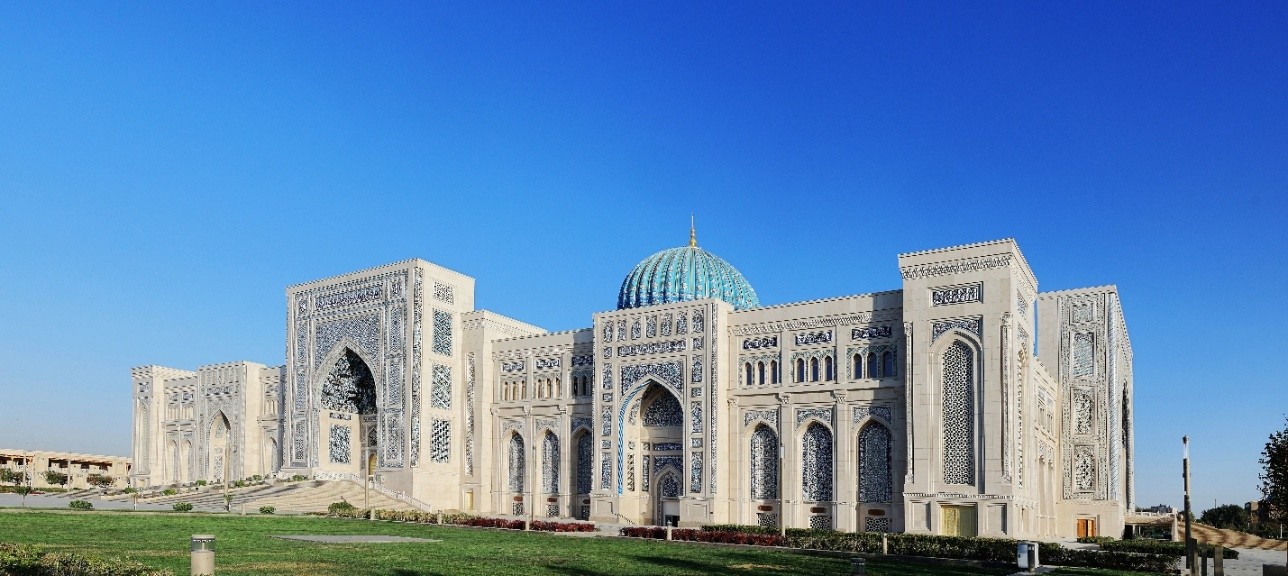
The Legacy of Amir Temur at the Center of Islamic Civilization: The Intellectual Foundation of the Third Renaissance
April 9 - the 690th anniversary of the birth of Amir Temur
Center of Islamic Civilization in Uzbekistan
Human history shows that great civilizations are built upon a combination of intellectual achievements, spiritual values, and cultural heritage. Central Asia has long been a center of science, art, and philosophy, forming civilizational foundations that have influenced the entire world.
Today, this potential is embodied in a large-scale project — the Center of Islamic Civilization in Uzbekistan, which not only preserves historical artifacts but also serves as a living platform for science, education, and spiritual development.
Created based on the authorial idea of the President of the Republic of Uzbekistan, Shavkat Mirziyoyev, the Center of Islamic Civilization clearly demonstrates that spiritual and educational values can serve as a foundation for national revival and international cooperation, attracting researchers, tourists, and the wider public from all over the world.
Amir Temur occupies a special place in world history as an outstanding statesman, military leader, and founder of one of the largest empires of his time. The late 14th and early 15th centuries were a period of profound political transformations, and in this context Amir Temur succeeded in uniting vast territories from India to the Middle East, creating a powerful state with a stable system of governance.
A special role in his policy was played by diplomacy. Amir Temur established contacts with European countries, including France, England, and Castile. The Spanish envoy Ruy González de Clavijo, who visited Samarkand in 1404, noted the high level of state organization, developed infrastructure, and respect shown to foreign ambassadors.
The arrival of the Castilian ambassador Ruy González de Clavijo to the court of Amir Temur in Samarkand in 1404
Amir Temur also created a unique legal foundation for his empire. According to the “Code of Temur,” the state relied on four pillars: council, deliberation, a well-considered plan, and determination. Nine-tenths of affairs were resolved through consultation and wise measures, and only one-tenth by the sword. This principle reflects the priority of diplomacy and legal solutions over military force, emphasizing the balance of justice and determination in governance.
After the death of Amir Temur, his successors — the Timurids — continued the development of the state, paying particular attention to science, culture, and education. This period became known as the Second Eastern Renaissance, as it witnessed a flourishing of intellectual and artistic life that accelerated the development of the European Renaissance.
A special place among the Timurids is occupied by Mirzo Ulughbek. Mirzo Ulughbek (1394–1449) was an outstanding scholar, astronomer, mathematician, and statesman of the Timurid era, as well as the grandson of Amir Temur. He spent most of his life in Samarkand, which under his rule became a major scientific center of the East.
One of Ulughbek’s greatest achievements was the construction of the Ulughbeg Observatory in the 1420s. This observatory was considered one of the most advanced in the world at that time. Here, together with scholars, he compiled the famous astronomical catalog “Zij-i Sultani,” in which the coordinates of more than 1,000 stars were determined with remarkable accuracy.
“The Baysunghur Quran”, copied by the calligrapher Umar Aqta for Amir Temur
Today, the legacy of the Timurids can be seen at the Center of Islamic Civilization in Uzbekistan, where unique exhibits demonstrating the cultural and spiritual richness of the era are preserved. Among them is a fragment of the Quran copied by the calligrapher Umar Aqta for Amir Temur, known as the “Baysunghur Quran.” This manuscript represents a triumph of calligraphy over ornamentation: harmonious, powerful letterforms and the precise flow of ink create a grand visual effect. The Center preserves a single line of this Quran, allowing visitors to experience the greatness of Timurid art and understand how the culture of writing shaped the spiritual image of the state.
A special place is also occupied by the Baburid talismanic robe — a protective garment created in court workshops to safeguard and bless its wearer. Dense cotton fabric is entirely covered with Quranic texts, as well as the shahada and the 99 names of Allah. On the back, there is a verse from Surah Yusuf (12:64): “Indeed, Allah is the best guardian, and He is the most merciful of the merciful.”
Baburid talismanic robe
The Center of Islamic Civilization in Uzbekistan is not only a museum but also a living educational platform. The architectural concept of the complex harmoniously combines Timurid traditions with modern technologies, symbolizing the unity of past and present. Its 65-meter dome and majestic portals embody the connection of all regions of Uzbekistan, creating a sense of monumentality and historical continuity.
The Center’s exposition is built on the principle of “Civilizations — Personalities — Discoveries” and covers key historical stages: the pre-Islamic period, the First and Second Renaissances, as well as the modern stage of New Uzbekistan. Visitors can not only observe unique artifacts but also interact with them through VR and AR technologies, holograms, and artificial intelligence, making history vivid and tangible.
The Center integrates diverse educational and cultural functions: interactive laboratories, the children’s museum “1001 Inventions”, a library with a collection of more than 2,500 manuscripts and lithographs, around 40,000 printed publications, and over 350,000 digital resources, a school of calligraphy and traditional arts by the King’s Foundation, as well as representative offices of ICESCO, IRCICA, and OCIS. All of this creates a space where tradition and innovation coexist and complement each other, stimulating the development of science and culture.
Thanks to this approach, the Center becomes not just a repository of knowledge but a living bridge between historical renaissances and the Third Renaissance, ensuring continuity of traditions and inspiring new generations toward scientific, cultural, and spiritual achievements.
On April 9, at the initiative of the President of the Republic of Uzbekistan, the 690th anniversary of the birth of the great statesman, military leader, and patron of science and culture, Amir Temur, is being widely celebrated. This anniversary is regarded not only as a tribute to historical memory, but also as an important factor in strengthening national identity, advancing scientific potential, and promoting the country’s cultural diplomacy.
As part of the anniversary events, the Center of Islamic Civilization serves as a key platform for international dialogue. In this regard, on April 9–10 of this year, a large-scale international scientific conference will be held there, bringing together more than 300 leading scholars, researchers, and experts from Europe, Asia, the Middle East, and North America. The conference is aimed at a comprehensive study of the role and significance of Amir Temur and the Timurid civilization in world history and culture, as well as at establishing a sustainable platform for further international scientific and cultural cooperation.
The Center of Islamic Civilization stands today as an intellectual and cultural locomotive of the region, contributing to the unification of humanity on the path toward peace, harmony, and progress, guided by the great principle: “Read in the name of your Lord…”
Dunyo IA
📅 10.04.2026
Uzbekistan news
Political mutual trust in the Central Asian region is transforming into economic capital
Uzbekistan attracts specialists from 16 countries to the anniversary international exhibition “Mining, Metallurgy and Metalworking – MiningMetals Uzbekistan 2026”
Uzbekistan has moved its economic cooperation with the Turkic states into a practical dimension
Akramjon Nematov: Central Asia is increasingly emerging as an independent centre for shaping its own economic and technological agenda
Central Asia Is Shaping Its Own Model of Regional Cooperation
Initiatives of Uzbekistan aimed at Economic Results for the Countries of Central Asia and Azerbaijan
Regular dialogue is the Foundation for addressing common water-related challenges in Central Asia
Uzbekistan and Turkmenistan: A New Stage in the Development of Their Strategic Partnership
11th Tashkent International Biennale of Contemporary Art to be held in the capital of Uzbekistan on October 12–16th
OTS Member States - A Crucial Link in the Eurasian Space
Uzbekistan plays an active role in Economic Integration within the framework of the Organization of Turkic States
CICA opens new horizons for financial cooperation
Aquatherm Tashkent 2026 to Showcase Latest Technologies for Construction and Utility Infrastructure
Uzbekistan is securing its place in the Global Hub for Technological Outsourcing
Digital Cooperation among the Turkic States Towards a Unified Technological Ecosystem
Uzbekistan and Azerbaijan are creating a Hub for Startups, Investors and Talent
UZBEKISTAN AND THE UN: FROM NATIONAL INITIATIVES TO THE GLOBAL AGENDA
The 5th Samarkand Forum on Human Rights to take place on September 28–29th
Uzbekistan's key trading partners participate in CICA
Speech by President Shavkat Mirziyoyev at the solemn ceremony dedicated to the thirty-fifth anniversary of the independence of the Republic of Uzbekistan
Uzbekistan Firmly Establishes Itself as a Stable and Predictable Partner for Long-Term International Business
Changing economic priorities of Uzbekistan reshape its engagement with the CIS
Inaugural Central Asia – Republic of Korea Summit at the highest level opens in Seoul
Uzbekistan and Korea: Advancing Green Energy and New Technologies
Uzbekistan and the Republic of Korea in the Emerging Framework for Cooperation with Central Asia
Tashkent brings together leaders and key deals in Polymer Market of Central Asia
The 1st Republic of Korea–Central Asia Summit: Why This Moment Matters
Uzbekistan – Serbia: A New Geography of Industrial Cooperation
The President of Uzbekistan’s Visit to Serbia: A New Stage in Economic Partnership Between Central Asia and the Balkans
Uzbekistan and the Republic of Korea: From Investment Partnership to Technological Cooperation

-
 Ministry of Foreign Affairs of the Republic of Uzbekistan
 -
 Diplomatic Service of the Ministry of Foreign Affairs
 -
 State Committee for Tourism Development
 -
Ministry of Investments and Foreign Trade of the Republic of Uzbekistan
-
 invest.gov.uz
 -

-

-

-

-

-

-


of Uzbekistan in the Republic
of Latvia
When using the information, a link to www.uzembassy.lv
must be provided.
All rights reserved
Address
Address: Riga c., LV-1010. 11-11 Elizabetes Str., Latvia
Phone: 37167322424
Fax: 37167322306
Email: embassy@uzbekistan.lv
Useful links
HomeIssuance of biometric passport for departure abroad
Certificate to return to Uzbekistan
Withdrawal of citizenship
Loss of citizenship