Phone
Consular Issues
Phone
Uzbekistan news
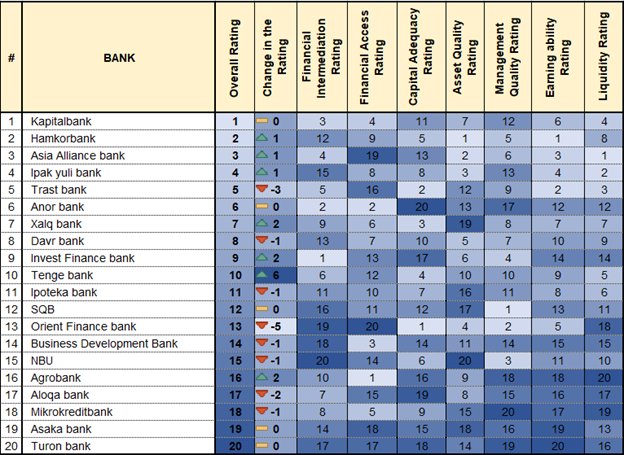
CERR Updates Bank Ranking for Q1 2026
Following the results of Q1 2026, the ranking of large banks underwent notable changes. While the leading group remained intact, positions within the segment were reshuffled. In the small-bank category, movements were also significant, pointing to continued realignment and stronger competition across the sector.
The Center for Economic Research and Reforms presented the updated Bank Ranking based on the results of the Banking Activity Index for Q1 2026.
The study covers 34 commercial banks of the republic, including 20 classified as large financial institutions by scale and branch network, while the remaining 14 were categorized as small banks.
The methodology is based on the analysis of 27 indicators benchmarked against national averages and international standards, including the requirements of the Basel Committee. The ranking serves as an important tool for enhancing transparency and strengthening confidence in the financial system. This approach is consistent with international practice and is widely used by leading financial institutions.
Financial Results for Q1 2026
During the reporting period, total assets of the banking sector amounted to 932.3 tn sums ($76.3 bn), while liabilities reached 793.9 tn sums ($64.9 bn). Lending increased by 14%, while deposits grew by 32%. The aggregate capital of the banking system was fully denominated in the national currency. Net profit reached 3.1 tn sums ($254 mn), which is 36.3% higher than a year earlier.
During the period under review, the share of non-performing loans declined to 3.3%, compared with 4.5% a year earlier, indicating improved portfolio quality. At the same time, in several banks the ratio remains above the sector average. Capital adequacy indicators exceed minimum regulatory requirements by more than 1.4 times, confirming the resilience of the banking sector.
Large Banks Activity Ranking for Q1 2026
The results of Q1 2026 show that despite the relative stability at the top of the ranking, both categories of banks recorded notable positional changes.
In the large-bank segment, performance was mixed. Out of 20 banks, 7 improved their positions, 8 declined, and 5 retained their previous places. This reflects a high level of competition and the ongoing redistribution of market positions.
The most notable progress was demonstrated by Tenge Bank, which moved up by 6 positions. Three more banks — Agrobank, Invest Finance Bank, and Xalq Bank — advanced by 2 positions each. Positive momentum was also recorded by Ipak Yuli Bank, Asia Alliance Bank, and Hamkorbank, all of which improved their standing in the overall ranking.
At the same time, several large banks recorded lower activity levels. The most significant decline was observed at Orient Finans Bank and Trast Bank, which fell by 5 and 3 positions respectively.
Changes Across Key Indicators
Financial Intermediation. The leading positions were taken by Invest Finance Bank, Anor Bank and Kapitalbank. In this ranking, Davr Bank and Hamkorbank fell by 4 positions, while Ipoteka Bank declined by 1 position.
Financial Accessibility. The leaders were Agrobank, Anor Bank and BRB. Under this indicator, declines were mainly observed among leading banks: Kapitalbank (-3 positions), Hamkorbank (-7), Asia Alliance Bank (-1), Ipak Yuli Bank (-5), and Trast Bank (-6). The strongest improvement in this ranking was recorded by Tenge Bank (+8), Xalq Bank, Davr Bank (+5), and Agrobank (+4).
Capital Adequacy. The top positions were occupied by Orient Finance Bank, Trast Bank and Halk Bank. At the same time, Agrobank dropped by 4 positions, while Aloqa Bank declined by 2 positions.
Asset Quality. The leaders were Hamkorbank, Asia Alliance Bank and Ipak Yuli Bank. Turonbank fell by 5 positions, while Asakabank, Mikrokreditbank, SQB, Trast Bank and Anor Bank each declined by 2 positions.
Management Efficiency. The highest positions were held by SQB, Orient Finance Bank and NBU. At the same time, Asaka Bank dropped by 5 positions, while BRB declined by 4 positions.
Profitability. The leaders were Hamkorbank, Trast Bank and Asia Alliance Bank. Turon Bank, after falling by 3 positions, ranked last. In this ranking, Kapitalbank, Asia Alliance Bank, Anor Bank and Davr Bank declined by 2 positions, while Ipoteka Bank and Mikrokreditbank fell by 1 position.
Liquidity. The leaders were Asia Alliance Bank, Ipak Yuli Bank and Trast Bank. At the same time, Mikrokreditbank, Ipoteka Bank, Anor Bank and SQB each declined by 1 position.
Small Banks Activity Ranking for Q1 2026
The small-bank group remained relatively stable, with leading institutions retaining their positions. The main changes in this category were concentrated in the middle segment, where several banks improved their standing due to stronger financial intermediation and higher profitability.
Within this group, 8 out of 14 financial institutions improved their rankings. The most notable gains were recorded by AVO Bank and Apex Bank, both rising by 3 positions. TBC became the leader of the ranking.
At the same time, 5 banks moved down, with the sharpest decline recorded by Octobank, which lost 6 positions. Saderat Bank, Garant Bank, and Ziraat Bank each rose by 2 positions. The ranking was rounded out by Open Bank and Uzum Bank, both up by 1 position.
Jafar Khidirov, CERR
CERR Banking and Financial Sector Research Sector
Tel: (78) 150 02 02 (441)
CERR Public Relations and Media Sector
Tel: (78) 150 02 02 (417)
📅 17.04.2026
Uzbekistan news
CICA Member States Account for More Than 50% of Uzbekistan’s Foreign Trade Turnover
Uzbekistan and the United States: The Economics of Mutual Interest
NEW OPPORTUNITIES IN HIGHER EDUCATION IN THE TURKIC STATES: A COMMON SPACE, SHARED GOALS
Peace and Trust in Asia - essential conditions for sustainable development
CICA amid a Crisis of Trust: Uzbekistan’s Role in Strengthening Cooperation in Asia
Uzbekistan promotes initiatives in Central Asia that unlock new opportunities for cooperation
Strengthening Transport Connectivity in Asia through the Development of the Trans-Caspian International Transport Corridor
Uzbekistan promotes Initiatives in Central Asia unlocking new opportunities for cooperation
Political mutual trust in the Central Asian region is transforming into economic capital
Uzbekistan attracts specialists from 16 countries to the anniversary international exhibition “Mining, Metallurgy and Metalworking – MiningMetals Uzbekistan 2026”
Uzbekistan has moved its economic cooperation with the Turkic states into a practical dimension
Akramjon Nematov: Central Asia is increasingly emerging as an independent centre for shaping its own economic and technological agenda
Central Asia Is Shaping Its Own Model of Regional Cooperation
Initiatives of Uzbekistan aimed at Economic Results for the Countries of Central Asia and Azerbaijan
Regular dialogue is the Foundation for addressing common water-related challenges in Central Asia
Uzbekistan and Turkmenistan: A New Stage in the Development of Their Strategic Partnership
11th Tashkent International Biennale of Contemporary Art to be held in the capital of Uzbekistan on October 12–16th
OTS Member States - A Crucial Link in the Eurasian Space
Uzbekistan plays an active role in Economic Integration within the framework of the Organization of Turkic States
CICA opens new horizons for financial cooperation
Aquatherm Tashkent 2026 to Showcase Latest Technologies for Construction and Utility Infrastructure
Uzbekistan is securing its place in the Global Hub for Technological Outsourcing
Digital Cooperation among the Turkic States Towards a Unified Technological Ecosystem
Uzbekistan and Azerbaijan are creating a Hub for Startups, Investors and Talent
UZBEKISTAN AND THE UN: FROM NATIONAL INITIATIVES TO THE GLOBAL AGENDA
The 5th Samarkand Forum on Human Rights to take place on September 28–29th
Uzbekistan's key trading partners participate in CICA
Speech by President Shavkat Mirziyoyev at the solemn ceremony dedicated to the thirty-fifth anniversary of the independence of the Republic of Uzbekistan
Uzbekistan Firmly Establishes Itself as a Stable and Predictable Partner for Long-Term International Business
Changing economic priorities of Uzbekistan reshape its engagement with the CIS

-
 Ministry of Foreign Affairs of the Republic of Uzbekistan
 -
 Diplomatic Service of the Ministry of Foreign Affairs
 -
 State Committee for Tourism Development
 -
Ministry of Investments and Foreign Trade of the Republic of Uzbekistan
-
 invest.gov.uz
 -
-

-

-
-
-

-


of Uzbekistan in the Republic
of Latvia
When using the information, a link to www.uzembassy.lv
must be provided.
All rights reserved
Address
Address: Riga c., LV-1010. 11-11 Elizabetes Str., Latvia
Phone: 37167322424
Fax: 37167322306
Email: embassy@uzbekistan.lv
Useful links
HomeIssuance of biometric passport for departure abroad
Certificate to return to Uzbekistan
Withdrawal of citizenship
Loss of citizenship