Phone
Consular Issues
Phone
Uzbekistan news
A new ecosystem has emerged on the dried seabed of the Aral Sea
At the beginning of the 20th century, the Aral Sea was the largest lake in Central Asia. Starting from the second half of this century, as a result of the drying up of the sea, a new desert ecosystem-the Aralkum Desert-was formed at its bottom. This area is currently considered one of the largest anthropogenic desert ecosystems in Central Asia. As a result of the decrease in sea level, more than 60,000 km2 of wetlands have turned into land.
The ecological changes occurring in this region have had a significant impact not only on the climate and soil composition but also on biological diversity. As a result, the distribution area of species adapted to wetland ecosystems has sharply decreased. At the same time, the Aralkum Desert, which emerged between the Ustyurt Plateau and the Kyzylkum Desert, led to the formation of a new bird community as a unique and unique desert ecosystem. Therefore, the scientific study of the state of the desert ecosystem formed on the dried seabed and its ornithological fauna, the distribution of species across the biotopes of these ecosystems, and adaptation mechanisms is of urgent importance.
In accordance with this, the Institute of Zoology of the Academy of Sciences of the Republic of Uzbekistan Scientific research is being conducted within the framework of the applied project AL-9424104883-R1 on the topic “Current state of the Aralkum avifauna, species adaptation to environmental changes, and conservation measures”. This project was deemed suitable based on the competition requirements announced by the Agency for Innovative Development under the Ministry of Higher Education, Science and Innovation within the framework of the 94th round and has been funded by the Fund for Financing Science and Supporting Innovation since the second half of 2025. The goal of the project is to identify important areas and biotopes for the ornithological fauna of the Aralkum Desert, to study species diversity, adaptation to environmental changes, biological characteristics, and distribution.
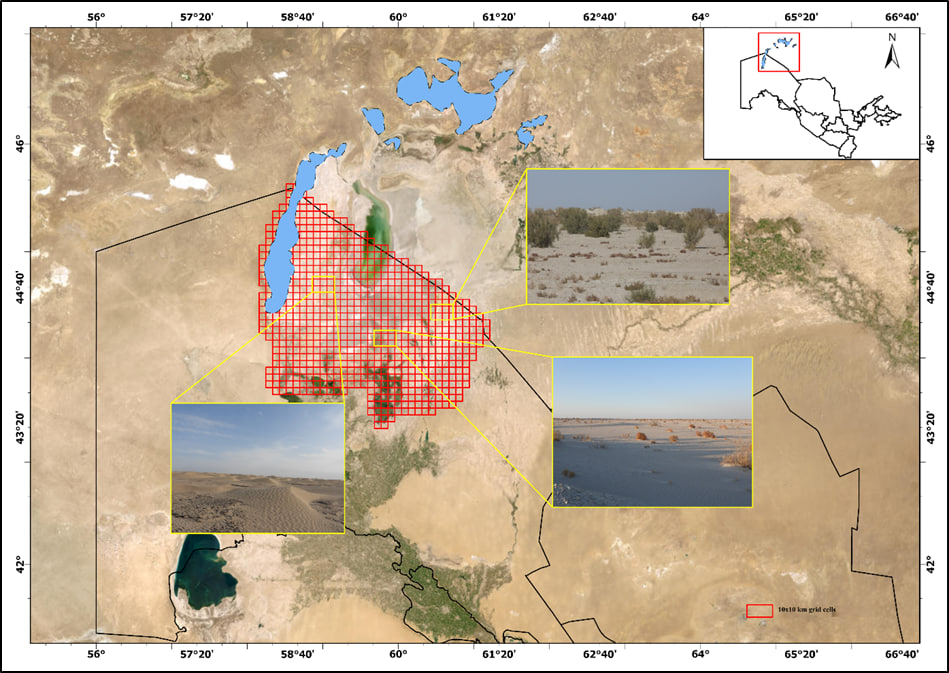
In accordance with the calendar plan of this applied project, a field expedition to the Aralkum Desert in the territory of Muynak district of the Republic of Karakalpakstan was carried out in October–November 2025. Ornithological studies were conducted in areas divided into 10 × 10 km grid cells using the ArcGIS software. A total of 68 grid cells were surveyed using transect and point count methods. Out of these, pedestrian transect observations were conducted in 56 grid cells, with a total length of 140 km. In the remaining 12 grid cells, point count observations were carried out. The grid-based approach to studying the area is important for identifying patterns in the distribution of birds across biotopes and for revealing their association with specific landscape elements.
As a result of scientific research conducted to date, it has been established that the Desert ecosystem formed on the dried seabed incorporates the following biotopes:
Saline deserts are characterized by high salt concentrations; specific species of halophytic plants predominate here.
Sandy deserts consist of wind-driven barchans, semi-fortified, and fortified sands, in which ephemerals, perennial herbs, semi-shrubs, and shrubs are found.
Stony and gravelly deserts cover ancient islands in the central part of the Aralkum Desert and adjacent territories.
Clay deserts are open plains in the western and southwestern parts of the Aralkum Desert.
Hills and chinkes include ancient coastal walls and adjacent hills in the western and northern parts of the Aralkum Desert.
Furthermore, in the northwestern part of this territory, there is a remnant of the Aral Sea preserved as a natural lake, as well as a number of artificial basins formed by drainage and collector waters in the southern regions, which are of great importance to hydrophilic birds as a biotope for wetlands.
During the field studies, data were collected on the autumn diversity, distribution, and abundance of 91 bird species belonging to 12 orders and 26 families across 6 types of biotopes. Among the recorded bird species, 13 species - Cygnus olor, Cygnus cygnus, Phoenicopterus roseus, Falco cherrug, Haliaeetus albicilla, Aegypius monachus, Circus macrourus, Aquila nipalensis, Aquila heliaca, Aquila chrysaetos, Chlamydotis macqueenii, Limosa limosa, and Glareola nordmanni — are included in the Red Data Book of the Republic of Uzbekistan. Additionally, 9 species are included in the International Union for Conservation of Nature (IUCN) Red List, 17 species in the Annexes to the Convention on International Trade in Endangered Species of Wild Fauna and Flora (CITES), and 28 species in the Annexes to the Convention on the Conservation of Migratory Wild Animals (CMS).
The research results showed that the areas of the Aralkum Desert with the highest ornithological fauna diversity correspond to sandy desert biotopes formed parallel to the chink, bordering the eastern part of the Ustyurt Plateau. This biotope was formed at the boundary of desert and steppe ecosystems, characterized by diverse vegetation and favorable habitat conditions for birds belonging to various ecological groups.
It was also found that hills and chins are of particular importance as favorable habitats for many species during the autumn season. In the remaining parts of stony and gravelly deserts and sandy deserts, highly specialized species for living in arid conditions were observed, while in saline and clay deserts, species diversity was noted to be at a minimum level.
Research has shown that the remnants of the Aral Sea, preserved as a natural lake, are of relatively low importance for waterfowl and waterfowl; conversely, artificial reservoirs in southern regions serve as an important wetland habitat for hydrophilic birds.
The Aralkum desert, formed on the dried bed of the Aral Sea, emerged as a unique new desert ecosystem within a short historical period. Conducted studies have shown that various biotopes have formed in this area, directly influencing the distribution and diversity of birds. The highest ornithological diversity was observed in sandy desert biotopes, while this indicator was low in saline and clay areas. The research results serve as an important scientific basis for identifying important habitats for birds in the Aralkum region and developing measures for their protection.
Institute of Zoology of the Academy of Sciences of
the Republic of Uzbekistan
📅 20.04.2026
Uzbekistan news
CICA Member States Account for More Than 50% of Uzbekistan’s Foreign Trade Turnover
Uzbekistan and the United States: The Economics of Mutual Interest
NEW OPPORTUNITIES IN HIGHER EDUCATION IN THE TURKIC STATES: A COMMON SPACE, SHARED GOALS
Peace and Trust in Asia - essential conditions for sustainable development
CICA amid a Crisis of Trust: Uzbekistan’s Role in Strengthening Cooperation in Asia
Uzbekistan promotes initiatives in Central Asia that unlock new opportunities for cooperation
Strengthening Transport Connectivity in Asia through the Development of the Trans-Caspian International Transport Corridor
Uzbekistan promotes Initiatives in Central Asia unlocking new opportunities for cooperation
Political mutual trust in the Central Asian region is transforming into economic capital
Uzbekistan attracts specialists from 16 countries to the anniversary international exhibition “Mining, Metallurgy and Metalworking – MiningMetals Uzbekistan 2026”
Uzbekistan has moved its economic cooperation with the Turkic states into a practical dimension
Akramjon Nematov: Central Asia is increasingly emerging as an independent centre for shaping its own economic and technological agenda
Central Asia Is Shaping Its Own Model of Regional Cooperation
Initiatives of Uzbekistan aimed at Economic Results for the Countries of Central Asia and Azerbaijan
Regular dialogue is the Foundation for addressing common water-related challenges in Central Asia
Uzbekistan and Turkmenistan: A New Stage in the Development of Their Strategic Partnership
11th Tashkent International Biennale of Contemporary Art to be held in the capital of Uzbekistan on October 12–16th
OTS Member States - A Crucial Link in the Eurasian Space
Uzbekistan plays an active role in Economic Integration within the framework of the Organization of Turkic States
CICA opens new horizons for financial cooperation
Aquatherm Tashkent 2026 to Showcase Latest Technologies for Construction and Utility Infrastructure
Uzbekistan is securing its place in the Global Hub for Technological Outsourcing
Digital Cooperation among the Turkic States Towards a Unified Technological Ecosystem
Uzbekistan and Azerbaijan are creating a Hub for Startups, Investors and Talent
UZBEKISTAN AND THE UN: FROM NATIONAL INITIATIVES TO THE GLOBAL AGENDA
The 5th Samarkand Forum on Human Rights to take place on September 28–29th
Uzbekistan's key trading partners participate in CICA
Speech by President Shavkat Mirziyoyev at the solemn ceremony dedicated to the thirty-fifth anniversary of the independence of the Republic of Uzbekistan
Uzbekistan Firmly Establishes Itself as a Stable and Predictable Partner for Long-Term International Business
Changing economic priorities of Uzbekistan reshape its engagement with the CIS

-
 Ministry of Foreign Affairs of the Republic of Uzbekistan
 -
 Diplomatic Service of the Ministry of Foreign Affairs
 -
 State Committee for Tourism Development
 -
Ministry of Investments and Foreign Trade of the Republic of Uzbekistan
-
 invest.gov.uz
 -

-

-

-

-

-

-


of Uzbekistan in the Republic
of Latvia
When using the information, a link to www.uzembassy.lv
must be provided.
All rights reserved
Address
Address: Riga c., LV-1010. 11-11 Elizabetes Str., Latvia
Phone: 37167322424
Fax: 37167322306
Email: embassy@uzbekistan.lv
Useful links
HomeIssuance of biometric passport for departure abroad
Certificate to return to Uzbekistan
Withdrawal of citizenship
Loss of citizenship