Phone
Consular Issues
Phone
Uzbekistan news
Uzbekistan at the Center of Economic Integration in the Turkic World
The Economic Agenda of New Uzbekistan Takes on a Regional Dimension
The strategic significance of the Turkic world is growing amid profound shifts in global logistics. The member states of the Organization of Turkic States (OTS) are forming one of Eurasia’s largest overland economic spaces, linking Central Asia, the Caucasus, Turkiye, and European markets.
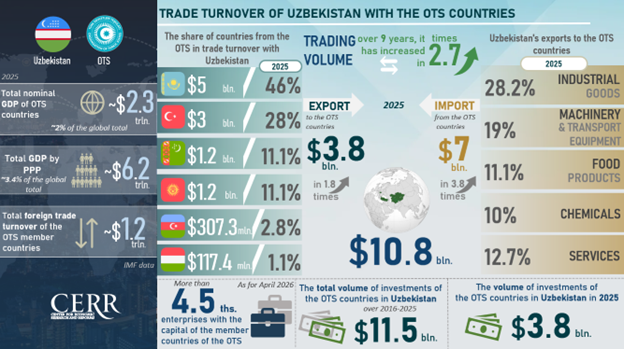
The OTS region is home to more than 170 million people and possesses substantial economic potential. In 2025, the combined nominal GDP of OTS member states reached approximately $2.3 trillion, equivalent to around 2% of the global economy. In purchasing power parity terms, GDP exceeded $6.2 trillion, accounting for 3.4% of world GDP. The aggregate foreign trade turnover of OTS countries surpassed $1.2 trillion.
Proven natural gas reserves across OTS member states amount to approximately 19.9 trillion cubic meters, while proven oil reserves total 38.2 billion barrels, making the region one of Eurasia’s prominent energy centers.
The Turkic world is characterized by a high degree of economic complementarity. Turkiye and Hungary possess advanced industrial and engineering capabilities, while Kazakhstan, Azerbaijan, and Turkmenistan hold substantial energy resources. Uzbekistan and Kyrgyzstan are strengthening their positions in manufacturing and agro-industrial production.
Against this backdrop, Uzbekistan is emerging as one of the most dynamic economies in the region. Over the past five years, the country has risen by 28 positions in Harvard Growth Lab’s Atlas of Economic Complexity, reaching 70th place among 145 economies. Average annual export growth stood at 13.4%, while non-energy exports expanded by an average of 17% per year, outpacing both regional and global trends.
In this context, the OTS is acquiring increasing practical economic relevance, with trade, transport, industrial cooperation, investment, and digitalization forming the foundation of a new model of regional connectivity.
Trade and Industrial Cooperation
Today, Uzbekistan’s cooperation within the OTS spans more than 35 areas. At the same time, the economic dimension of this engagement continues to deepen. Over the past nine years, Uzbekistan’s trade turnover with OTS countries increased 2.7-fold, from $4 billion in 2017 to $10.8 billion in 2025. Exports rose from $1.2 billion to $3.8 billion, while imports expanded from $1.8 billion to $7 billion.
Kazakhstan and Turkiye remain Uzbekistan’s largest trading partners within the OTS. Kazakhstan accounts for 46% of total trade, or approximately $5 billion, while Turkiye’s share stands at 28%, or around $3 billion. Trade with Turkmenistan and Kyrgyzstan also reached significant levels, totaling about $1.2 billion with each country.
The structure of trade is evolving. In Uzbekistan’s exports to OTS countries, manufactured goods account for 28.2%, machinery and transport equipment for 19%, food products for 11.1%, chemical products for 10%, and services for 12.7%. This reflects a gradual transition toward a more sophisticated trade model, with growing exports of finished goods, services, and products created through industrial cooperation.
Imports from OTS countries are closely linked to the needs of Uzbekistan’s modernizing economy. Key import categories include food products, mineral fuels, manufactured goods, machinery, and equipment, indicating the expansion of production linkages across the region.
According to estimates by the Center for Economic Research and Reforms (CERR), Uzbekistan has the potential to increase its exports to OTS countries by an additional $2.7 billion. The largest unrealized export opportunity is in Turkiye, where additional export potential is estimated at $1.8 billion.
This export potential is based on Uzbekistan’s competitive advantages across a number of product categories, particularly agricultural products such as dried fruits, vegetables, and nuts. The combined agricultural market of OTS countries is estimated at approximately $72 billion, where Uzbek producers already hold solid positions.
Further export growth could be driven by increased shipments of textiles, electrical equipment, construction materials, food products, fertilizers, copper, ethylene polymers, and other higher value-added goods.
Investment and the Institutional Framework for Cooperation
Trade integration within the OTS is being accompanied by deeper investment and industrial cooperation. Between 2017 and 2025, total investments from OTS countries into Uzbekistan exceeded $11.5 billion, including $3.8 billion attracted in 2025 alone.
These investments have been directed primarily to manufacturing, energy, agriculture, construction, and logistics. As of April 2026, more than 4,500 enterprises with capital from OTS countries were operating in Uzbekistan. These include joint manufacturing ventures, logistics projects, and industrial partnerships serving both regional and external markets.
Turkiye remains the most active investor. In 2025, Turkish investments totaled $2.4 billion, while the number of enterprises with Turkish capital in Uzbekistan reached 2,140. Turkish businesses are playing a major role in industrial production, construction, textiles, and transport and logistics infrastructure.
Kazakhstan, as Uzbekistan’s largest trading partner among OTS countries, is also one of its most important investment partners. More than 1,200 enterprises with Kazakh capital are currently operating in the country.
The signing of the Treaty on Allied Relations between Uzbekistan and Azerbaijan in 2024 has provided a major impetus to bilateral cooperation. As a result, 367 enterprises with Azerbaijani capital are now active in Uzbekistan.
The Comprehensive Strategic Partnership with Kyrgyzstan has contributed to an increase in the number of joint ventures to 346.
Although the number of enterprises with Hungarian capital remains relatively modest, the projects being implemented are notable for their scale and technological sophistication. These include poultry clusters in the Syrdarya Region valued at $165 million and wastewater treatment facilities in New Tashkent worth $59 million.
An additional mechanism supporting joint projects is the Turkic Investment Fund. In 2025, its authorized capital was increased from $500 million to $600 million, with Uzbekistan contributing $100 million. Going forward, the Fund could become an important instrument for financing infrastructure, industrial, logistics, and digital projects across the OTS region.
For Uzbekistan, investment cooperation within the OTS facilitates capital inflows, export-oriented production, technology localization, broader industrial cooperation, and deeper integration into regional value chains.
Transport Integration
For a landlocked country such as Uzbekistan, transport connectivity is a critical prerequisite for expanding foreign trade and integrating into global production networks. Accordingly, transport has become one of the central pillars of economic cooperation within the OTS.
Growing trade among member states has been accompanied by a significant expansion in freight flows. Kazakhstan remains Uzbekistan’s most important transport partner, serving as the main land bridge to Russia, the Caucasus, and Europe. In 2025, freight volumes between the two countries exceeded 22.3 million tons, including 19.6 million tons transported by rail.
The Kyrgyz route is also demonstrating strong momentum. In 2025, cargo volumes between Uzbekistan and Kyrgyzstan increased by 22.4% to nearly 5.4 million tons, while export shipments by all modes of transport more than doubled.
Transport cooperation with Azerbaijan and Turkiye is also expanding steadily. In 2025, freight volumes between Uzbekistan and Azerbaijan increased by 28.3%. Regular air service between Tashkent and Baku currently operates 14 times per week. Air links with Turkiye are similarly intensive, with 97 scheduled flights per week on eight routes, including services to Istanbul and Ankara.
Turkmenistan remains another important element of the regional transport system. A practical step toward facilitating border trade was the launch of the joint trade zone “Shavat–Dashoguz.” In 2025, freight volumes between the two countries rose by 22.5% to approximately 1.8 million tons.
As trade within the OTS expands, the development of resilient multimodal connectivity is becoming increasingly important. This requires an integrated system of corridors linking rail, road, air, and maritime infrastructure.
In this context, the Trans-Caspian International Transport Route, widely known as the Middle Corridor, has gained particular significance. For Uzbekistan, this route is important not only as a transit corridor, but also as a strategic channel for expanding exports to Azerbaijan, Turkiye, Europe, and the Middle East.
The relevance of alternative Eurasian transport routes is increasing amid ongoing changes in global logistics. The restructuring of supply chains due to geopolitical instability has already raised transport costs for Central Asian countries by as much as 30% and extended delivery times by several weeks.
Against this backdrop, the China–Kyrgyzstan–Uzbekistan Railway is becoming strategically important as a new East-West transport link. Once operational, the railway is expected to reduce delivery times to 10 days and enable the transportation of up to 15 million tons of cargo annually.
In the longer term, integration of this route with the Middle Corridor and the Trans-Afghan corridor could reshape the transport geography of Eurasia. In such a system, Uzbekistan would be positioned not only as a transit country, but also as a full participant in regional value chains, supported by its own cargo base, logistics centers, transport companies, and industrial facilities.
At the same time, further progress in transport integration will require coordinated policies within the OTS. Key priorities include tariff harmonization, infrastructure development, capacity expansion, digital customs procedures, and the alignment of technical standards. These areas are gradually shaping the organization’s practical transport agenda.
The Digital Agenda as Trade Infrastructure
The theme of the current OTS Summit in Turkistan, focused on artificial intelligence and digital development, is directly linked to the broader economic agenda. In modern trade, competitiveness depends not only on product quality and proximity to markets, but increasingly on the speed of customs clearance, supply chain transparency, digital interoperability, and access to information.
For OTS member states, digital integration could become one of the most practical and impactful areas of cooperation. Harmonizing e-commerce standards, mutually recognizing digital documents, integrating customs information systems, and creating digital business registries could significantly reduce transaction costs and facilitate market access.
This is particularly important for small and medium-sized enterprises. Many firms face fewer tariff barriers than informational constraints related to partners, certification requirements, logistics, and payment mechanisms. A unified digital platform for businesses across OTS countries could serve as a practical tool for expanding trade, especially within border regions and regional supply chains.
Over recent years, Uzbekistan has accumulated substantial experience in the digitalization of public services and the business environment. This experience could prove highly valuable within the organization, particularly in areas such as e-government services, digital platforms, customs administration, and entrepreneurship support.
Conclusion
The OTS is gradually evolving toward a more practical model of economic cooperation. For Uzbekistan, this process coincides with the current stage of economic reforms aimed at expanding export capacity, developing industry, and strengthening connectivity with external markets.
As economic interaction within the OTS deepens, Uzbekistan’s role in shaping regional trade, transport, and production linkages continues to grow. In recent years, cooperation within the organization has already acquired a stable economic dimension encompassing trade, investment, industrial cooperation, transport infrastructure, and logistics.
In this context, the agenda of the informal OTS Summit in Turkistan places particular emphasis on the development and application of artificial intelligence and digital technologies. This reflects the growing interest among member states in modern forms of economic interaction, especially the digitalization of trade and logistics, the expansion of electronic services, the integration of infrastructure solutions, and the reduction of transaction costs across the region.
Against this backdrop, Uzbekistan’s participation in the informal OTS Summit is increasingly acquiring a practical economic focus. The expansion of trade, development of multimodal transport corridors, deepening industrial cooperation, growth in investment ties, and enhanced digital connectivity are creating a strong foundation for further integration into Eurasia’s regional production and logistics networks.
Ziyoda Rizaeva
Head of Public Relations and Media Sector
Center for Economic Research and Reforms
📅 13.05.2026
Uzbekistan news
UZBEKISTAN AND THE UN: FROM NATIONAL INITIATIVES TO THE GLOBAL AGENDA
The 5th Samarkand Forum on Human Rights to take place on September 28–29th
Uzbekistan's key trading partners participate in CICA
Speech by President Shavkat Mirziyoyev at the solemn ceremony dedicated to the thirty-fifth anniversary of the independence of the Republic of Uzbekistan
Uzbekistan Firmly Establishes Itself as a Stable and Predictable Partner for Long-Term International Business
Changing economic priorities of Uzbekistan reshape its engagement with the CIS
Inaugural Central Asia – Republic of Korea Summit at the highest level opens in Seoul
Uzbekistan and Korea: Advancing Green Energy and New Technologies
Uzbekistan and the Republic of Korea in the Emerging Framework for Cooperation with Central Asia
Tashkent brings together leaders and key deals in Polymer Market of Central Asia
The 1st Republic of Korea–Central Asia Summit: Why This Moment Matters
Uzbekistan – Serbia: A New Geography of Industrial Cooperation
The President of Uzbekistan’s Visit to Serbia: A New Stage in Economic Partnership Between Central Asia and the Balkans
Uzbekistan and the Republic of Korea: From Investment Partnership to Technological Cooperation
Regional Approaches to SDG Delivery: What Can Central Asia Offer?
Uzbekistan Opens a Balkan Gateway to Europe
The SCO Bishkek Summit: The Economic Agenda of a New Stage of Cooperation
Tourism: A new dimension of Uzbekistan-Kyrgyzstan partnership
Uzbekistan’s Role in the SCO: Economy, Security and Regional Cooperation
Economic Cooperation of Uzbekistan within the SCO at a New Stage of Development
Uzbekistan and Serbia: From Labour Mobility to a Strategic Partnership in Human Capital
Prospects for Uzbekistan–Serbia Cooperation in the ICT Sector
Prospects for Cooperation between the Republic of Uzbekistan and the Republic of Korea within the Framework of the Central Asia–Republic of Korea Cooperation Forum
THE SCO’S NEW FINANCIAL ARCHITECTURE: FROM COORDINATION TO PRACTICAL DEVELOPMENT MECHANISMS
INFORMATION NOTE ON COOPERATION WITH SERBIA
On September 8–10th, Tashkent to gather International Textile Industry Professionals
The Seoul Summit: Uzbekistan in the New Industrial Architecture of C5+1
New Opportunities to Expand Cooperation Between Uzbekistan and Serbia
Uzbekistan and Azerbaijan: Turning Political Alignment into Economic Growth
BRIGHT PROSPECTS FOR MUTUALLY BENEFICIAL PARTNERSHIP

-
 Ministry of Foreign Affairs of the Republic of Uzbekistan
 -
 Diplomatic Service of the Ministry of Foreign Affairs
 -
 State Committee for Tourism Development
 -
Ministry of Investments and Foreign Trade of the Republic of Uzbekistan
-
 invest.gov.uz
 -

-

-

-

-
-

-

of Uzbekistan in the Republic
of Latvia
When using the information, a link to www.uzembassy.lv
must be provided.
All rights reserved
Address
Address: Riga c., LV-1010. 11-11 Elizabetes Str., Latvia
Phone: 37167322424
Fax: 37167322306
Email: embassy@uzbekistan.lv
Useful links
HomeIssuance of biometric passport for departure abroad
Certificate to return to Uzbekistan
Withdrawal of citizenship
Loss of citizenship