Phone
Consular Issues
Phone
Uzbekistan news
To Europe via the “Middle Corridor”: New Horizons for Uzbek-Azerbaijani Logistics Cooperation
Given the recent geopolitical instability observed around the world, one of the top priorities for every sovereign state is to ensure the security and continuity of its foreign trade routes.
For Uzbekistan, located at the geopolitical center of Central Asia, it is strategically important to maintain the continuous and stable operation of transport and logistics corridors with European countries, which account for a significant share of its foreign trade. It should be noted that in 2025, the volume of Uzbekistan’s international freight traffic with European countries amounted to 1.5 million tons, which is 29% more than in 2024.
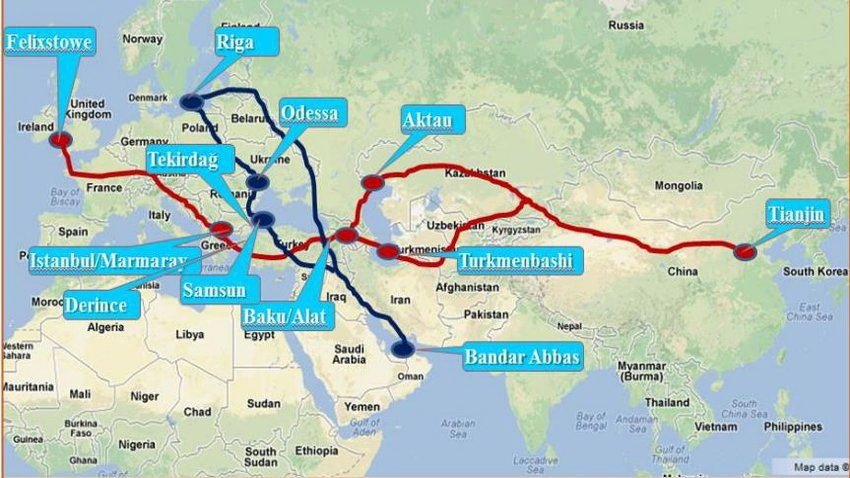
Today, the Middle Corridor serves as a safe and reliable transport corridor for export shipments to Europe or import shipments from Europe via land transport. Azerbaijan is one of the most important hubs of the Middle Corridor. In January–March 2026, the volume of international freight traffic between Uzbekistan and Azerbaijan amounted to 28,300 tons, which is 2.9 times more than during the same period in 2025.
Overall, over the past five years, the volume of Uzbek cargo transported via the Middle Corridor has doubled, reaching 1.2 million tons by the end of 2025. While in 2021 the share of cargo transported via this corridor with EU countries was 12%, by the end of 2025 this figure had reached 28%.
Due to its geographical location, Azerbaijan serves as a natural bridge connecting Central Asia to the Caucasus region and Turkey via the Caspian Sea. It will enable the reception of export cargo from the East (China, Central Asia, including Uzbekistan) and its direct shipment to European markets via the ports of Poti and Batumi in Georgia and Mersin and Ambarli in Turkey.
Today, bilateral and multilateral cooperation in the transport and logistics sector has been established between Uzbekistan and Azerbaijan. This cooperation makes a significant contribution not only to the development of bilateral relations but also to the development of the Middle Corridor, connecting the Central Asian region with Europe.
Recent reports by prestigious international financial institutions, such as the World Bank and the European Bank for Reconstruction and Development, dedicated to studying the potential of the “Middle Corridor,” have analyzed a number of obstacles that reduce the corridor’s effectiveness. In particular, international experts note that one of the main challenges to the corridor’s development is the disparity in digitalization levels among transit countries, the lack of a unified platform for information exchange, and the persistence of paper-based bureaucratic processes at border and customs checkpoints.
It is precisely to address these systemic challenges in practice and increase the capacity of the “Middle Corridor” between Uzbekistan and Azerbaijan that active and exemplary digital integration processes have been established. In particular, the “E-TIR” system has been successfully implemented, streamlining customs procedures between the two countries and reducing the human factor. Additionally, in the field of international road transport, efforts are actively underway to fully transition to the paperless “E-PERMIT” system.
Furthermore, Uzbekistan and Azerbaijan are implementing the necessary measures to develop freight transport within the “Asia-Pacific Region – China – Kyrgyzstan – Uzbekistan – Turkmenistan – Azerbaijan – Turkey – Europe” (CASCA+) framework for multimodal transport along the Middle Corridor. In 2025, 6,722 TEU container shipments were carried out on this international route, which is 47% more than in 2024. Preferential rates have also been established for this route for 2026, and a further increase in transport volumes is expected.
It should be noted that the railway administrations of Uzbekistan and Azerbaijan are the initiators and active participants in the implementation of a set of measures aimed at developing the “Middle Corridor” transport and logistics network. In particular, to further expand the potential of this corridor, a multilateral meeting was held in 2024 between the railway authorities of Kyrgyzstan, Uzbekistan, Turkmenistan, Azerbaijan, Georgia, Turkey, and Tajikistan. Following these negotiations, an institutional platform—the “Eurasian Transport Route” Association—was established to accelerate freight transportation processes and create a mechanism for the prompt removal of logistical barriers arising within the system.
In conclusion, it should be noted that the strategic partnership between Uzbekistan and Azerbaijan in the transport and logistics sector contributes not only to the stabilization of the two countries’ foreign trade turnover but also to the integration of the entire Central Asian region into the international supply chain. The implementation of digital solutions that eliminate bureaucratic barriers, the diversification of multimodal routes, and the strengthening of institutional mechanisms will further enhance the international transit appeal of the “Middle Corridor.” This, in turn, will increase the resilience of Uzbekistan’s economy to external shocks amid global geopolitical changes and serve as a solid guarantee for the safe and uninterrupted conduct of international transport operations.
📅 18.05.2026
Uzbekistan news
OTS Member States - A Crucial Link in the Eurasian Space
Uzbekistan plays an active role in Economic Integration within the framework of the Organization of Turkic States
CICA opens new horizons for financial cooperation
Aquatherm Tashkent 2026 to Showcase Latest Technologies for Construction and Utility Infrastructure
Uzbekistan is securing its place in the Global Hub for Technological Outsourcing
Digital Cooperation among the Turkic States Towards a Unified Technological Ecosystem
Uzbekistan and Azerbaijan are creating a Hub for Startups, Investors and Talent
UZBEKISTAN AND THE UN: FROM NATIONAL INITIATIVES TO THE GLOBAL AGENDA
The 5th Samarkand Forum on Human Rights to take place on September 28–29th
Uzbekistan's key trading partners participate in CICA
Speech by President Shavkat Mirziyoyev at the solemn ceremony dedicated to the thirty-fifth anniversary of the independence of the Republic of Uzbekistan
Uzbekistan Firmly Establishes Itself as a Stable and Predictable Partner for Long-Term International Business
Changing economic priorities of Uzbekistan reshape its engagement with the CIS
Inaugural Central Asia – Republic of Korea Summit at the highest level opens in Seoul
Uzbekistan and Korea: Advancing Green Energy and New Technologies
Uzbekistan and the Republic of Korea in the Emerging Framework for Cooperation with Central Asia
Tashkent brings together leaders and key deals in Polymer Market of Central Asia
The 1st Republic of Korea–Central Asia Summit: Why This Moment Matters
Uzbekistan – Serbia: A New Geography of Industrial Cooperation
The President of Uzbekistan’s Visit to Serbia: A New Stage in Economic Partnership Between Central Asia and the Balkans
Uzbekistan and the Republic of Korea: From Investment Partnership to Technological Cooperation
Regional Approaches to SDG Delivery: What Can Central Asia Offer?
Uzbekistan Opens a Balkan Gateway to Europe
The SCO Bishkek Summit: The Economic Agenda of a New Stage of Cooperation
Tourism: A new dimension of Uzbekistan-Kyrgyzstan partnership
Uzbekistan’s Role in the SCO: Economy, Security and Regional Cooperation
Economic Cooperation of Uzbekistan within the SCO at a New Stage of Development
Uzbekistan and Serbia: From Labour Mobility to a Strategic Partnership in Human Capital
Prospects for Uzbekistan–Serbia Cooperation in the ICT Sector
Prospects for Cooperation between the Republic of Uzbekistan and the Republic of Korea within the Framework of the Central Asia–Republic of Korea Cooperation Forum

-
 Ministry of Foreign Affairs of the Republic of Uzbekistan
 -
 Diplomatic Service of the Ministry of Foreign Affairs
 -
 State Committee for Tourism Development
 -
Ministry of Investments and Foreign Trade of the Republic of Uzbekistan
-
 invest.gov.uz
 -

-

-

-

-

-

-


of Uzbekistan in the Republic
of Latvia
When using the information, a link to www.uzembassy.lv
must be provided.
All rights reserved
Address
Address: Riga c., LV-1010. 11-11 Elizabetes Str., Latvia
Phone: 37167322424
Fax: 37167322306
Email: embassy@uzbekistan.lv
Useful links
HomeIssuance of biometric passport for departure abroad
Certificate to return to Uzbekistan
Withdrawal of citizenship
Loss of citizenship