Phone
Consular Issues
Phone
Uzbekistan news
Green Economy, Social Sustainability, and Transparent Governance: Uzbekistan’s New Development Formula
The global economy has entered a stage in which sustainable development is no longer merely a declarative agenda but has become one of the key criteria for assessing trust in governments, companies, and financial institutions. As a result, ESG standards are now viewed not as an image-building tool, but as a means of evaluating reliability, governance quality, technological maturity, and long-term competitiveness.
For reference: ESG (Environmental, Social, and Governance) refers to business principles under which a company considers its impact on the environment, society, and the quality of governance while seeking to achieve sustainable development and minimize risks.
Today, this trend is naturally shifting from voluntary commitments toward stricter requirements, including non-financial disclosure, climate reporting, independent verification, carbon regulation, supply-chain oversight, and measures to combat greenwashing—that is, the unjustified presentation of activities as environmentally sustainable.
Notably, according to available estimates, global ESG assets exceeded USD 30 trillion in 2022 and may reach USD 40 trillion by 2030. At the same time, sustainable bond issuance amounted to approximately USD 1.1 trillion in 2025. This demonstrates that sustainable development has become part of the global financial infrastructure rather than a narrow area of corporate policy.
Against this backdrop, Uzbekistan is shaping its own model of sustainable development based on national priorities. Water and energy security, employment, social stability, improved performance of state-owned enterprises, greater transparency in governance, and stronger investment appeal are of particular importance to the country.
A key feature of Uzbekistan’s approach is that the ESG agenda is not being developed in a fragmented manner, but as part of broad reforms implemented under the leadership of the President of the Republic of Uzbekistan. The Uzbekistan–2030 Strategy, the transition toward a green economy, national sustainable development goals, the green taxonomy, the MRV system, ESG reporting by state-owned enterprises, social protection, the development of mahallas, and anti-corruption measures together form a unified framework for public policy.
A new stage in the institutional development of ESG was formalized by Cabinet of Ministers Resolution No. 221 dated May 4, 2026. The document approved rules for introducing environmental, social, and corporate governance principles, preparing ESG reports, and disclosing information on sustainable development. As a result, ESG in Uzbekistan is moving from a broad strategic framework toward a specific system of implementation, monitoring, and reporting.
This is therefore not a collection of isolated initiatives, but a new logic of governance. The economy must not only grow, but also remain sustainable; state-owned enterprises must not only be large, but also transparent; social policy must not only compensate for hardship, but also support development; and the environmental agenda must not only protect nature, but also carry economic significance.
The environmental pillar remains the most developed area. Given Uzbekistan’s water scarcity, high climate vulnerability, the consequences of the Aral Sea crisis, and the need to modernize the energy sector, the green economy is an objective necessity.
Key documents signed by the Head of State define the main areas of environmental transformation: the development of renewable energy, improved energy efficiency, the introduction of water-saving technologies, emissions reduction, waste recycling, the expansion of green spaces, the restoration of natural ecosystems, and the creation of an emissions-monitoring system.
As a result, environmental policy is gradually moving beyond traditional nature conservation and becoming part of the country’s economic strategy. At a time when the carbon footprint is becoming a factor in export competitiveness, energy modernization, reduced water losses, and improved industrial efficiency are gaining not only environmental but also macroeconomic importance.
Alongside the environmental agenda, Uzbekistan’s sustainable development model includes a strong social dimension. This includes reducing poverty, expanding employment, supporting women, protecting vulnerable groups, developing mahallas, improving infrastructure, and raising living standards.
It is the social pillar that gives the reforms a human dimension. The green transition must not be limited to reporting and technical indicators. It must remain people-centered, since changes in energy, water management, and industry may affect employment, tariffs, access to resources, and household income structures.
At the same time, the aforementioned government resolution establishes ESG as an integrated system in which environmental indicators are not considered separately from social and governance factors. The focus extends beyond emissions, energy, and water to include governance quality, labor practices, risks affecting stakeholders, data transparency, and management accountability.
The quality of governance is becoming a key condition for the effectiveness of the ESG agenda. In today’s environment, investor confidence depends not only on macroeconomic indicators, but also on institutional transparency, corporate governance, information disclosure, and the predictability of public policy.
Uzbekistan has made notable progress in this area. Digital monitoring, the KPI system for government bodies, anti-corruption policy, ESG reporting by state-owned enterprises, and a national system for measuring, reporting, and verifying climate and ESG indicators for emissions accounting are all being developed.
Changes in the public sector are particularly significant. In recent years, substantial progress has been achieved in improving the investment appeal of state-owned enterprises. By the end of 2025, 17 state-owned enterprises had received international credit ratings, while seven had obtained publicly available ESG ratings. This indicates a transition from a closed administrative model toward the standards of international financial discipline.
In practice, the public sector is becoming subject to external assessment, public reporting, and corporate accountability. Ratings require the disclosure of risks, financial discipline, a clear strategy, and stronger governance. Through this mechanism, ESG is moving from the conceptual level into the practical sphere of corporate management.
Within this framework, the government resolution is of fundamental importance. It stipulates that state-owned enterprises undergoing transformation must introduce ESG reporting rules from July 1, 2026, and prepare ESG reports in accordance with disclosure standards by November 1, 2026.
Based on the above, the following conclusions may be drawn:
First, ESG is becoming a strategic instrument for modernizing Uzbekistan’s public sector and economy. Its significance extends beyond environmental policy and encompasses investment, social sustainability, and competitiveness.
Second, reforms implemented under the leadership of the Head of State are transforming sustainable development from a set of declarations into a system of practical governance. Reporting, the green economy, social policy, transparency, and ESG standards are becoming elements of a unified reform architecture.
Third, in the new global economy, the advantage belongs to countries that grow sustainably, transparently, and predictably from an investor’s perspective. This is precisely where Uzbekistan’s competitive opportunity lies: in turning sustainability into a source of trust, capital, and long-term development.
Thus, ESG is not an external slogan for Uzbekistan, but an internal logic of development. It is a mechanism for connecting economic growth with responsibility, investment with trust, reforms with quality of life, and national interests with the requirements of the new global economy.
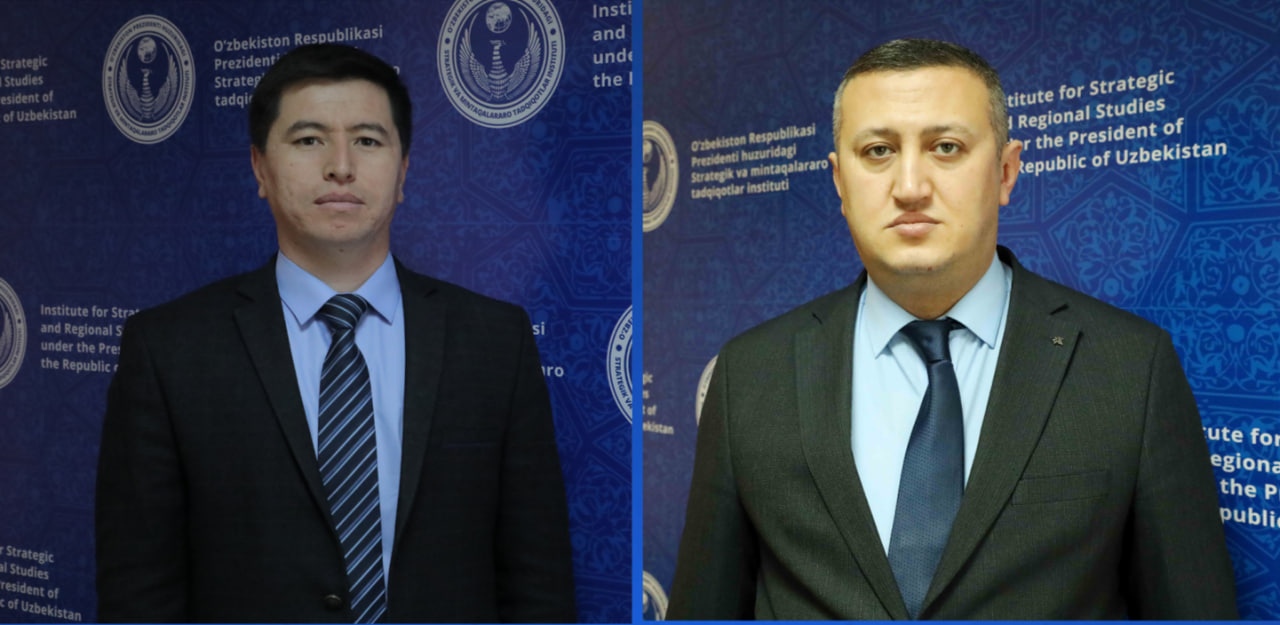
- Nizamov
Head of Department
Institute for Strategic and Regional Studies
under the President of the Republic of Uzbekistan
- Sattorov
Leading Research Fellow
Institute for Strategic and Regional Studies
under the President of the Republic of Uzbekistan
📅 14.07.2026
Uzbekistan news
Peace and Trust in Asia - essential conditions for sustainable development
CICA amid a Crisis of Trust: Uzbekistan’s Role in Strengthening Cooperation in Asia
Uzbekistan promotes initiatives in Central Asia that unlock new opportunities for cooperation
Strengthening Transport Connectivity in Asia through the Development of the Trans-Caspian International Transport Corridor
Uzbekistan promotes Initiatives in Central Asia unlocking new opportunities for cooperation
Political mutual trust in the Central Asian region is transforming into economic capital
Uzbekistan attracts specialists from 16 countries to the anniversary international exhibition “Mining, Metallurgy and Metalworking – MiningMetals Uzbekistan 2026”
Uzbekistan has moved its economic cooperation with the Turkic states into a practical dimension
Akramjon Nematov: Central Asia is increasingly emerging as an independent centre for shaping its own economic and technological agenda
Central Asia Is Shaping Its Own Model of Regional Cooperation
Initiatives of Uzbekistan aimed at Economic Results for the Countries of Central Asia and Azerbaijan
Regular dialogue is the Foundation for addressing common water-related challenges in Central Asia
Uzbekistan and Turkmenistan: A New Stage in the Development of Their Strategic Partnership
11th Tashkent International Biennale of Contemporary Art to be held in the capital of Uzbekistan on October 12–16th
OTS Member States - A Crucial Link in the Eurasian Space
Uzbekistan plays an active role in Economic Integration within the framework of the Organization of Turkic States
CICA opens new horizons for financial cooperation
Aquatherm Tashkent 2026 to Showcase Latest Technologies for Construction and Utility Infrastructure
Uzbekistan is securing its place in the Global Hub for Technological Outsourcing
Digital Cooperation among the Turkic States Towards a Unified Technological Ecosystem
Uzbekistan and Azerbaijan are creating a Hub for Startups, Investors and Talent
UZBEKISTAN AND THE UN: FROM NATIONAL INITIATIVES TO THE GLOBAL AGENDA
The 5th Samarkand Forum on Human Rights to take place on September 28–29th
Uzbekistan's key trading partners participate in CICA
Speech by President Shavkat Mirziyoyev at the solemn ceremony dedicated to the thirty-fifth anniversary of the independence of the Republic of Uzbekistan
Uzbekistan Firmly Establishes Itself as a Stable and Predictable Partner for Long-Term International Business
Changing economic priorities of Uzbekistan reshape its engagement with the CIS
Inaugural Central Asia – Republic of Korea Summit at the highest level opens in Seoul
Uzbekistan and Korea: Advancing Green Energy and New Technologies
Uzbekistan and the Republic of Korea in the Emerging Framework for Cooperation with Central Asia

-
 Ministry of Foreign Affairs of the Republic of Uzbekistan
 -
 Diplomatic Service of the Ministry of Foreign Affairs
 -
 State Committee for Tourism Development
 -
Ministry of Investments and Foreign Trade of the Republic of Uzbekistan
-
 invest.gov.uz
 -

-

-

-

-
-

-


of Uzbekistan in the Republic
of Latvia
When using the information, a link to www.uzembassy.lv
must be provided.
All rights reserved
Address
Address: Riga c., LV-1010. 11-11 Elizabetes Str., Latvia
Phone: 37167322424
Fax: 37167322306
Email: embassy@uzbekistan.lv
Useful links
HomeIssuance of biometric passport for departure abroad
Certificate to return to Uzbekistan
Withdrawal of citizenship
Loss of citizenship