Phone
Consular Issues
Phone
Uzbekistan news
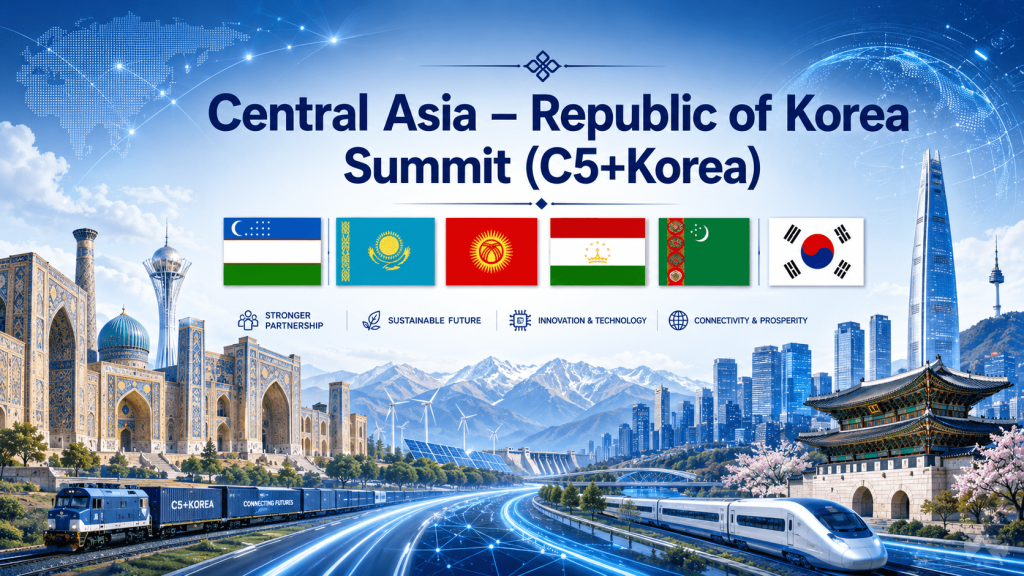
The Seoul Summit: Uzbekistan in the New Industrial Architecture of C5+1
The upcoming first “Central Asia – Republic of Korea” Summit in Seoul gives the C5+1 format a more substantive economic dimension. The new agenda focuses on industrial modernization, infrastructure, critical minerals and energy, human capital development, and private-sector participation. An important institutional basis for this work is provided by a dedicated consultative mechanism of industry ministers, aimed at maintaining regular sectoral dialogue, identifying joint initiatives, and developing a list of priority projects.
In this way, the national industrial priorities of Central Asian countries have an opportunity to be aligned with the technological and investment capabilities of the Republic of Korea at the level of specific production chains. Technology, infrastructure, financing, and markets come together here as an integrated system for implementing major joint initiatives.
The potential of this model is particularly evident in the case of Uzbekistan. Relations between Tashkent and Seoul have held the status of a special strategic partnership since 2019, while the accumulated volume of direct Korean investment in Uzbekistan’s economy has exceeded USD 8 billion. In January–June 2026, bilateral trade approached USD 1 billion, increasing by 11.5 percent.
Behind these figures lies an already established technological foundation for the partnership. Joint centers are operating in Uzbekistan in the textile industry, rare metals and alloys, agricultural machinery, and e-government, while cooperation in chemical technologies and construction is also developing. This network creates sustainable channels for the transfer of engineering solutions, practical knowledge, and production experience.
The accumulated foundation makes it possible to focus Uzbekistan’s C5+1 agenda on further developing processing, localization, technological upgrading, and the production of high-value-added goods. At the same time, the regional format expands the range of potential partners and connections between enterprises of Central Asian countries and Korean businesses.
One of the most promising areas is related to critical minerals. Cooperation covers the entire technological chain — geological exploration, processing, refining, and the development of value-added production. Under such a model, Central Asia’s mineral resource base becomes a starting point for deepening technological ties and creating new industries within the region.
Uzbekistan already has a concrete foundation in this area. The Uzbek-Korean Scientific and Technological Center for Rare Metals and Alloys is operating in the country. Its potential makes it possible to develop cooperation in materials science, processing technologies, research, and specialist training, with prospects for their further industrial application.
The development of more sophisticated industries simultaneously increases infrastructure requirements. Within the C5+1 agenda, this area includes energy, industrial complexes, transport and logistics, urban infrastructure, as well as the entire life cycle of major projects — from planning and construction to modernization and operation. For investors, this means the opportunity to consider an industrial site together with the necessary energy, engineering, and logistics solutions.
Uzbek-Korean cooperation already has a financial foundation for implementing projects of this scale. The cooperation program between Uzbekistan and the Economic Development and Cooperation Fund of the Republic of Korea (EDCF) for 2024–2027 has been established at USD 2 billion. At the same time, a new portfolio of initiatives is being developed, and financing mechanisms without state guarantees and on the basis of public-private partnerships are being explored.
The expansion of available financial instruments creates greater space for commercially viable projects, private capital, and long-term partnerships between companies. This is particularly important for industrial and infrastructure cooperation with long investment cycles, where the financing structure largely determines the possibilities for project implementation and subsequent expansion.
As production becomes increasingly technologically sophisticated, requirements for skilled specialists also grow. The development of professional skills and human capital is among the priorities of the C5+1 industrial mechanism. Uzbekistan already has a practical foundation in this area: four vocational education centers established with the participation of the Korea International Cooperation Agency are operating in Tashkent, Fergana, Shakhrisabz, and Samarkand, while another center is under construction in Urgench.
Further development of this model largely moves to the company level. It is here that technologies and accumulated knowledge are transformed into new production facilities, while sectoral priorities become investment decisions and commercial products. Therefore, the private sector, financial institutions, and research organizations play an important role in C5+1 industrial cooperation.
The development of a list of priority projects gives this work practical consistency. Such an instrument makes it possible to link promising areas with specific partners and sources of financing and to support their advancement between meetings of the industrial mechanism.
Uzbekistan is entering the new regional architecture with a substantial practical foundation: many of its elements are already functioning within bilateral cooperation with Korea. Investment is combined with technological centers, financial programs, a specialist training system, and experience in implementing complex projects. C5+1 makes it possible to bring this foundation to a broader level by connecting the national capabilities of Central Asian countries through new production linkages.
This is where the main economic potential of the Seoul Summit for Uzbekistan lies. The special strategic partnership with the Republic of Korea is gaining a regional dimension through deeper processing, technological localization, new production facilities, and access of finished products to new foreign markets. The accumulated Uzbek-Korean experience is becoming one of the practical elements of the industrial architecture of C5+1, strengthening Uzbekistan’s role in the Republic of Korea’s technological and industrial partnership with Central Asia.
📅 24.08.2026
Uzbekistan news
Central Asia Is Shaping Its Own Model of Regional Cooperation
Initiatives of Uzbekistan aimed at Economic Results for the Countries of Central Asia and Azerbaijan
Regular dialogue is the Foundation for addressing common water-related challenges in Central Asia
Uzbekistan and Turkmenistan: A New Stage in the Development of Their Strategic Partnership
11th Tashkent International Biennale of Contemporary Art to be held in the capital of Uzbekistan on October 12–16th
OTS Member States - A Crucial Link in the Eurasian Space
Uzbekistan plays an active role in Economic Integration within the framework of the Organization of Turkic States
CICA opens new horizons for financial cooperation
Aquatherm Tashkent 2026 to Showcase Latest Technologies for Construction and Utility Infrastructure
Uzbekistan is securing its place in the Global Hub for Technological Outsourcing
Digital Cooperation among the Turkic States Towards a Unified Technological Ecosystem
Uzbekistan and Azerbaijan are creating a Hub for Startups, Investors and Talent
UZBEKISTAN AND THE UN: FROM NATIONAL INITIATIVES TO THE GLOBAL AGENDA
The 5th Samarkand Forum on Human Rights to take place on September 28–29th
Uzbekistan's key trading partners participate in CICA
Speech by President Shavkat Mirziyoyev at the solemn ceremony dedicated to the thirty-fifth anniversary of the independence of the Republic of Uzbekistan
Uzbekistan Firmly Establishes Itself as a Stable and Predictable Partner for Long-Term International Business
Changing economic priorities of Uzbekistan reshape its engagement with the CIS
Inaugural Central Asia – Republic of Korea Summit at the highest level opens in Seoul
Uzbekistan and Korea: Advancing Green Energy and New Technologies
Uzbekistan and the Republic of Korea in the Emerging Framework for Cooperation with Central Asia
Tashkent brings together leaders and key deals in Polymer Market of Central Asia
The 1st Republic of Korea–Central Asia Summit: Why This Moment Matters
Uzbekistan – Serbia: A New Geography of Industrial Cooperation
The President of Uzbekistan’s Visit to Serbia: A New Stage in Economic Partnership Between Central Asia and the Balkans
Uzbekistan and the Republic of Korea: From Investment Partnership to Technological Cooperation
Regional Approaches to SDG Delivery: What Can Central Asia Offer?
Uzbekistan Opens a Balkan Gateway to Europe
The SCO Bishkek Summit: The Economic Agenda of a New Stage of Cooperation
Tourism: A new dimension of Uzbekistan-Kyrgyzstan partnership

-
 Ministry of Foreign Affairs of the Republic of Uzbekistan
 -
 Diplomatic Service of the Ministry of Foreign Affairs
 -
 State Committee for Tourism Development
 -
Ministry of Investments and Foreign Trade of the Republic of Uzbekistan
-
 invest.gov.uz
 -
-

-
-
-
-

-

of Uzbekistan in the Republic
of Latvia
When using the information, a link to www.uzembassy.lv
must be provided.
All rights reserved
Address
Address: Riga c., LV-1010. 11-11 Elizabetes Str., Latvia
Phone: 37167322424
Fax: 37167322306
Email: embassy@uzbekistan.lv
Useful links
HomeIssuance of biometric passport for departure abroad
Certificate to return to Uzbekistan
Withdrawal of citizenship
Loss of citizenship