Phone
Consular Issues
Phone
Uzbekistan news
Uzbekistan Opens a Balkan Gateway to Europe
The Center for Economic Research and Reforms (CERR) examines the prospects for expanding trade, economic and investment cooperation between Uzbekistan and Serbia.
As Uzbekistan broadens its economic engagement with Europe, new avenues for cooperation are emerging. Serbia is becoming one of these promising directions, with its strategic location offering Uzbek businesses additional opportunities to access markets across Central and Southeastern Europe.
For Serbia, closer cooperation with Uzbekistan provides access to Central Asia’s growing market as well as new manufacturing and investment opportunities. This complementarity creates considerable scope for taking bilateral economic relations well beyond their current level.
A New Stage in Economic Relations
Economic ties between Uzbekistan and Serbia have gained significant momentum in recent years. In April 2023, Serbia’s First Deputy Prime Minister and Minister of Foreign Affairs Ivica Dacic paid an official visit to Uzbekistan.
A major milestone came with the first official visit of Serbian President Aleksandar Vucic to Uzbekistan on October 28–31, 2025. Following talks in Tashkent, the two countries signed an Agreement on the Reciprocal Promotion and Protection of Investments and an Agreement on Economic Cooperation.
These agreements established a stronger institutional framework for investment projects and more systematic cooperation between businesses in the two countries.
In May 2026, during a visit by Serbian Foreign Minister Marko Duric, the two sides continued discussions on expanding trade and industrial cooperation. Mechanical engineering, pharmaceuticals, the chemical industry, agriculture and a number of other sectors were identified among the most promising areas.
The economic rationale for closer cooperation is closely linked to the geographical positions of the two countries and their ability to provide access to broader regional markets.
Serbia lies at the heart of the Balkans, connecting the markets of Central and Southeastern Europe. Uzbekistan, meanwhile, has the largest consumer market in Central Asia and a rapidly expanding industrial base.
This economic complementarity creates opportunities that extend well beyond bilateral trade. For Uzbek businesses, Serbia can serve as a gateway to European markets through the Balkans. For Serbian companies, Uzbekistan offers a platform for expanding their presence across Central Asia.
Trade Is Gaining Momentum
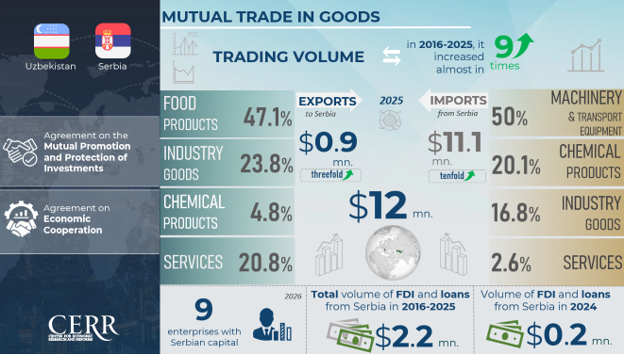
Trade between Uzbekistan and Serbia has expanded rapidly in recent years. Between 2016 and 2025, bilateral trade increased almost ninefold, from $1.4 million to $12 million.
In 2025, Uzbekistan exported $0.9 million worth of goods and services to Serbia, while imports from Serbia exceeded $11 million.
The composition of trade highlights the different nature of the two countries’ supplies.
Food products accounted for the largest share of Uzbekistan’s exports to Serbia at 47%, followed by manufactured goods at 23.8%, services at 20.8%, chemical products at 4.8%, crude materials excluding food at 2.4%, and mineral fuels and lubricants at 1%.
Serbian exports to Uzbekistan, by contrast, are predominantly industrial in nature. Machinery and transport equipment accounted for 50% of imports, followed by chemical products at 20.1% and manufactured goods at 16.8%. Food products represented 4.8%, miscellaneous manufactured articles 4.2%, services 2.6%, and crude materials excluding food 1.5%.
Together, machinery and transport equipment, chemical products and manufactured goods account for 87% of Serbian supplies to Uzbekistan. This predominantly industrial structure creates a solid foundation for developing deeper production cooperation between companies in the two countries.
In 2026, nine enterprises with Serbian capital were operating in Uzbekistan. The cumulative volume of foreign direct investment and loans attracted from Serbia between 2016 and 2025 amounted to $2.2 million.
The next stage of bilateral cooperation could therefore involve a transition toward more sophisticated forms of economic engagement, including contract manufacturing, localization and joint investment projects.
From Trade to Industrial Cooperation
The greatest potential for further cooperation lies in expanding production and investment links between companies in the two countries.
Particularly promising areas include light industry, pharmaceuticals, mechanical engineering, electrical engineering, the chemical industry and energy. Opportunities in these sectors include placing manufacturing orders with Uzbek enterprises, localizing production, producing components and implementing joint projects.
Infrastructure represents another promising area. Uzbekistan’s potential participation in railway projects in Serbia is currently being explored. Such cooperation could enable Uzbek companies to expand exports of engineering and construction services and gain experience in implementing projects in European markets.
Serbian companies, in turn, could broaden their participation in infrastructure and industrial projects in Uzbekistan.
Stronger production linkages between enterprises could also increase the involvement of local suppliers from both countries in international value chains.
The new institutional framework, together with investment initiatives and growing industrial cooperation, creates the conditions for bilateral economic relations to move toward a broader and more diversified model.
The Balkan direction could thus become an important route for expanding the presence of Uzbek businesses in Europe, while Uzbekistan could serve as a platform for Serbian companies seeking to establish a long-term presence in Central Asia.
As production ties deepen, companies from Uzbekistan and Serbia may also gain new opportunities to jointly enter third-country markets.
Khurshed Asadov,
Deputy Director of Center for Economic Research and Reforms
📅 05.09.2026
Uzbekistan news
Tashkent to host 22nd International Exhibition “Transport and Logistics - TransLogistica Uzbekistan” on November 10–12th, 2026
CICA Member States Account for More Than 50% of Uzbekistan’s Foreign Trade Turnover
Uzbekistan and the United States: The Economics of Mutual Interest
NEW OPPORTUNITIES IN HIGHER EDUCATION IN THE TURKIC STATES: A COMMON SPACE, SHARED GOALS
Peace and Trust in Asia - essential conditions for sustainable development
CICA amid a Crisis of Trust: Uzbekistan’s Role in Strengthening Cooperation in Asia
Uzbekistan promotes initiatives in Central Asia that unlock new opportunities for cooperation
Strengthening Transport Connectivity in Asia through the Development of the Trans-Caspian International Transport Corridor
Uzbekistan promotes Initiatives in Central Asia unlocking new opportunities for cooperation
Political mutual trust in the Central Asian region is transforming into economic capital
Uzbekistan attracts specialists from 16 countries to the anniversary international exhibition “Mining, Metallurgy and Metalworking – MiningMetals Uzbekistan 2026”
Uzbekistan has moved its economic cooperation with the Turkic states into a practical dimension
Akramjon Nematov: Central Asia is increasingly emerging as an independent centre for shaping its own economic and technological agenda
Central Asia Is Shaping Its Own Model of Regional Cooperation
Initiatives of Uzbekistan aimed at Economic Results for the Countries of Central Asia and Azerbaijan
Regular dialogue is the Foundation for addressing common water-related challenges in Central Asia
Uzbekistan and Turkmenistan: A New Stage in the Development of Their Strategic Partnership
11th Tashkent International Biennale of Contemporary Art to be held in the capital of Uzbekistan on October 12–16th
OTS Member States - A Crucial Link in the Eurasian Space
Uzbekistan plays an active role in Economic Integration within the framework of the Organization of Turkic States
CICA opens new horizons for financial cooperation
Aquatherm Tashkent 2026 to Showcase Latest Technologies for Construction and Utility Infrastructure
Uzbekistan is securing its place in the Global Hub for Technological Outsourcing
Digital Cooperation among the Turkic States Towards a Unified Technological Ecosystem
Uzbekistan and Azerbaijan are creating a Hub for Startups, Investors and Talent
UZBEKISTAN AND THE UN: FROM NATIONAL INITIATIVES TO THE GLOBAL AGENDA
The 5th Samarkand Forum on Human Rights to take place on September 28–29th
Uzbekistan's key trading partners participate in CICA
Speech by President Shavkat Mirziyoyev at the solemn ceremony dedicated to the thirty-fifth anniversary of the independence of the Republic of Uzbekistan
Uzbekistan Firmly Establishes Itself as a Stable and Predictable Partner for Long-Term International Business

-
 Ministry of Foreign Affairs of the Republic of Uzbekistan
 -
 Diplomatic Service of the Ministry of Foreign Affairs
 -
 State Committee for Tourism Development
 -
Ministry of Investments and Foreign Trade of the Republic of Uzbekistan
-
 invest.gov.uz
 -
-

-

-

-

-

-

of Uzbekistan in the Republic
of Latvia
When using the information, a link to www.uzembassy.lv
must be provided.
All rights reserved
Address
Address: Riga c., LV-1010. 11-11 Elizabetes Str., Latvia
Phone: 37167322424
Fax: 37167322306
Email: embassy@uzbekistan.lv
Useful links
HomeIssuance of biometric passport for departure abroad
Certificate to return to Uzbekistan
Withdrawal of citizenship
Loss of citizenship