Phone
Consular Issues
Phone
Uzbekistan news
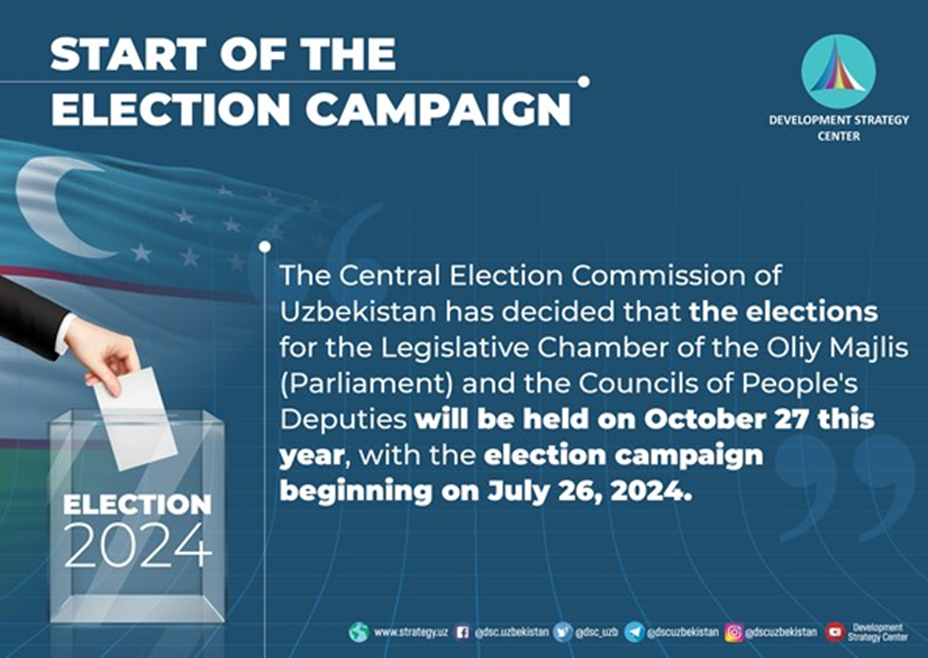
UZBEKISTAN’S ELECTORAL TRANSFORMATION: EMBRACING TECHNOLOGY FOR A STRONGER DEMOCRACY
Uzbekistan's upcoming elections for the Legislative Chamber of the Oliy Majlis (Parliament) and the Councils of People's Deputies, scheduled for October 27th, are not just a routine event. They mark a significant milestone in the nation's democratic journey, introducing groundbreaking changes that promise to transform the electoral landscape. The recent meeting of the Central Election Commission unveiled several key innovations that will ensure greater efficiency, transparency, and inclusivity, making these elections a matter of global interest.
For the first time in the nation's history, the Legislative Chamber elections will employ a mixed electoral system, combining majoritarian and proportional representation. This change means that voters will elect seventy-five deputies directly, while another seventy-five will be chosen based on party votes. This system aims to create a more balanced and representative legislature, enhancing democratic legitimacy and ensuring a broader spectrum of political voices.
One of the most notable advancements in Uzbekistan's electoral system is the full digitization of election commission activities. The introduction of the 'E-Saylov' information system is a significant leap forward, revolutionizing the election process. This digital platform not only streamlines the process, reducing bureaucracy and document handling, but also ensures a smoother, more efficient, and transparent electoral experience. It automates interactions between election commissions, political parties, candidates, observers, and the media, providing real-time statistical data, candidate information, and interactive maps. This technological leap empowers voters with unprecedented access to essential election-related information, making the electoral process more inclusive and transparent.
Inclusivity is another cornerstone of these elections. New election legislation requires political parties to ensure that at least 40% of their candidates are women, a progressive move towards gender equality in political representation. This requirement not only aligns Uzbekistan with advanced democratic standards but also enriches the political discourse by incorporating diverse perspectives.
The elections are taking place in a context where the updated Constitution has significantly enhanced the powers of parliament and representative bodies. The Legislative Chamber's powers have increased from 5 to 12, and the Senate's from 12 to 18. Parliament's oversight functions over executive, judicial, law enforcement, and special services have also been expanded. Additionally, the leadership of local Councils of People's Deputies by hokims (governors) has been abolished, transferring 33 powers previously held by hokims to local Councils to increase their role in resolving critical state issues.
The slogan "My Choice—My Prosperous Homeland" not only captures the spirit of these elections but also reflects the unwavering commitment of Uzbekistan's leadership to democratic state-building and citizen empowerment. With over 120,000 election commission members, 70,000 citizens, and numerous international observers participating, the elections are set to be a transparent and inclusive process, further demonstrating this commitment.
In conclusion, Uzbekistan is setting a remarkable precedent with its upcoming elections by embracing technological innovation and inclusivity. These initiatives will undoubtedly pave the way for a more prosperous and democratic future, showcasing Uzbekistan’s dedication to advancing democratic principles and practices.
Eldor Tulyakov,
The Executive Director,
Development Strategy Centre (Uzbekistan)
📅 26.07.2024
Uzbekistan news
Uzbekistan and the Republic of Korea in the Emerging Framework for Cooperation with Central Asia
Tashkent brings together leaders and key deals in Polymer Market of Central Asia
The 1st Republic of Korea–Central Asia Summit: Why This Moment Matters
Uzbekistan – Serbia: A New Geography of Industrial Cooperation
The President of Uzbekistan’s Visit to Serbia: A New Stage in Economic Partnership Between Central Asia and the Balkans
Uzbekistan and the Republic of Korea: From Investment Partnership to Technological Cooperation
Regional Approaches to SDG Delivery: What Can Central Asia Offer?
Uzbekistan Opens a Balkan Gateway to Europe
The SCO Bishkek Summit: The Economic Agenda of a New Stage of Cooperation
Tourism: A new dimension of Uzbekistan-Kyrgyzstan partnership
Uzbekistan’s Role in the SCO: Economy, Security and Regional Cooperation
Economic Cooperation of Uzbekistan within the SCO at a New Stage of Development
Uzbekistan and Serbia: From Labour Mobility to a Strategic Partnership in Human Capital
Prospects for Uzbekistan–Serbia Cooperation in the ICT Sector
Prospects for Cooperation between the Republic of Uzbekistan and the Republic of Korea within the Framework of the Central Asia–Republic of Korea Cooperation Forum
THE SCO’S NEW FINANCIAL ARCHITECTURE: FROM COORDINATION TO PRACTICAL DEVELOPMENT MECHANISMS
INFORMATION NOTE ON COOPERATION WITH SERBIA
On September 8–10th, Tashkent to gather International Textile Industry Professionals
The Seoul Summit: Uzbekistan in the New Industrial Architecture of C5+1
New Opportunities to Expand Cooperation Between Uzbekistan and Serbia
Uzbekistan and Azerbaijan: Turning Political Alignment into Economic Growth
BRIGHT PROSPECTS FOR MUTUALLY BENEFICIAL PARTNERSHIP
Transport and Logistics Connectivity of the SCO Amid Geopolitical Turbulence: New Opportunities for the Regions
Business in Uzbekistan are moving from digitalization to technological modernization
Uzbekistan and Serbia expand prospects for cooperation in ecology and environmental protection
SCO AND WATER DIPLOMACY: IN PURSUIT OF COMMON INTERESTS
TASHKENT-DELHI: A NEW STAGE OF STRATEGIC PARTNERSHIP
On September 4–6th, Samarkand will host XII Inter-Parliamentary Union Global Conference of Young Parliamentarians
The Infrastructure Already Linking Uzbekistan and Korea What Korea Has Already Built Inside Uzbekistan's Digital Economy From Fiber Optics to AI: The Scope of Uzbek-Korean Digital Cooperation The Digital Bridge Already Built Between Uzbekistan and South Korea
On September 8–10th, Tashkent to gather International Textile Industry Professionals

-
 Ministry of Foreign Affairs of the Republic of Uzbekistan
 -
 Diplomatic Service of the Ministry of Foreign Affairs
 -
 State Committee for Tourism Development
 -
Ministry of Investments and Foreign Trade of the Republic of Uzbekistan
-
 invest.gov.uz
 -
-

-

-
-
-

-

of Uzbekistan in the Republic
of Latvia
When using the information, a link to www.uzembassy.lv
must be provided.
All rights reserved
Address
Address: Riga c., LV-1010. 11-11 Elizabetes Str., Latvia
Phone: 37167322424
Fax: 37167322306
Email: embassy@uzbekistan.lv
Useful links
HomeIssuance of biometric passport for departure abroad
Certificate to return to Uzbekistan
Withdrawal of citizenship
Loss of citizenship