Phone
Consular Issues
Phone
Embassy messages
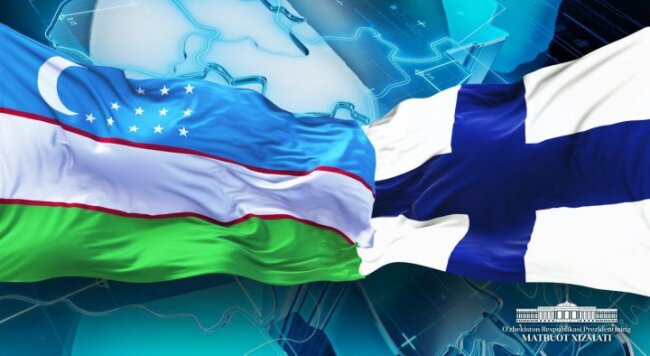
Uzbek–Finnish Cooperation: New Dynamics and Practical Areas of Partnership
The resilience of Finland’s development model and the dynamism of Uzbekistan’s reforms provide a solid foundation for deepening bilateral cooperation. Finland combines technological leadership, efficient governance, and a robust social policy. Its mixed model of development with strong public regulation and an active private sector is based on long-term planning, technological excellence, and social equality.
A balanced economic policy keeps inflation at 2–3%, while maintaining a high AA+ credit rating. The national research infrastructure is funded as a key element of state strategy. Total spending on research and development exceeds 3% of GDP, reaching €8.4 billion in 2023, up 6.3% from the previous year. The contributions came from the public sector, universities, and private business.
Finland’s economy remains open and export-oriented. In 2024, foreign trade reached €146.5 billion, including €72.2 billion in exports and €74.3 billion in imports. Its technological specialization, advanced digital environment, and high human capital create a predictable setting for investors.
At the same time, Uzbekistan has become a driver of reform in Central Asia over the past eight years. The country’s GDP has doubled to reach $115 billion. Since 2017, fixed capital investments have totaled $240 billion, with over $130 billion coming from foreign sources. International reserves exceed $48 billion. The structure of production has evolved: the share of industry rose from 20% to 26%, services from 44% to 47%, and labor productivity increased by 45%. Regulatory reforms expanded the space for private capital, while transport and energy infrastructure projects established a new foundation for industrialization and export growth.
As a result of these reforms, Uzbekistan’s trade with the European Union has entered a stable growth trajectory. Between 2017 and 2024, trade turnover between Uzbekistan and the EU increased 2.4 times from $2.6 billion to $6.4 billion. In 2024, exports rose by nearly 27% compared to 2023, while imports remained at a comparable level.
A New Stage of Political and Economic Relations
Particularly strong momentum has emerged in Uzbek–Finnish relations. Regular high-level contacts have given fresh impetus to the bilateral dialogue. On 12 November 2024, on the sidelines of the COP29 Summit in Baku, President of Uzbekistan Shavkat Mirziyoyev met with President of Finland Alexander Stubb. The two leaders discussed prospects for cooperation in the fields of the green economy, renewable energy, innovation, and education, and exchanged views on sustainable development and climate policy.
The political dialogue continued with a telephone conversation on 9 September 2025, during which the heads of state explored ways to expand economic and humanitarian cooperation. Furthermore, an official visit of the President of Finland to Uzbekistan is expected in late October 2025, aimed at consolidating earlier agreements and opening new areas of partnership.
This process is creating a favorable foundation for strengthening trade and economic ties, introducing Finnish technologies, and attracting investment into Uzbekistan’s priority sectors. From 2019 to 2024, bilateral trade more than tripled to reach $152 million. Uzbekistan’s exports to Finland increased almost 17 times to $4.73 million, while imports from Finland nearly tripled to $147 million. Over the past year alone, Uzbek exports to Finland grew by 56%, and imports rose 3.2 times. From January to August 2025, trade volume exceeded $68 million.
Trade flows reflect each country’s comparative advantages: Uzbekistan supplies industrial goods and services, while Finland exports machinery, transport equipment, chemicals, and food products.
Prospects for Cooperation
The emerging agenda for trade and economic cooperation draws on Finland’s experience in engineering, clean technologies, digital healthcare, education, and R&D management – areas closely aligned with Uzbekistan’s goals for technological renewal, energy efficiency, and human capital development. At the same time, Uzbekistan’s favorable business climate and major infrastructure projects are reducing operational costs for foreign companies.
Given Uzbekistan’s development priorities and conducive investment conditions, there is significant potential to further deepen Uzbek–Finnish cooperation across several areas. According to the Center for Economic Research and Reforms, Uzbekistan’s exports to Finland could expand even in the short term, particularly in sectors where Uzbek producers have existing capacity and advantage – textiles and garments, fruits and nuts, footwear, leather goods, stone and cement products, as well as copper and semi-finished copper products.
Logistics could be organized through the ports of Helsinki and HaminaKotka, with Turku as a potential reserve. Distribution channels could be developed via major retail networks and distributors, including Kesko and S Group. Key success factors include certification under EU standards, stable supply chains, and regular contracts.
Industrial cooperation should move toward deeper processing with full production cycles, for example, in knitwear, wool, and leather, from spinning and dyeing to finished apparel. Potential partners include Finnish companies such as Lapuan Kankurit and Pirtin Kehräämö, as well as the Aalto University School of Arts, Design and Architecture. In agriculture, joint breeding programs using Finnish sheep lines and supported by LUKE (Natural Resources Institute Finland) could strengthen the raw-material base of Uzbekistan’s textile clusters.
In the digital and green transformation sphere, collaboration could extend to telecom infrastructure and critical systems management with companies such as Nokia. In energy, there is potential for cooperation in localizing components for solar installations and storage systems, developing smart grids, and improving generation efficiency in hot climates, with participation from Finnish firms Valoe, Fortum Solar, and Wärtsilä.
For research and materials science, engaging institutions such as VTT and LUT University would help build a sustainable technological and human-resource base in Uzbekistan, while opening new regional export niches.
In mechanical engineering, cooperation could develop with Metso and Valmet on equipment components, servicing, and partial localization. In logistics and cargo handling solutions, Finnish companies Konecranes and Cargotec offer relevant expertise. In climate monitoring and water-chemical solutions, potential partners include Vaisala and Kemira.
A cross-cutting priority remains human capital. Joint programs with the University of Helsinki, Tampere University, and University of Oulu are needed to establish industrial internships and introduce Finnish methods for training engineers, technologists, and quality specialists for high-tech industries.
At the institutional level, further progress will require harmonizing border procedures, launching green corridors, implementing digital customs systems, and ensuring mutual recognition of certificates. It will also be important to develop industrial and agro-processing clusters, logistics hubs, and training programs for workforce development.
In the near future, Uzbek–Finnish cooperation may reach a stable, long-term trajectory. For Finland, Uzbekistan represents a reliable supplier of manufactured goods and components, and a new market for technology and equipment. For Uzbekistan, deeper cooperation provides access to advanced solutions and Northern European distribution channels.
In conclusion, the combination of Finland’s effective governance model, innovation, and environmental responsibility with Uzbekistan’s large-scale reforms creates a strong foundation for joint practical projects in manufacturing, energy, telecommunications, and education. Such a partnership can not only enhance the technological level of Uzbekistan’s economy but also give new quality to Uzbek–Finnish relations – anchored in long-term, sustainable, and mutually beneficial development.
Afzal Artikov,
Chief researcher,
Center for Economic Research and
Reforms under the Administration
of the President of the Republic of Uzbekistan
📅 29.10.2025
Embassy messages
The Ministry of Foreign Affairs of the Republic of Uzbekistan has launched the “Consular Services” mobile application
Consular Services Reception Procedure at the Embassy of Uzbekistan in Latvia
Узбекистан и страны Балтии объединяют усилия в борьбе с коррупцией
Uzbek specialists study Latvia’s best practices in veterinary and livestock sectors
Uzbekistan and Finland discussed prospects for cooperation in the field of entrepreneurship support
A holiday of unity: Navruz celebration connects nations in Riga
Trade union delegation of Uzbekistan discusses in Latvia issues of protecting the rights of compatriots – labor migrants
Ambassador of Uzbekistan presented his credentials to the President of Lithuania
Uzbekistan and Finland are preparing for the next meeting of the intergovernmental commission and a business forum within its framework
Discussions on potential areas of cooperation with the Association of European Chambers of Commerce and Industry were held in Riga
Uzbekistan and Latvia agreed to prepare a bilateral agreement on cooperation in the field of labor migration
Uzbekistan and Latvia ready for permanent dialogue in the field of labor migration
Торговый дом Узбекистана в Латвии провел онлайн-тренинг для хокимов и экспортеров Сырдарьинской области
Uzbek delegation studied Finland's experience in preventing violence against children
A festive evening for compatriots was organized in Estonia
Latvia widely celebrated the anniversary of the adoption of the Basic Law of Uzbekistan
Возможности медицинского туризма в Узбекистане презентованы в Риге
New contracts worth over $4 million signed as part of Uzbek exporters' business mission to Latvia
A roundtable discussion on the topic "Mirzo Ulugbek: a great encyclopedist and a famous statesman" was held in Riga
СМИ Латвии: Явка на выборах в Узбекистане составила 74,72%
Досрочное голосование по выборам в Законодательную палату Олий Мажлиса Узбекистана проходит в Латвии
В Латвии и Литве обсуждаются ключевые аспекты предстоящих парламентских выборов в Узбекистане
Issues related to the development of cooperation between Uzbekistan and Latvia in the field of combating crime discussed in Riga
A round table was held in Latvia on the upcoming elections in Uzbekistan to the Legislative Chamber of the Oliy Majlis and Kengashes of People's Deputies
Uzbek exporters familiarized with requirements for import of Uzbek products to Latvian and European markets
Export of agricultural products from Uzbekistan to the Latvian market increases
ЭЪЛОН!
Uzbek ambassador meets Latvian Saeima speaker to discuss prospects for boosting inter-parliamentary cooperation
Diplomats of Uzbekistan held a visiting reception of fellow citizens living in Estonia and Finland
Ambassador of Uzbekistan presents credentials to President of Latvia

-
 Ministry of Foreign Affairs of the Republic of Uzbekistan
 -
 Diplomatic Service of the Ministry of Foreign Affairs
 -
 State Committee for Tourism Development
 -
Ministry of Investments and Foreign Trade of the Republic of Uzbekistan
-
 invest.gov.uz
 -
-

-

-

-

-

-


of Uzbekistan in the Republic
of Latvia
When using the information, a link to www.uzembassy.lv
must be provided.
All rights reserved
Address
Address: Riga c., LV-1010. 11-11 Elizabetes Str., Latvia
Phone: 37167322424
Fax: 37167322306
Email: embassy@uzbekistan.lv
Useful links
HomeIssuance of biometric passport for departure abroad
Certificate to return to Uzbekistan
Withdrawal of citizenship
Loss of citizenship