Phone
Consular Issues
Phone
Embassy messages
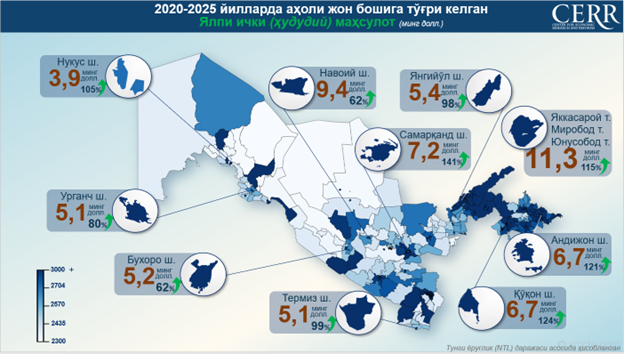
CERR Assesses Economic Activity Across Uzbekistan’s Regions Over Five Years Using Satellite Data
An analysis of nighttime satellite illumination data indicates a strengthening of economic activity across regions and an expansion in the number of territories exhibiting urban-type development.
The Center for Economic Research and Reforms (CERR) applied satellite-based nighttime lights (NTL) data to assess economic activity at the level of regions and cities in Uzbekistan.
The analysis shows that higher light intensity corresponds to higher levels of economic activity and more advanced urban infrastructure.
CERR’s findings demonstrate a high degree of consistency between satellite-based indicators and official statistics. In particular, according to estimates based on NASA nighttime lights data, nominal GDP per capita in Uzbekistan grew by 80.3% in 2020–2025, corresponding to an average annual growth rate of 15.8%, increasing from $2,090 to $3,887 over five years.
For comparison, according to official statistics, GDP per capita increased by 81.8% over the same period, with an average annual growth rate of 16.1%, rising from $2,048 to $3,881.
Economic Activity in Large and Medium-Sized Cities
According to the data, over the past five years the highest growth in gross regional product (GRP) per capita among regions was recorded in the city of Tashkent, where the indicator increased by approximately $5,000, reaching $9.3 thousand by the end of 2025 (according to official statistics — $9.2 thousand).
Estimates for 2025 also show high GRP per capita levels in a number of large and medium-sized cities. In Navoi, the NTL-based estimate reached $9.3 thousand, in Zarafshan $7.9 thousand, in Samarkand $7.2 thousand, in Kokand and Andijan $6.7 thousand each, and in Akhangaran, Yangiyul, and Bukhara ranged from $5.8 thousand to $5.2 thousand, respectively.
Relatively high growth rates of GRP per capita were also observed across several regions. In Tashkent region, the indicator increased by $1.8 thousand to reach around $4 thousand. In Navoi region, GRP per capita also grew by $1.8 thousand to approximately $4 thousand. In Fergana and Syrdarya regions, the increase amounted to $1.6 thousand, reaching about $3.5 thousand and $3.4 thousand, respectively.
Economic Activity in Small and Medium-Sized Cities
Relatively high GRP per capita levels were also recorded in a number of small and medium-sized cities. In Termez, the indicator reached $5.1 thousand, in Margilan and Chirchik around $5 thousand, and in Namangan $4.8 thousand. Economic activity levels also remain relatively high in the cities of Kagan and Urgench.
Economic Activity at the District Level
At the district level, the highest GRP per capita growth dynamics in 2020–2025 were observed in Mirabad district, where the indicator increased by $7.1 thousand, in Yakkasaray district by $6.3 thousand, and in Chilanzar district by $5.6 thousand. As a result, GRP per capita in these districts exceeded $10 thousand, which is nearly three times higher than the average across other districts and cities in the country.
Among districts, the highest growth rates of economic activity were also recorded in Karmana district (2.5-fold increase), Yashnabad and Bektemir districts (2.4-fold), as well as Sergeli, Yangi Hayot, and Mirzo Ulugbek districts (2.3-fold).
Expansion of Territories with High Economic Activity
The use of nighttime lights data also made it possible to assess urbanization processes at the district level. In particular, between 2020 and 2025, the number of territories with high nighttime light intensity (NTL above 10), characteristic of urban agglomerations, increased from 22 to 31. The average GRP per capita in these territories rose from $3.8 thousand to $7 thousand.
At the same time, over five years the number of districts with low nighttime light intensity (NTL below 1) declined from 129 to 85, confirming the transition of 44 districts toward an urban-type development model.
In these districts, NTL levels increased on average by more than 2.5 times, while GRP per capita rose from $1.7 thousand to $3.2 thousand.
Conclusion
The results confirm that satellite-based nighttime lights data can effectively complement official statistics and be used for timely assessment of regional economic activity.
This approach enables the identification of new growth points and allows for more targeted allocation of state support toward infrastructure development and investment activity in the regions.
Abdulaziz Gaybullayev, CERR
CERR Public Relations Sector
Tel.: (+998) 78 150-32-20 (417)
📅 25.03.2026
Embassy messages
The Ministry of Foreign Affairs of the Republic of Uzbekistan has launched the “Consular Services” mobile application
Consular Services Reception Procedure at the Embassy of Uzbekistan in Latvia
Узбекистан и страны Балтии объединяют усилия в борьбе с коррупцией
Uzbek specialists study Latvia’s best practices in veterinary and livestock sectors
Uzbekistan and Finland discussed prospects for cooperation in the field of entrepreneurship support
A holiday of unity: Navruz celebration connects nations in Riga
Trade union delegation of Uzbekistan discusses in Latvia issues of protecting the rights of compatriots – labor migrants
Ambassador of Uzbekistan presented his credentials to the President of Lithuania
Uzbekistan and Finland are preparing for the next meeting of the intergovernmental commission and a business forum within its framework
Discussions on potential areas of cooperation with the Association of European Chambers of Commerce and Industry were held in Riga
Uzbekistan and Latvia agreed to prepare a bilateral agreement on cooperation in the field of labor migration
Uzbekistan and Latvia ready for permanent dialogue in the field of labor migration
Торговый дом Узбекистана в Латвии провел онлайн-тренинг для хокимов и экспортеров Сырдарьинской области
Uzbek delegation studied Finland's experience in preventing violence against children
A festive evening for compatriots was organized in Estonia
Latvia widely celebrated the anniversary of the adoption of the Basic Law of Uzbekistan
Возможности медицинского туризма в Узбекистане презентованы в Риге
New contracts worth over $4 million signed as part of Uzbek exporters' business mission to Latvia
A roundtable discussion on the topic "Mirzo Ulugbek: a great encyclopedist and a famous statesman" was held in Riga
СМИ Латвии: Явка на выборах в Узбекистане составила 74,72%
Досрочное голосование по выборам в Законодательную палату Олий Мажлиса Узбекистана проходит в Латвии
В Латвии и Литве обсуждаются ключевые аспекты предстоящих парламентских выборов в Узбекистане
Issues related to the development of cooperation between Uzbekistan and Latvia in the field of combating crime discussed in Riga
A round table was held in Latvia on the upcoming elections in Uzbekistan to the Legislative Chamber of the Oliy Majlis and Kengashes of People's Deputies
Uzbek exporters familiarized with requirements for import of Uzbek products to Latvian and European markets
Export of agricultural products from Uzbekistan to the Latvian market increases
ЭЪЛОН!
Uzbek ambassador meets Latvian Saeima speaker to discuss prospects for boosting inter-parliamentary cooperation
Diplomats of Uzbekistan held a visiting reception of fellow citizens living in Estonia and Finland
Ambassador of Uzbekistan presents credentials to President of Latvia

-
 Ministry of Foreign Affairs of the Republic of Uzbekistan
 -
 Diplomatic Service of the Ministry of Foreign Affairs
 -
 State Committee for Tourism Development
 -
Ministry of Investments and Foreign Trade of the Republic of Uzbekistan
-
 invest.gov.uz
 -

-

-

-

-

-

-


of Uzbekistan in the Republic
of Latvia
When using the information, a link to www.uzembassy.lv
must be provided.
All rights reserved
Address
Address: Riga c., LV-1010. 11-11 Elizabetes Str., Latvia
Phone: 37167322424
Fax: 37167322306
Email: embassy@uzbekistan.lv
Useful links
HomeIssuance of biometric passport for departure abroad
Certificate to return to Uzbekistan
Withdrawal of citizenship
Loss of citizenship